
Wire Gauge Conversion Calculator
Selecting the correct wire size is crucial for safe and efficient electrical installations. Different regions and industries use varying wire measurement standards, such as AWG (American Wire Gauge) and mm² (square millimeters). Converting between these units is essential for electricians, engineers, and DIY enthusiasts working with international wiring standards.
Table of Contents
Table of Contents
A wire gauge conversion calculator simplifies this process, ensuring accurate conversions between AWG and mm². This guide will cover the conversion process in detail and provide answers to common questions regarding AWG to mm² conversion and wire size selection.
Wire Gauge Conversion Calculator
Wire Gauge Conversion Calculator
Convert between AWG, metric cross-section, diameter and kcmil, with resistance, weight, and ampacity reference data for copper and aluminum conductors.
AWG · mm² · kcmil · NEC / IEC ReferenceWire Size Input
Conversion Results
Resistance & Weight (per unit length)
Typical Ampacity Reference (copper conductor, insulated, in raceway)
How to Use This Calculator
- Choose Select Standard Size if you know the AWG or kcmil designation, or Manual Entry to convert from a diameter or area value.
- In Standard Size mode, pick a wire size from the dropdown and select Calculate.
- In Manual Entry mode, choose the input basis (AWG number, diameter, or area), type in the value, and select Calculate.
- Review the results panel for diameter, area, resistance, weight, and ampacity reference data.
- For manually entered custom sizes, the tool also identifies the nearest recognized standard size for comparison, since resistance and ampacity tables are only published for standard sizes.
- Use the Copy Result Summary button to place a text summary of the results on your clipboard for reports or notes.
Technical Notes
American Wire Gauge (AWG) is a standardized wire sizing system used throughout North America for round, solid, non-ferrous conductors. Gauge number decreases as conductor size increases; sizes larger than 1 AWG are designated 1/0 through 4/0, and conductors larger than 4/0 are specified directly by circular mil area (kcmil) rather than by gauge number.
Metric conductor sizes, as used in IEC 60228 and most equipment outside North America, are specified directly by cross-sectional area in square millimeters rather than by gauge. There is no exact one-to-one match between AWG and IEC metric sizes; the nearest equivalent is typically used, and the actual conductor cross-section should always be confirmed against the manufacturer’s datasheet or nameplate.
- Resistance values shown are nominal DC resistance for uncoated copper and aluminum conductors at 20°C, consistent with typical conductor property tables. Actual resistance varies with temperature, stranding, coating, and manufacturing tolerance.
- Weight values reflect bare conductor mass only and do not include insulation, jacketing, shielding, or armor.
- Ampacity values are typical reference figures for copper conductors with 60°C, 75°C, and 90°C insulation ratings, based on common allowable ampacity tables for not more than three current-carrying conductors in raceway or cable at standard ambient temperature. Actual allowable ampacity depends on ambient temperature, number of current-carrying conductors, conduit fill, installation method, terminal ratings, and applicable correction and adjustment factors, and must be verified against the governing electrical code and equipment listing.
- Conductors smaller than 14 AWG are generally used in electronics, control, and signal applications rather than power distribution, so standard power ampacity ratings are not published for these sizes.
- For manually entered custom sizes, resistance and weight are derived from the physical relationship between conductor cross-sectional area and these properties, calibrated to the nearest recognized standard size. This provides a closer estimate than simply reading the nearest table row, but exact values should still be confirmed with the conductor manufacturer.
Understanding Wire Gauge Standards
Wire size is measured using two primary standards:
- AWG (American Wire Gauge): A logarithmic scale used in North America, where smaller numbers indicate thicker wires.
- mm² (Square Millimeters): The cross-sectional area of a wire, commonly used in Europe and other international markets.
Since these systems use different measurement approaches, a wire gauge conversion calculator is necessary for accurate conversions.
Why Use a Wire Gauge Conversion Calculator?
A wire gauge conversion calculator eliminates manual calculations, ensuring precision in selecting the correct wire size. Benefits include:
- Accuracy: Eliminates errors caused by incorrect formulas.
- Convenience: Quick conversions between AWG and mm².
- Safety: Ensures proper wire sizing for electrical loads.
For practical applications like domestic wiring, EV chargers, and industrial installations, using a wiring size calculator ensures compliance with electrical codes.
How to Convert mm² to AWG
The relationship between AWG and mm² is nonlinear. The formula for converting AWG to mm² is:

Where:
- Dmm is the wire diameter in mm
- AWG is the wire gauge
For practical conversion, using an mm² to AWG calculator is the best approach.

Wire Gauge Conversion Chart (mm² to AWG)
| AWG | Diameter (mm) | Cross-Sectional Area (mm²) |
|---|---|---|
| 10 AWG | 2.59 mm | 5.26 mm² |
| 12 AWG | 2.05 mm | 3.31 mm² |
| 14 AWG | 1.63 mm | 2.08 mm² |
| 16 AWG | 1.29 mm | 1.31 mm² |
| 18 AWG | 1.02 mm | 0.823 mm² |
For other conversions, an AWG to mm² calculator can be used.
Selecting the Right Wire Size for Your Application
1. Domestic Wiring
For domestic wiring, the size of the earth wire is critical for grounding safety. Typical earth wire sizes:
- 2.5 mm² for general circuits
- 4 mm² – 6 mm² for main distribution
- 10 mm² – 16 mm² for larger installations
2. EV Charger Wiring
For EV charger installations, wire size depends on the charger power rating. A What Cable Size for EV Charger guide can help determine the appropriate cable.
3. Industrial Applications
For high-power applications, consulting a wiring size calculator is essential to select the correct conductor size.
Frequently Asked Questions
1. How many MM² is AWG wire?
The conversion varies with wire size. For example:
10 AWG = 5.26 mm²
12 AWG = 3.31 mm²
14 AWG = 2.08 mm²
2. What AWG is 10mm²?
A 10 mm² wire corresponds to 8 AWG, commonly used in high-power circuits.
3. What is 60mm² to AWG?
A 60 mm² wire is approximately 1/0 AWG, suitable for heavy electrical loads.
4. What AWG is 2.5 mm²?
A 2.5 mm² wire is close to 14 AWG, commonly used for household wiring.
6. What is 3.5 mm² to AWG?

A 3.5 mm² wire corresponds to approximately 12 AWG.
7. How much current can a 10 sq mm wire carry?
A 10 mm² wire can carry:
45-50A for copper
35-40A for aluminum
However, always check voltage drop and insulation type.
8. How to calculate AWG wire size?
The best method is to use an AWG wire size calculator, which factors in:
Current capacity
Voltage drop
Wire material (Copper/Aluminum)
9. How many mm² amps is 10 AWG?
A 10 AWG wire (5.26 mm²) carries:
30-40A for copper
25-30A for aluminum
Conclusion
A wire gauge conversion calculator simplifies AWG to mm² conversions, ensuring accurate wire selection for domestic, industrial, and EV charging applications. Using a wiring size calculator, you can avoid undersized conductors, which can cause overheating and voltage drops. Further, explore our online electrical calculators for your specific needs.
Follow Us on Social:
Subscribe our Newsletter on Electrical Insights for latest updates from Electrical Engineering Hub
WireGauge #AWGtoMM #WireSizeChart #GaugeConversion #ElectricalWiring #CableSizing #WireGaugeCalculator #ElectricalEngineering #WireThickness #AWGConversion #GaugeToMM #WireMeasurement #CopperWire #ElectricalCalculator #WireSizingTool
Wire Gauge Conversion Calculator : Electrical Engineering Hub
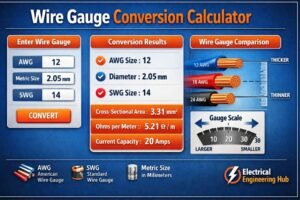
Wire Gauge Conversion Calculator helps you accurately convert AWG, SWG, and metric wire sizes in seconds. Compare wire diameters, cross-sectional areas, and standard gauge equivalents for electrical and engineering applications.
Price Currency: USD
Operating System: Web Browser
Application Category: UtilitiesApplication
