
Junction Box Fill Chart: Conductor Capacity by Box Size
Choosing the correct junction box is essential for electrical safety, code compliance, and easier maintenance. This Junction Box Fill Chart provides a quick reference for the maximum number of conductors that can fit inside common electrical boxes based on NEC 314.16 requirements.
It also includes a general IEC reference for readers working with IEC-based installations. These charts are intended for straightforward installations where all conductors are the same size. If your installation includes mixed conductor sizes, switches, receptacles, internal clamps, or other fittings, use an Electrical Junction Box Calculator for an accurate code-compliant calculation instead of relying solely on a chart.
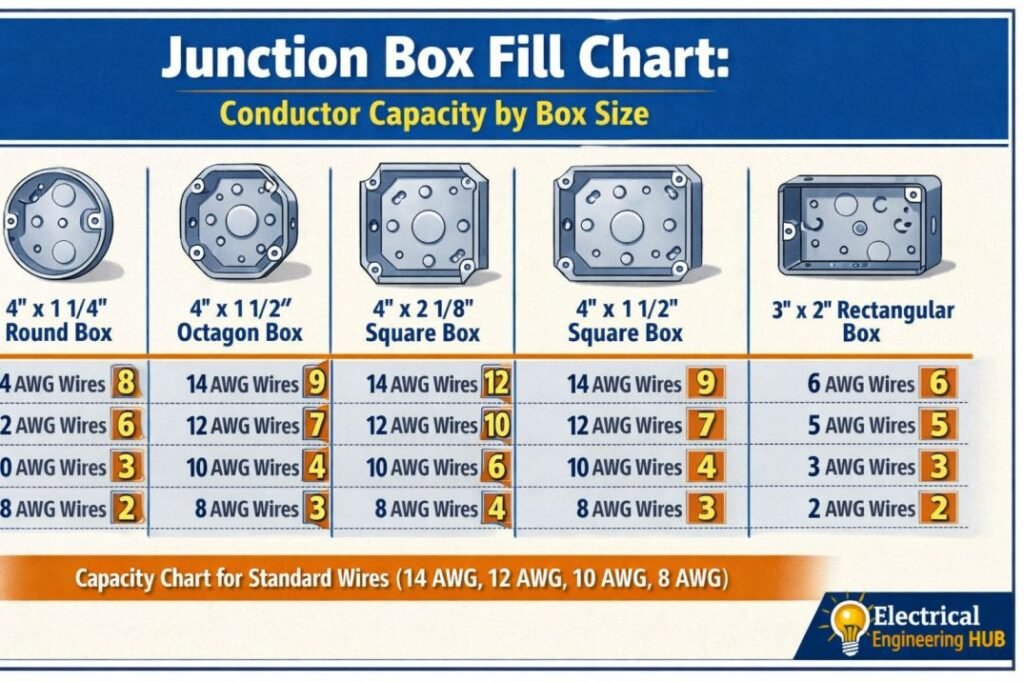
Table of Contents
Table of Contents
How to Read This Chart
This Junction Box Fill Chart is designed for quick field reference. The conductor capacities shown assume every insulated conductor inside the box is the same wire size. Once different conductor gauges are mixed together, the available capacity changes because each wire size has a different volume allowance under NEC 314.16.
Keep these points in mind before using the chart:
- All conductors are assumed to be the same gauge.
- Devices such as switches and receptacles count as two conductor volumes.
- Internal cable clamps reduce available box capacity.
- Equipment grounding conductors are counted together as one conductor volume.
- For installations with mixed conductor sizes, use the Electrical Junction Box Calculator instead of estimating.
For a detailed explanation of the code rules, see our guide on NEC 314.16 Junction Box Fill Requirements.
NEC Junction Box Fill Chart (by Box Size and Conductor Gauge)
The table below provides a quick junction box sizing chart based on common box volumes and standard conductor sizes. Always verify the actual box volume stamped by the manufacturer before installation.
| Box Volume (cu. in.) | Maximum 14 AWG | Maximum 12 AWG | Maximum 10 AWG |
|---|---|---|---|
| 12.5 | 6 | 5 | 4 |
| 14.0 | 7 | 6 | 5 |
| 18.0 | 9 | 8 | 7 |
| 21.0 | 10 | 9 | 8 |
| 30.3 | 15 | 13 | 12 |
Reference values are based on NEC 314.16 conductor volume allowances for standard single-gauge installations. Actual allowable conductor count may decrease when devices, clamps, fittings, or mixed conductor sizes are present.
Standard Conductor Volume Allowances
| Conductor Size | Volume Allowance (cu. in.) |
|---|---|
| 14 AWG | 2.0 |
| 12 AWG | 2.25 |
| 10 AWG | 2.50 |
| 8 AWG | 3.00 |
| 6 AWG | 5.00 |
For mixed conductor sizes or more complex installations, use our Electrical Junction Box Calculator instead of estimating from the chart. The calculator automatically performs the box fill calculation according to code requirements and helps prevent overfilled boxes.
IEC Junction Box Capacity Reference
IEC standards generally do not prescribe conductor fill using the same volume allowance method as NEC 314.16. Instead, installers select a junction box based on cable entry requirements, termination space, bending radius, and manufacturer recommendations. The table below serves as a practical reference for sizing junction boxes in typical IEC installations.
For complete IEC compliance requirements, refer to our IEC Standard for Junction Box guide.
| Junction Box Size | Typical Cable Entries | Recommended Application |
|---|---|---|
| 100 × 100 × 50 mm | 4–6 | Small lighting circuits |
| 150 × 110 × 70 mm | 6–10 | Power distribution circuits |
| 200 × 150 × 80 mm | 10–16 | Industrial control wiring |
| 250 × 200 × 100 mm | 16–24 | Large cable terminations |
| 300 × 250 × 120 mm | 24+ | Heavy industrial installations |
This IEC junction box capacity chart should be used as a planning reference only. Final sizing depends on conductor cross-sectional area, cable glands, terminal blocks, enclosure accessories, and installation requirements. When precision matters, use the Electrical Junction Box Calculator together with manufacturer specifications.
What Changes Your Actual Capacity
Although a Junction Box Fill Chart provides an excellent starting point, the actual conductor capacity often changes because every installation is different. Several code requirements directly affect how many conductors can legally fit inside the enclosure.
Factors that reduce available capacity include:
- Switches and receptacles each count as two conductor volume allowances.
- Internal cable clamps occupy box volume and reduce conductor capacity.
- Fixture studs, support fittings, and similar internal hardware may affect usable space.
- Equipment grounding conductors count together as one conductor volume regardless of how many are present.
- Mixed conductor gauges require calculating the actual volume used by each conductor instead of simply counting wires.
- Pigtails that originate and terminate inside the same box without leaving it are generally not counted toward box fill.
- Larger wire connectors and terminal blocks may require selecting a larger enclosure even when conductor count appears acceptable.
- Deep boxes often provide more flexibility for conductor bending and future maintenance.
Instead of manually checking every allowance, an electrical junction box size calculator automatically evaluates these factors and provides a code-compliant answer within seconds. It is especially useful for electricians working with renovation projects or industrial control panels where conductor sizes frequently vary.
Get an Exact Count for Your Configuration
The Junction Box Fill Chart is perfect for quick field checks involving standard, single-gauge conductor installations. However, real projects rarely stay that simple. Mixed conductor sizes, internal clamps, switches, receptacles, grounding conductors, and additional fittings all change the allowable box fill.
Rather than performing manual calculations, use our Electrical Junction Box Calculator to receive an exact code-compliant result. The calculator supports both NEC and IEC methods, making it easier to size junction boxes accurately for residential, commercial, and industrial applications. Whether you need a j box size calculator, junction box size calculator, or electrical junction box size calculator, the tool provides fast and reliable results for sizing junction boxes with confidence.
Frequently Asked Questions
How many 12 AWG wires fit in a standard junction box?
The answer depends on the box volume. For example, an 18 cubic inch box typically accommodates up to eight 12 AWG conductors under standard NEC box fill rules, assuming no devices or internal clamps reduce the available capacity.
Does a switch count as one wire or two for box fill?
Under NEC 314.16, a switch or receptacle mounted in the box counts as two conductor volume allowances based on the largest conductor connected to the device.
Is the fill chart different for IEC-rated boxes?
Yes. NEC uses conductor volume allowances to determine box fill, while IEC installations generally rely on enclosure dimensions, cable entry requirements, bending space, and manufacturer recommendations. That is why the IEC junction box capacity chart serves as a sizing reference rather than a strict fill calculation.
What happens if I exceed the box fill count?
Overfilling a junction box can violate electrical codes, make conductor installation difficult, increase heat buildup, damage insulation, and create future maintenance problems. If the calculated conductor count exceeds the allowable limit, select a larger enclosure or use the Electrical Junction Box Calculator to determine the correct box size.
Follow Us on Social:
Subscribe our Newsletter on Electrical Insights for latest updates from Electrical Engineering Hub
#JunctionBoxFillChart, #ElectricalCode, #NEC31416, #ElectricalEngineering, #ConductorCapacity, #JunctionBoxSizing, #ElectricalInstallation, #ElectricianTools, #BoxFillCalculator, #WiringStandards
