
Electric Motor Stator Testing: Complete Industrial Motor Inspection & Fault Detection Guide
Industrial motors are the backbone of manufacturing plants, pumping stations, HVAC systems, and processing industries. When a motor fails unexpectedly, it can stop production, increase maintenance costs, and reduce operational efficiency. This is why Electric Motor Stator Testing plays a critical role in preventive maintenance and fault diagnosis.
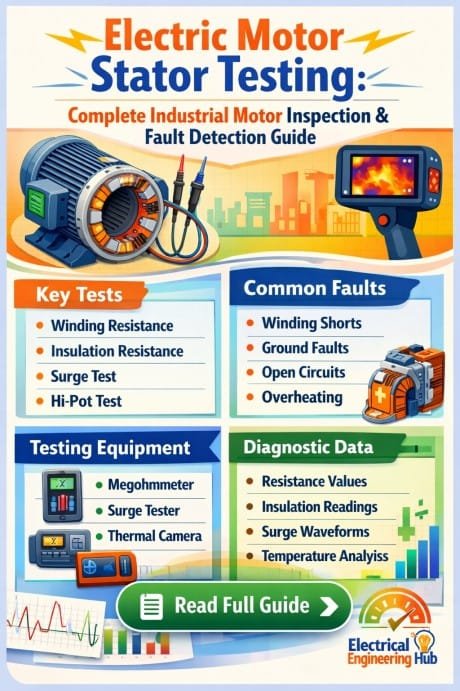
Table of Contents
A damaged stator winding can lead to overheating, insulation failure, phase imbalance, and complete motor breakdown. Regular inspection helps maintenance teams identify hidden issues before they become expensive failures. Modern industries now rely on advanced testing methods to improve motor reliability, extend equipment life, and reduce downtime.
Use our free online tool Generator Sizing Calculator for VFD Motors
This guide explains the importance of Electric Motor Stator Testing, major testing methods, common stator faults, inspection procedures, and best practices used in industrial environments.
What is Electric Motor Stator Testing?
Electric Motor Stator Testing is the process of inspecting and evaluating the condition of a motor stator winding, insulation system, and electrical performance. The stator is the stationary part of an electric motor that contains copper windings responsible for generating the magnetic field required for motor rotation.
Testing procedures help technicians determine whether the motor is operating safely and efficiently. These inspections are commonly performed during routine maintenance, commissioning, troubleshooting, and motor rewinding projects.
Uncover insights on motor generator transformer manufacturers
Industries use stator testing for:
- Detecting insulation weakness
- Identifying winding short circuits
- Finding phase imbalance issues
- Preventing unexpected motor failure
- Evaluating motor health condition
- Improving equipment reliability
Importance of Stator Inspection in Industrial Motors
Industrial motors often operate under harsh conditions including dust, vibration, moisture, voltage fluctuations, and overload conditions. Over time, these factors weaken the insulation and damage winding components.
Proper Electric Motor Stator Testing helps maintenance engineers detect faults early and schedule repairs before catastrophic failure occurs.
Key Benefits of Regular Stator Testing
| Benefit | Description |
|---|---|
| Reduced Downtime | Detects faults before complete motor failure |
| Improved Efficiency | Ensures motors operate at optimal performance |
| Longer Motor Life | Prevents insulation deterioration and overheating |
| Lower Maintenance Cost | Early repairs reduce major replacement expenses |
| Enhanced Safety | Minimizes electrical hazards and fire risks |
Access our powerful online calculator now star delta motor cable size calculator
Common Stator Faults in Electric Motors
Understanding common stator defects is important for accurate motor diagnosis. Most industrial motor problems begin with insulation degradation or winding damage.
Typical Stator Faults
| Fault Type | Possible Cause | Symptoms |
|---|---|---|
| Insulation Breakdown | Heat, moisture, aging | Motor tripping |
| Turn-to-Turn Short | Vibration, overheating | High current draw |
| Phase-to-Phase Fault | Insulation failure | Burning smell |
| Ground Fault | Moisture contamination | Earth leakage |
| Open Winding | Broken conductor | Motor not starting |
| Coil Imbalance | Uneven winding resistance | Excessive vibration |
Early detection through Electric Motor Stator Testing can prevent severe damage and expensive production losses.
Visual Inspection Before Electrical Testing
Before performing electrical measurements, technicians should conduct a detailed visual inspection. Many motor problems can be identified through simple observation.
Visual Inspection Checklist
- Check for burnt insulation
- Inspect winding discoloration
- Look for moisture contamination
- Examine terminal connections
- Verify cooling fan condition
- Inspect stator core damage
- Check for loose mounting bolts
- Observe unusual odor or carbon deposits
Visual inspections provide useful clues that support detailed electrical analysis.
Use our online tool for free Wire Size Calculator for Motors – Accurate Motor Cable Sizing Tool for Electric Loads
Insulation Resistance Testing
Insulation resistance testing is one of the most widely used methods in Electric Motor Stator Testing. It measures the resistance between motor windings and ground using a megohmmeter.
Low insulation resistance indicates contamination, aging insulation, or moisture ingress.
Recommended Insulation Resistance Values
| Motor Voltage | Minimum Insulation Resistance |
|---|---|
| Below 1 kV | 1 Megaohm |
| 1 kV to 5 kV | 100 Megaohms |
| Above 5 kV | Higher values preferred |
Steps for Insulation Resistance Test
- Disconnect motor power supply
- Isolate motor terminals
- Connect megger leads
- Apply test voltage
- Record resistance readings
- Compare with standard values
A sudden decrease in insulation resistance usually indicates winding deterioration.
Know more about How to Size a VFD for a Motor
Winding Resistance Testing
Winding resistance testing measures the resistance of each motor phase. It helps identify loose connections, damaged windings, and phase imbalance.
Technicians use digital micro-ohm meters for accurate measurement.
Indicators of Winding Problems
- Unequal phase resistance
- Open circuit readings
- Excessively high resistance
- Unstable resistance values
Balanced resistance across all phases indicates healthy winding condition.
Surge Testing for Stator Windings
Surge testing is an advanced diagnostic procedure used in Electric Motor Stator Testing. It detects turn-to-turn insulation weakness that may not appear during insulation resistance testing.
This test applies high-voltage pulses to winding coils and compares waveform patterns.
Know more about Top 15 Motor Control Center Manufacturers in Malaysia – Trusted MCC Brands for Industrial Power
Advantages of Surge Testing
| Advantage | Purpose |
|---|---|
| Detects Weak Insulation | Identifies early winding failure |
| Finds Turn Shorts | Locates hidden coil damage |
| Prevents Sudden Breakdown | Supports predictive maintenance |
| Improves Reliability | Ensures motor operational safety |
Surge comparison testing is commonly used in motor repair workshops and industrial maintenance programs.
Polarization Index Testing
Polarization Index testing evaluates insulation condition over time. The test compares insulation resistance readings at one minute and ten minutes.
PI Formula
PI = 10-minute resistance ÷ 1-minute resistance
PI Reading Interpretation
| PI Value | Condition |
|---|---|
| Below 1 | Poor insulation |
| 1 to 2 | Marginal condition |
| Above 2 | Good insulation |
This method helps determine insulation aging and contamination levels.
High Voltage Testing
High voltage testing, also called hipot testing, checks the dielectric strength of motor insulation. It confirms whether the insulation can withstand operating voltage conditions.
This procedure is often performed after motor rewinding or repair.
Know more about How does the star delta starter reduce starting current?
Safety Precautions During High Voltage Testing
- Use proper PPE equipment
- Ensure motor isolation
- Follow voltage limits
- Discharge windings after testing
- Maintain safe clearance distance
Improper testing can damage healthy insulation, so trained personnel should perform the procedure.
Motor Current Signature Analysis
Motor Current Signature Analysis is a predictive maintenance technique that evaluates motor current waveforms to identify electrical and mechanical issues.
This method supports advanced Electric Motor Stator Testing programs in large industrial facilities.
Faults Detected by Current Analysis
- Rotor bar defects
- Stator winding faults
- Bearing damage
- Air gap eccentricity
- Load imbalance
Many industries now use online monitoring systems for continuous motor health analysis.
Thermal Imaging for Stator Inspection
Infrared thermography helps technicians identify abnormal temperature rise in motor windings and connections.
Hotspots usually indicate:
- Loose electrical connections
- Overloaded windings
- Cooling blockage
- Insulation deterioration
Thermal imaging allows non-contact inspection while motors remain operational.
Know more about Motor Overload Protection Chart
Best Practices for Industrial Motor Testing
Proper maintenance procedures improve testing accuracy and motor reliability.
Recommended Best Practices
- Maintain regular inspection schedules
- Keep testing records for trend analysis
- Use calibrated testing instruments
- Follow manufacturer standards
- Train maintenance personnel regularly
- Store motors in dry conditions
- Monitor vibration and temperature
Preventive maintenance significantly reduces unplanned shutdowns.
Typical Industrial Applications
Electric Motor Stator Testing is widely used across multiple industries.
| Industry | Application |
|---|---|
| Manufacturing | Conveyor and process motors |
| Agriculture | Irrigation pump motors |
| Oil & Gas | Compressor and pump systems |
| Power Plants | Generator auxiliary motors |
| HVAC Systems | Fans and blowers |
| Water Treatment | Pump station motors |
Reliable motor performance is essential for continuous industrial operations.
Signs That a Motor Requires Immediate Testing
Ignoring early warning signs can lead to severe motor failure.
Common Warning Indicators
- Frequent tripping
- Unusual vibration
- Excessive heating
- Burning smell
- Reduced motor speed
- High current consumption
- Noise during operation
Immediate Electric Motor Stator Testing should be performed whenever these symptoms appear.
Use our online tool Motor Overload Setting Calculator
Conclusion
Electric Motor Stator Testing is an essential part of industrial motor maintenance and reliability management. Regular inspection helps identify insulation problems, winding defects, phase imbalance, and hidden electrical faults before they cause major breakdowns.
Modern testing methods such as insulation resistance testing, surge testing, thermal imaging, and motor current analysis provide accurate insights into motor condition. Industries that implement structured testing programs experience lower downtime, reduced maintenance costs, and improved equipment lifespan.
A proactive approach to stator inspection not only protects valuable industrial assets but also improves operational safety and production efficiency. With proper testing procedures and preventive maintenance strategies, industrial motors can deliver reliable performance for many years.
Know everything about 3 Phase Motor Overload Relay Setting
Follow Us on Social:
Subscribe our Newsletter on Electrical Insights for latest updates from Electrical Engineering Hub
#ElectricMotorStatorTesting,#MotorTesting,#StatorInspection,#ElectricMotorRepair,#IndustrialMaintenance,#MotorDiagnostics,#ElectricalEngineering,#MotorWinding,#PredictiveMaintenance,#MotorConditionMonitoring
