Substation Bus Size Calculator
A Substation Bus Size Calculator is an essential tool for electrical engineers, consultants, and substation designers who need to determine the correct busbar dimensions for safe and efficient power distribution. Choosing the right bus size is critical because it directly affects current carrying capacity, thermal performance, voltage drop, and short circuit withstand capability.
In modern substations, improper bus sizing can cause overheating, excessive energy losses, and equipment failure. This is why using a Substation Bus Size Calculator helps simplify calculations and ensures compliance with international electrical standards.
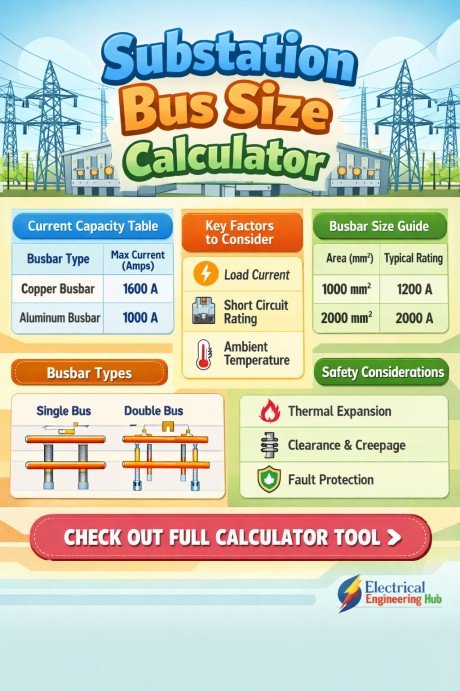
Table of Contents
Table of Contents
Whether you are designing a transmission substation, distribution yard, or industrial switchyard, understanding bus sizing fundamentals can improve system reliability and reduce maintenance costs.
Use our online tool Bus Duct Size Calculator
What Is a Substation Bus Size Calculator?
A Substation Bus Size Calculator is a practical engineering tool used to calculate the required busbar size based on electrical load, fault current, temperature rise, and material type.
Busbars act as the main conductors inside substations. They collect and distribute electrical power to multiple outgoing feeders. Since they carry high current levels, their size must be selected carefully.
The calculator usually considers:
- Rated current
- Short circuit current
- Duration of fault
- Busbar material
- Ambient temperature
- Permissible temperature rise
These factors help engineers choose the correct conductor cross-sectional area.
Find the DC Busway size with our DC Busway Size Calculator
Substation Bus Size Calculator
Substation Bus Size Calculator
Estimate minimum busbar cross-section for continuous current and short-circuit withstand in substation and switchgear applications.
System Parameters
Calculation Results
How to Use
- Enter the continuous load current the bus must carry in normal operation.
- Select the bus material — copper or aluminum — based on project specification.
- Choose the bus shape and the installation environment that matches the actual layout.
- Set the site ambient temperature and the permissible temperature rise allowed by the switchgear design.
- Enter the system short-circuit fault current and the protective device clearing time.
- Click Calculate Bus Size to view the thermal and short-circuit cross-section requirements.
- The Recommended Bus Size reflects whichever requirement — continuous rating or fault withstand — is larger.
- Cross-check the result against the manufacturer’s bus bar catalog before finalizing the design.
Technical Notes
Continuous current sizing depends on the permissible temperature rise above ambient, the bus material, the shape factor, and whether the bus is enclosed or open to natural air circulation. Enclosed bus ducts and higher ambient temperatures both reduce the safe continuous rating of a given cross-section, which is why this tool applies a derating adjustment rather than a single fixed value.
Short-circuit withstand sizing depends on the magnitude of the fault current and how long the protective device takes to clear it. A bus that is adequately sized for continuous load may still be undersized for short-circuit duty if the protection scheme allows a long clearing time or the fault level is high, so both checks must be carried out independently.
Material selection affects both the achievable current density and the mechanical robustness of the bus. Copper generally allows a smaller cross-section for the same rating compared to aluminum, while aluminum is lighter and often more economical for larger installations.
Bus shape influences heat dissipation. Rectangular bars are common in indoor switchgear, tubular bus is typical in outdoor substations for its strength and surface area, and channel sections are used where higher mechanical rigidity is required.
This calculator provides a preliminary sizing estimate for planning and comparison purposes. Final bus bar selection should always be verified against the applicable national or international standard and the manufacturer’s certified ratings before procurement or installation.
Find more Electrical Engineering Tools for easy electrical calculations and estimations.
Why Correct Bus Size Matters in Substations
Bus sizing is not just about current carrying capacity. It affects the overall performance of the electrical system.
Here are the main reasons why proper sizing matters:
| Factor | Impact |
|---|---|
| Heat Dissipation | Prevents overheating |
| Voltage Drop | Maintains system efficiency |
| Mechanical Strength | Handles fault forces |
| Energy Losses | Reduces I²R losses |
| Reliability | Improves operational safety |
An undersized bus can fail under heavy load. An oversized bus increases project cost unnecessarily. A Substation Bus Size Calculator balances both.
Key Inputs for Busbar Calculation
To use a Substation Bus Size Calculator accurately, you need some important inputs.
Load Current
This is the continuous current that the busbar will carry during normal operation.
Formula:
Current (I) = Power / (√3 × Voltage × Power Factor)
Example:
For a 10 MVA load at 11kV with 0.9 PF:
I = 10,000 / (1.732 × 11 × 0.9)
Current = 583A
Know more about Bus Bar Current Rating Calculation: Practical Method for Accurate Sizing and Load Capacity
Short Circuit Current
Substation busbars must withstand fault currents for a specific duration.
Common fault durations:
- 1 second
- 3 seconds
Higher fault levels require larger busbars.
Material Selection
Busbars are mainly made of:
| Material | Conductivity | Cost | Weight |
|---|---|---|---|
| Copper | High | High | Heavy |
| Aluminum | Moderate | Lower | Light |
Copper offers better conductivity, while aluminum is cost-effective for larger substations. Find the heat capacity of busbar with our Bus Bar Heat Capacity Calculator
Ambient Temperature
High surrounding temperatures reduce the current carrying capacity of busbars.
Installation Type
Busbars installed in open air cool better than enclosed systems.
How a Substation Bus Size Calculator Works
The Substation Bus Size Calculator uses thermal and short circuit formulas to determine the minimum busbar size.
Current Carrying Formula
A = I / J
Where:
- A = Busbar area (mm²)
- I = Current (A)
- J = Current density (A/mm²)
Find also about Busbar Sizing Rule of Thumb: Practical Engineer’s Guide for Accurate Panel Busbar Selection
Typical current density values:
| Material | Current Density |
|---|---|
| Copper | 1.2 – 1.6 A/mm² |
| Aluminum | 0.8 – 1.2 A/mm² |
For example:
If current = 1000A and copper density = 1.5A/mm²
A = 1000 / 1.5
A = 667 mm²
Short Circuit Formula
A = Isc × √t / k
Where:
- Isc = Short circuit current
- t = Fault duration
- k = Material constant
This checks thermal withstand during fault conditions.
Typical Busbar Sizes in Substations
The following table shows common busbar sizes used in substations. Find the cross sectional area with this amazing tool Bus Bar Cross Sectional Area Calculator
| Current Rating | Copper Size | Aluminum Size |
|---|---|---|
| 400A | 50 × 6 mm | 60 × 8 mm |
| 800A | 100 × 8 mm | 120 × 10 mm |
| 1600A | 120 × 10 mm | 150 × 12 mm |
| 2500A | 150 × 12 mm | 200 × 15 mm |
| 4000A | 200 × 15 mm | 250 × 20 mm |
These are general values. Actual sizing depends on site conditions.
Find all about Busbar Kg Calculation | Accurate Copper & Aluminum Busbar Weight Formula for Electrical Design
Key Takeaways
Before selecting a busbar size, keep these points in mind:
- Always calculate based on continuous current and fault current.
- Copper busbars require less cross-sectional area than aluminum.
- Temperature rise must remain within allowable limits.
- Mechanical strength matters during short circuits.
- Use a Substation Bus Size Calculator for faster and more accurate results.
- Verify results with standard codes like IEC 60865 and IEEE C37.
For quick conductor sizing, you can also try our Busbar Size Calculator to compare dimensions and ampacity easily.
Standards for Substation Bus Sizing
Busbar sizing should follow recognized electrical standards.
Important standards include:
| Standard | Purpose |
|---|---|
| IEC 60865 | Short circuit forces |
| IEC 62271 | High voltage switchgear |
| IEEE C37.23 | Metal enclosed bus |
| IEC 61439 | Low voltage assemblies |
These standards ensure safe and efficient bus design.
Find all about Busbar Bending Calculation
Factors That Affect Busbar Performance
A Substation Bus Size Calculator may provide base values, but field conditions matter too.
Skin Effect
At higher currents, current tends to flow on the outer surface.
Proximity Effect
Nearby conductors influence current distribution.
Ventilation
Poor ventilation increases operating temperature.
Busbar Arrangement
Flat, edgewise, and tubular busbars have different cooling characteristics.
Surface Coating
Silver-plated or tin-plated busbars improve corrosion resistance.
Benefits of Using a Substation Bus Size Calculator
Using this tool saves time and improves accuracy.
Main benefits include:
- Fast load calculation
- Reduced design errors
- Better thermal analysis
- Quick fault withstand checking
- Improved system optimization
- Cost-effective material selection
Instead of manual calculations, engineers can get instant sizing results.
Find out more about iec 61439 busbar clearance
Common Mistakes in Busbar Sizing
Avoid these common mistakes:
- Ignoring future load expansion
- Not checking short circuit ratings
- Using incorrect current density
- Overlooking ambient temperature correction
- Choosing material without cost analysis
A reliable Substation Bus Size Calculator helps prevent these issues.
Conclusion
A Substation Bus Size Calculator is an important engineering tool for designing safe and efficient substations. It helps determine the correct busbar dimensions by considering current load, fault current, temperature rise, and conductor material.
Accurate bus sizing improves reliability, minimizes losses, and ensures compliance with electrical standards. Whether you are planning a new installation or upgrading an existing substation, using this calculator simplifies the process and improves design confidence.
With growing power demands and increasing fault levels, selecting the correct busbar size has become more important than ever.
Know more about IEC Standard for Busbar Clearance
Frequently Asked Questions
How does a Substation Bus Size Calculator work?
It calculates the required busbar cross-sectional area using load current, material type, and short circuit values.
Which material is better for substation busbars?
Copper offers better conductivity, but aluminum is more economical for larger systems.
What standard is used for busbar sizing?
IEC 60865 and IEEE C37 standards are commonly used.
Why is short circuit calculation important?
It ensures the busbar can withstand thermal and mechanical stress during faults.
Can I use the same bus size for future expansion?
It is recommended to keep extra capacity for future load growth to avoid costly upgrades later.
Follow Us on Social:
Subscribe our Newsletter on Electrical Insights for latest updates from Electrical Engineering Hub
#SubstationBusSizeCalculator,#BusSizeCalculator,#ElectricalEngineering,#SubstationDesign,#BusbarSizing,#PowerSystemDesign,#ElectricalCalculations,#BusbarCurrentRating,#HVSubstation,#EngineeringTools
Substation Bus Size Calculator : Electrical Engineering Hub

Use the Substation Bus Size Calculator to quickly determine the right bus size for substations with accurate calculations and practical guidance.
Price Currency: USD
Operating System: Web Browser
Application Category: UtilitiesApplication