IEC 60364 Voltage Drop Guide for Safe and Efficient Design
In electrical installations, proper voltage management plays a key role in ensuring equipment safety, energy efficiency, and long-term reliability. One of the most important considerations in low-voltage systems is IEC 60364 Voltage Drop, which defines how much voltage loss is acceptable between the origin of supply and the load point.
If this drop is not controlled, motors may underperform, lighting may flicker, and sensitive devices may fail prematurely. Designers and engineers must carefully evaluate conductor sizing, load distribution, and installation length to stay within recommended limits. A well-planned system not only improves performance but also reduces energy losses and maintenance issues over time.
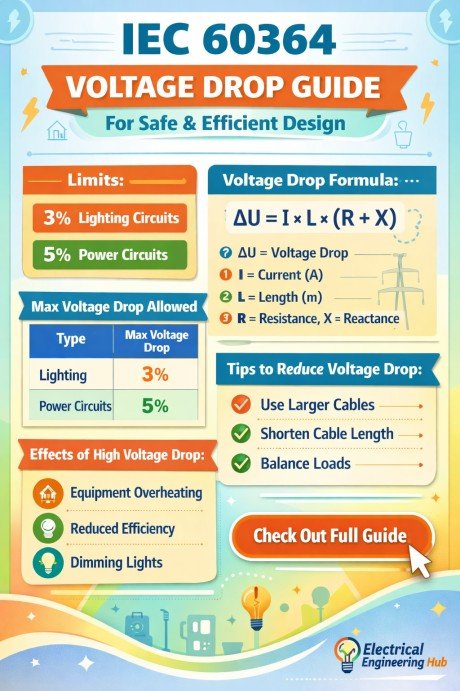
Table of Contents
Understanding IEC 60364 Voltage Drop in Electrical Systems
IEC 60364 Voltage Drop refers to the reduction in electrical potential as current flows through cables and conductors in a distribution system. This drop occurs due to the inherent resistance and impedance of the wiring. In practical installations, longer cable runs and higher load currents increase the voltage drop significantly.
The standard emphasizes that voltage at the load end should remain within acceptable limits to ensure proper operation of electrical equipment. In residential and industrial systems, this is especially important for motor-driven loads and lighting circuits. Excessive drop leads to inefficient energy usage and can shorten equipment lifespan.
Permissible Limits and Calculation Principles
The guidelines under IEC 60364 Voltage Drop specify recommended maximum limits depending on the type of installation and application. Engineers often use simplified formulas or manufacturer data to calculate expected losses during the design stage.
Find all about IEC 60364 Part 5-54
Typical permissible limits are:
| Application Type | Recommended Voltage Drop Limit |
|---|---|
| Lighting Circuits | 3% of nominal voltage |
| Power Circuits | 5% of nominal voltage |
| Motor Starting Circuits | As low as possible (preferred <4%) |
The calculation depends on conductor resistance, current load, cable length, and installation method. Copper and aluminum conductors behave differently, so material selection is critical. Proper application of IEC 60364 Voltage Drop ensures that system efficiency remains within safe operating conditions while avoiding over-sizing of cables.
Use our online tool for free southwire voltage drop calculator
Factors Affecting Voltage Drop in Installations
Several technical and environmental factors influence IEC 60364 Voltage Drop in real-world installations. Understanding these helps engineers design more reliable systems.
Key influencing factors include:
- Cable length: Longer runs increase resistance and voltage loss
- Conductor size: Smaller cross-sections increase voltage drop
- Load current: Higher current directly increases losses
- Material type: Copper has lower resistance compared to aluminum
- Ambient temperature: Higher temperatures increase conductor resistance
- Power factor: Low power factor increases effective current flow
These factors must be evaluated collectively rather than individually. In complex installations, even small miscalculations can lead to significant performance issues, especially in industrial networks with fluctuating loads.
Explore all about IEC 60364 5 52
Practical Methods to Reduce Voltage Drop
Reducing IEC 60364 Voltage Drop requires both correct design practices and proper material selection. Engineers often adopt a combination of strategies to optimize system efficiency. Use our online tool NEC Wire Size Calculator
Common methods include:
| Method | Description |
|---|---|
| Increasing cable size | Reduces resistance and improves current flow |
| Shortening cable routes | Minimizes total conductor length |
| Using parallel conductors | Shares load between multiple cables |
| Improving power factor | Reduces current demand |
| Choosing copper conductors | Offers lower resistivity than aluminum |
In many modern installations, careful routing and proper load balancing provide significant improvements without increasing project cost excessively. Early-stage planning is essential to avoid expensive redesigns later. Know more about IEC 60364-1
Role of Earthing in Voltage Stability and Safety
Proper grounding is closely connected to system stability and plays a supportive role in controlling IEC 60364 Voltage Drop behavior under fault conditions. A well-designed earthing system ensures fault currents are safely discharged, maintaining voltage balance across the network.
For a deeper understanding of system safety practices, you can refer to this detailed guide on IEC 60364 earthing, which explains how grounding design improves protection against electrical faults and enhances installation reliability.
Find all about IEC 60364-6
A strong earthing system does not directly reduce voltage drop in normal operation, but it stabilizes voltage during disturbances, ensuring protective devices operate correctly. This indirect relationship is critical in industrial environments where electrical faults can cause major disruptions.
Design Checklist for Engineers and Installers
When planning electrical systems, following a structured checklist helps ensure IEC 60364 Voltage Drop compliance from the beginning.
Important design steps include:
- Determine total load demand accurately
- Select appropriate conductor material and size
- Calculate voltage drop for each circuit separately
- Verify compliance with installation standards
- Consider future load expansion
- Optimize cable routing for minimum distance
By integrating these steps early in the design phase, engineers can avoid excessive energy losses and ensure consistent performance across all connected equipment. Proper documentation and verification also help during inspection and maintenance stages.
Explore all about IEC 60364-5
Frequently Asked Questions
What is the importance of IEC 60364 Voltage Drop in electrical design?
IEC 60364 Voltage Drop ensures that electrical equipment receives adequate voltage for safe and efficient operation, preventing performance issues and overheating.
How is voltage drop calculated in a circuit?
It is calculated using conductor resistance, current load, and cable length. Standard formulas or software tools are often used for accuracy.
What happens if voltage drop exceeds recommended limits?
Excessive drop can lead to equipment malfunction, reduced efficiency, motor overheating, and increased energy losses.
Which conductor material is better for reducing voltage drop?
Copper is generally preferred due to its lower resistance compared to aluminum, resulting in reduced voltage drop.
Does earthing affect voltage drop directly?
Earthing does not directly reduce voltage drop, but it improves system safety and stability, especially during fault conditions.
Conclusion
Proper management of IEC 60364 Voltage Drop is essential for achieving efficient, safe, and reliable electrical installations. From conductor selection to load analysis, every design decision influences system performance. Engineers who prioritize voltage drop calculations during planning stages can significantly reduce energy losses and improve equipment lifespan.
In modern electrical networks, where efficiency and safety are critical, understanding and applying IEC 60364 Voltage Drop principles ensures long-term operational stability and compliance with international standards.
Follow Us on Social:
Subscribe our Newsletter on Electrical Insights for latest updates from Electrical Engineering Hub
#iec60364voltagedrop,#voltage,#electricaldesign,#cablecalculation,#powerengineering,#electricalstandards,#voltageloss,#electricalsafety,#energyefficiency,#electricalinstallation