IEC 60811: Best Testing Guide for Cable Insulation & Sheathing Standards
Cable insulation and sheathing play a critical role in the safety, reliability, and lifespan of electrical cables. To ensure consistent quality across different cable types, manufacturers follow internationally recognized testing procedures. One of the most important standards used worldwide for this purpose is IEC 60811.
IEC 60811 specifies test methods for non-metallic materials used in electrical and optical fiber cables. It provides detailed procedures for evaluating insulation and sheath materials under different environmental, mechanical, and thermal conditions. By following IEC60811, cable manufacturers can verify that their products meet performance expectations and comply with international requirements. Know more about IEC Standard for MV Cable Testing
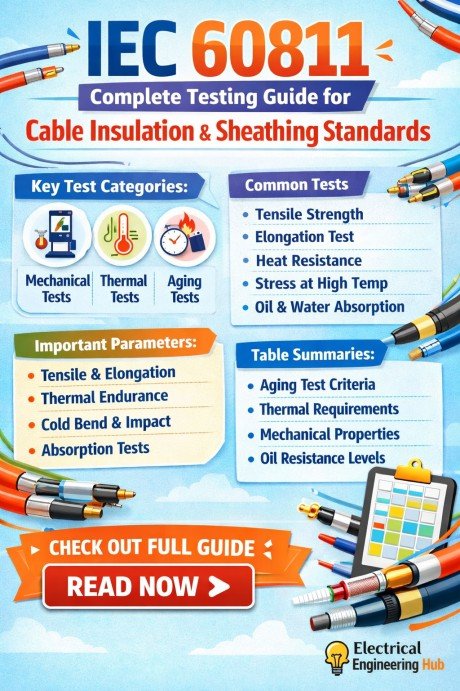
Table of Contents
Whether you are a cable engineer, quality inspector, procurement specialist, or electrical contractor, understanding IEC 60811 can help you assess cable quality more effectively and ensure long-term system reliability.
What is IEC 60811?
IEC 60811 is an international standard developed by the International Electrotechnical Commission (IEC). It defines common test methods for insulating and sheathing materials used in power cables, control cables, communication cables, and fiber optic cables.
Know more about Types of Transmission Lines Explained
Key Takeaways
Check Key Takeaways
- IEC 60811 provides standardized testing methods for cable insulation and sheathing materials.
- The standard supports quality assurance and international compliance.
- It covers mechanical, thermal, environmental, and chemical testing.
- Multiple industries rely on IEC 60811 for cable qualification.
- Compliance helps improve cable reliability, safety, and service life.
The primary purpose of IEC 60811 is to standardize testing procedures so that cable performance can be evaluated consistently regardless of the manufacturer or geographical location.
The standard covers a wide range of tests, including:
- Mechanical testing
- Thermal aging tests
- Electrical performance tests
- Environmental resistance tests
- Chemical resistance evaluation
- Physical property verification
These tests help determine whether insulation and sheath materials can withstand real-world operating conditions.
Why IEC 60811 is Important
Electrical cables operate in challenging environments where they may be exposed to heat, moisture, chemicals, ultraviolet radiation, and mechanical stress. Poor-quality insulation can lead to electrical failures, short circuits, and safety hazards.
IEC60811 helps ensure that cable materials:
- Maintain electrical insulation properties
- Resist environmental degradation
- Withstand mechanical stress
- Perform reliably throughout their service life
- Meet international quality requirements
As a result, IEC 60811 has become a critical reference standard for cable manufacturers, testing laboratories, and certification agencies worldwide.
Use this tool if you are trying to calculate cable size for underground cables. Try here Underground Cable Size Calculator – Find Correct Wire Size for Long Distance Runs
Scope of IEC 60811
The scope of IEC 60811 includes testing of non-metallic materials used in:
| Cable Type | Application |
|---|---|
| Power Cables | Electrical power transmission and distribution |
| Control Cables | Industrial control systems |
| Instrumentation Cables | Signal transmission |
| Communication Cables | Telecommunications networks |
| Optical Fiber Cables | Data transmission systems |
The standard applies to materials such as:
- PVC insulation
- XLPE insulation
- EPR insulation
- Polyethylene compounds
- Rubber compounds
- Thermoplastic sheathing materials
- Thermosetting materials
Structure of IEC60811
IEC 60811 is divided into multiple parts, each focusing on specific testing methods. This modular approach allows manufacturers and testing laboratories to apply only the relevant sections.
Explore details on iec standard for underground cable laying
Some commonly referenced parts include:
| IEC 60811 Part | Test Category |
|---|---|
| IEC 60811-100 Series | General requirements |
| IEC 60811-200 Series | Elastomeric compounds |
| IEC 60811-300 Series | PVC compounds |
| IEC 60811-400 Series | Polyethylene and polypropylene compounds |
| IEC 60811-500 Series | Filling compounds |
This structure makes IEC60811 easier to apply across different cable technologies. Understand better about nec 430.32
For a broader understanding of installation requirements, readers should also review our detailed guide on iec standard for cable laying, which complements testing requirements with practical installation standards.
Tensile Strength and Elongation Tests
One of the most frequently performed tests under IEC60811 is the tensile strength and elongation test.
This test measures how much force insulation or sheathing material can withstand before breaking. It also determines how far the material can stretch before failure.
Get complete information about iec standard for busbar sizing
The procedure typically involves:
- Preparing standardized test specimens
- Conditioning samples at specified temperatures
- Applying tensile force using a testing machine
- Recording elongation and breaking strength values
These results help verify the mechanical durability of cable materials.
Know more about Phase to Phase Clearance as per IEC 61439
Thermal Aging Tests Under IEC 60811
Heat is one of the main factors affecting cable lifespan. IEC60811 includes thermal aging tests to evaluate long-term performance under elevated temperatures.
During testing:
- Samples are placed in an air-circulating oven.
- Exposure occurs for a specified duration.
- Mechanical properties are measured before and after aging.
The comparison reveals whether insulation and sheath materials can maintain their characteristics throughout their expected service life. Explore details on High Voltage Cable Testing Procedure
Industries commonly use these results when selecting cables for high-temperature environments.
Find out more about iec 61439 busbar clearance
Hot Set Test
The hot set test is particularly important for cross-linked insulation materials such as XLPE.
This test determines:
- Material deformation under heat
- Resistance to permanent elongation
- Cross-linking quality
A sample is heated and subjected to a specific load. The resulting elongation and recovery characteristics indicate whether the insulation meets the requirements specified in IEC60811. Find all about Phase to Phase Clearance in 132 kV
Shrinkage Test
Cable insulation can shrink when exposed to elevated temperatures. Excessive shrinkage may affect cable integrity and performance.
The shrinkage test evaluates dimensional stability by:
- Measuring initial sample length
- Heating the sample under controlled conditions
- Measuring final dimensions
Manufacturers use this test to confirm that insulation remains stable during operation.
Discover everything about cable bending radius iec standard
Water Absorption Testing
Moisture ingress can significantly impact cable performance. IEC 60811 includes water absorption tests to assess resistance to moisture penetration.
These tests help determine:
- Water uptake levels
- Material stability in humid environments
- Long-term insulation reliability
Water absorption testing is especially important for underground and outdoor cable applications.
Low-Temperature Tests
Many cables operate in cold climates where insulation materials may become brittle.
IEC 60811 contains low-temperature testing procedures to verify:
- Flexibility at low temperatures
- Resistance to cracking
- Mechanical durability in cold environments
These tests are commonly required for utility, mining, and outdoor infrastructure projects.
Learn more about earthing cable size as per iec
Environmental Stress Testing
Environmental conditions can accelerate cable deterioration. To address this, IEC60811 includes several environmental evaluation methods.
Common environmental tests include:
| Test Type | Purpose |
|---|---|
| Ozone Resistance | Assess cracking resistance |
| UV Exposure | Evaluate sunlight resistance |
| Water Immersion | Verify moisture resistance |
| Heat Resistance | Determine thermal stability |
| Weathering Tests | Simulate outdoor exposure |
These tests provide valuable information regarding long-term field performance.
Chemical Resistance Evaluation
Industrial cables are often exposed to oils, fuels, acids, and other chemicals.
IEC 60811 provides methods to evaluate:
- Material swelling
- Mechanical property retention
- Surface degradation
- Weight changes after exposure
Successful performance in these tests indicates suitability for harsh industrial environments.
Know in detail about 33kV Phase to Phase Clearance
Industries That Use IEC60811
Many industries depend on IEC60811 for cable qualification and quality assurance.
These include:
- Power generation
- Electrical distribution
- Oil and gas facilities
- Renewable energy projects
- Manufacturing plants
- Transportation systems
- Telecommunications networks
- Data centers
Because cable failures can result in significant downtime and safety risks, compliance with IEC60811 is often a contractual requirement.
Benefits of IEC 60811 Compliance
Organizations gain several advantages by using cables tested according to IEC 60811.
Key benefits include:
- Improved product reliability
- Enhanced electrical safety
- Better resistance to environmental conditions
- Consistent manufacturing quality
- Easier international market acceptance
- Reduced maintenance costs
- Longer cable service life
These benefits make IEC 60811 one of the most widely referenced cable testing standards globally.
Know more about IEC Standard for Busbar Clearance
Conclusion
IEC60811 serves as the foundation for testing cable insulation and sheathing materials across the electrical industry. By defining standardized methods for mechanical, thermal, environmental, and chemical testing, the standard ensures that cable materials perform reliably throughout their operational life.
Manufacturers, testing laboratories, engineers, and asset owners rely on IEC60811 to verify product quality, improve safety, and achieve international compliance. As cable systems become increasingly critical to modern infrastructure, adherence to IEC 60811 remains essential for ensuring long-term performance and reliability.
Explore in detail IEC 61936 Clearance Table
Frequently Asked Questions
What is IEC60811 used for?
IEC 60811 is used to define standardized test methods for cable insulation and sheathing materials. It helps verify mechanical, thermal, environmental, and chemical performance.
Does IEC60811 apply to power cables only?
No. IEC 60811 applies to power cables, control cables, instrumentation cables, communication cables, and optical fiber cables that use non-metallic insulation and sheath materials.
What materials are tested under IEC 60811?
The standard covers materials such as PVC, XLPE, polyethylene, rubber compounds, thermoplastic sheathing, and thermosetting insulation materials.
Why is thermal aging testing important in IEC 60811?
Thermal aging testing evaluates how insulation and sheathing materials perform after prolonged exposure to elevated temperatures, helping predict long-term service life.
Is IEC 60811 mandatory for cable manufacturers?
The standard itself is not universally mandatory, but many product specifications, contracts, certifications, and regulatory requirements reference IEC60811 as a compliance requirement.
Follow Us on Social:
Subscribe our Newsletter on Electrical Insights for latest updates from Electrical Engineering Hub
#IEC60811,#CableTesting,#ElectricalStandards,#CableInsulation,#IECStandards,#PowerCables,#ElectricalEngineering,#CableCompliance,#WireAndCable,#EngineeringStandards