Motor Control Center for Oil and Gas: Best Technical Guide
What Is a Motor Control Center (MCC)?
A Motor Control Center (MCC) is a centralized electrical system used to control multiple electric motors from a single location. It integrates motor starters, protection devices, control circuits, and communication modules inside a metal enclosure. In industrial environments, it ensures safe starting, stopping, and monitoring of motors used in pumps, compressors, conveyors, and process equipment.
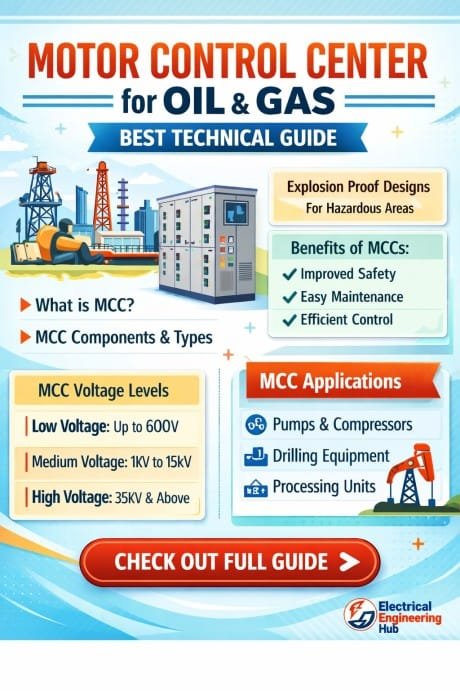
Table of Contents
In modern industrial plants, especially in energy infrastructure, Motor Control Center for Oil and Gas refers to specialized MCC systems designed to handle harsh environments, hazardous gases, and continuous-duty operations typical of petroleum facilities. These systems are engineered for reliability, safety, and remote automation.
An MCC typically includes feeders, busbars, circuit breakers, overload relays, variable frequency drives (VFDs), and PLC interfaces, all arranged in a modular structure for easy maintenance and expansion.
Know more about Motor Control Center Upgrade vs Replace
Role of MCC in Oil & Gas Power Distribution
In oil and gas facilities, electrical power distribution must remain stable under extreme conditions. MCC systems act as the backbone of motor-driven operations such as crude pumping, gas compression, water injection, and refining processes.
The Motor Control Center for Oil and Gas plays a critical role in distributing power from main switchgear to field motors while ensuring overload protection and operational continuity. It also supports automation systems by integrating with SCADA and DCS platforms, enabling real-time monitoring of equipment performance.
Key Components of an Oil & Gas MCC
A typical MCC used in petroleum and gas industries includes several essential components:
| Component | Function |
|---|---|
| Busbar System | Distributes incoming power to feeder units |
| Motor Starters | Control motor start/stop operations |
| Circuit Breakers | Provide short-circuit and overload protection |
| VFDs | Control motor speed for process optimization |
| PLC Modules | Enable automation and remote control |
| Protection Relays | Monitor faults and ensure safe shutdown |
These components ensure continuous operation even in demanding upstream, midstream, and downstream environments.
Types of Motor Control Center for Oil and Gas
Different operating environments require different MCC configurations. The Motor Control Center for Oil and Gas is available in multiple designs depending on voltage, safety, and automation requirements.
Low Voltage MCC (LV MCC)
Low voltage MCCs operate up to 1000V and are widely used in pumps, fans, and small compressors. They are cost-effective and commonly installed in non-critical applications across oil fields and refineries.
Find all about Motor Control Center Installation Cost
Medium Voltage MCC (MV MCC)
Medium voltage MCCs handle loads above 1kV and are used for large compressors and high-power pumps. These systems are critical in offshore platforms and gas processing plants where high torque motors are required.
Process Motor Control Center (PMCC)
PMCC systems integrate control and power distribution in a single unit. A PMCC oil gas setup is commonly used in continuous process industries where reliability and redundancy are essential.
Intelligent / Smart MCC
An intelligent MCC integrates digital communication, IoT sensors, and predictive analytics. A smart motor control center provides real-time diagnostics, energy monitoring, and remote fault detection, improving operational efficiency.
Flameproof & Explosion-Proof MCC Panels
In hazardous zones where flammable gases are present, explosion proof MCC and flameproof MCC panel designs are used. These units prevent ignition sources from escaping the enclosure, making them suitable for Zone 1 and Zone 2 classified areas.
Containerized / Skid-Mounted MCC
These MCC systems are pre-assembled in containers or skid-mounted structures for rapid deployment in remote oil fields. They reduce installation time and improve mobility for temporary or offshore operations.
Oil & Gas MCC Applications: Upstream, Midstream & Downstream
The Motor Control Center for Oil and Gas is deployed across the entire hydrocarbon value chain, from extraction to refining.
Upstream Applications (Wellhead, Pumps, Compressors)
In upstream operations, MCC systems control drilling rigs, artificial lift systems, and injection pumps. Motor control center compressor station setups ensure stable gas compression and well pressure management.
Know more about Motor Control Center Lifespan Expectancy
Midstream Applications (Pipeline Boosters, Gas Treatment)
Midstream facilities rely on MCC systems for pipeline booster stations, gas dehydration units, and metering systems. These applications require high reliability and continuous motor operation.
Downstream Applications (Refineries, Petrochemical Plants)
In refineries, MCC systems control complex processes such as distillation, catalytic cracking, and chemical processing. MCC refinery installations are designed for maximum safety and process stability.
Standards and Codes for Oil & Gas MCC Design
Compliance with international standards ensures safety and interoperability in oil and gas installations.
IEC 61439 — Low-Voltage Switchgear and Controlgear Assemblies
The IEC 61439 MCC standard defines design verification, temperature rise limits, and short-circuit withstand requirements for low-voltage assemblies.
NEMA & UL 845 Standards (North America)
UL 845 motor control center standards ensure safety, construction integrity, and testing procedures. NEMA MCC standards define enclosure types and performance ratings.
IEC 61508 / 61511 — Functional Safety & SIL Rating
These standards govern safety instrumented systems and define Safety Integrity Levels (SIL) for critical process control.
Know more about Top 12 Motor Control Center Manufacturers USA
ATEX / IECEx — Hazardous Area Classification
ATEX MCC and IECEx certifications are essential for equipment used in explosive atmospheres, ensuring compliance with hazardous zone requirements.
Arc Flash Safety in Oil & Gas Motor Control Centers
Arc flash incidents are a major concern in high-energy electrical systems. Proper design and protection reduce risk significantly.
Why Arc Flash Risk Is Higher in Oil & Gas
The Motor Control Center for Oil and Gas operates in high-load environments where fault currents can be extremely high. Limited maintenance access and harsh conditions increase arc flash risk.
Arc-Resistant MCC Design Requirements (IEEE C37.20.7)
Arc flash MCC oil gas systems are designed with reinforced enclosures, pressure relief vents, and remote racking systems. These features protect personnel during internal faults and ensure safe operation in critical environments.
How to Select the Right MCC for an Oil & Gas Facility
Selecting the right MCC requires careful evaluation of operational, environmental, and safety factors.
Voltage Level and Motor Load Requirements
Engineers must assess total motor load, starting current, and duty cycles. This ensures correct sizing of low voltage MCC or medium voltage MCC systems.
Know more about Motor Control Center Bucket Replacement Cost
Environmental and Enclosure Protection (IP/NEMA Rating)
Hazardous area MCC systems require high IP ratings and corrosion-resistant enclosures. Offshore platforms often use stainless steel or epoxy-coated panels.
Communication Protocols: Profibus, Modbus, EtherNet/IP
Modern MCC systems support industrial communication protocols for SCADA integration and real-time monitoring.
Form of Construction (IEC Form 1 to Form 4b)
The construction form defines internal separation and safety levels. Form 4b offers maximum isolation, widely used in high-risk oil and gas environments.
MCC Maintenance and Reliability in Oil & Gas Plants
Reliable operation depends on structured maintenance strategies.
Preventive vs. Predictive Maintenance Strategies
Preventive maintenance includes scheduled inspections, while predictive maintenance uses sensor data to detect early failures. This reduces downtime in critical MCC systems.
Thermal Monitoring and Fault Detection
Infrared sensors and smart relays help detect overheating in busbars and terminals, ensuring early intervention before failures occur.
Find all about How Does a Motor Control Center Work
Leading MCC Manufacturers for Oil & Gas
Several global manufacturers specialize in high-performance MCC systems for petroleum applications:
| Manufacturer | Specialization |
|---|---|
| Siemens | Smart MCC and automation integration |
| Schneider Electric | EcoStruxure-based MCC systems |
| ABB | Medium voltage MCC and drive integration |
| Rockwell Automation | Intelligent MCC with ArcShield technology |
| Eaton | UL 845 compliant MCC systems |
These companies provide advanced Motor Control Center for Oil and Gas solutions designed for reliability and safety.
Find out the mcc panel design guide pdf in detail here.
Frequently Asked Questions
What is the difference between MCC and switchgear?
MCC controls motors directly, while switchgear is primarily used for power distribution and protection of electrical circuits.
What is a PMCC in oil and gas?
A PMCC oil gas system integrates process control and motor control into a single panel for improved automation and efficiency.
What are the IEC standards for MCC?
IEC 61439 is the primary standard governing MCC design, construction, and testing for low-voltage systems.
How does a smart MCC improve plant efficiency?
A smart motor control center uses digital monitoring, predictive analytics, and remote diagnostics to reduce downtime and optimize energy usage.
Follow Us on Social:
Subscribe our Newsletter on Electrical Insights for latest updates from Electrical Engineering Hub
#MotorControlCenterForOilAndGas,#MCCOilAndGas,#MotorControlCenter,#OilAndGasAutomation,#IndustrialMCC,#SCADASystems,#ElectricalControlPanels,#ProcessAutomation,#EnergyInfrastructure,#SmartMCC