IEC 60502 Cable Bending Radius
When installing power cables, one of the most overlooked factors is the bending radius. Improper bending can damage insulation, weaken conductors, and reduce the overall service life of the cable. This is where IEC 60502 Cable Bending Radius becomes important.
IEC 60502 sets the standard requirements for power cables with extruded insulation used in fixed installations. It provides clear guidance on how much a cable can bend without causing mechanical or electrical damage. Whether you are dealing with low-voltage or medium-voltage systems, understanding these limits is essential for safe installation.
In practical projects, electricians and engineers often use tools like a bend radius for cables guide or a cable bending radius calculator to ensure compliance before pulling or routing cables.
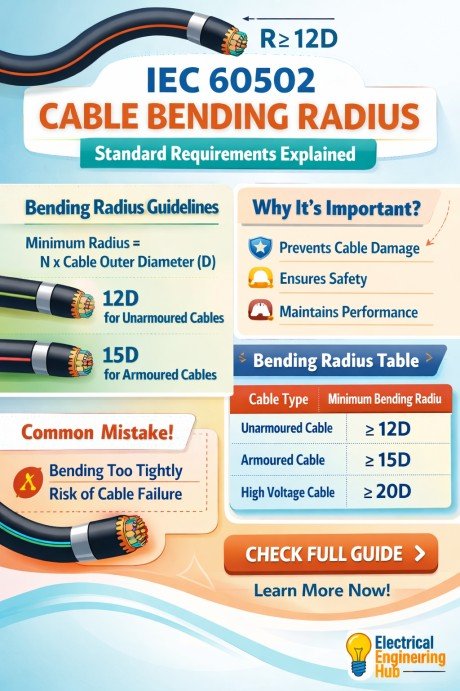
Table of Contents
Table of Contents
What Is IEC 60502?
IEC 60502 is an international standard published by the International Electrotechnical Commission. It covers power cables with extruded insulation and their accessories for rated voltages from 1kV up to 30kV.
The standard is divided into two main parts:
| IEC Standard Part | Voltage Range | Application |
|---|---|---|
| IEC 60502-1 | 1kV to 3kV | Low-voltage power cables |
| IEC 60502-2 | 6kV to 30kV | Medium-voltage power cables |
This standard defines:
- Construction requirements
- Electrical performance
- Testing methods
- Installation recommendations
- Mechanical handling limits
Among these requirements, the bending radius is one of the most critical installation parameters.
The main goal of IEC 60502 Cable Bending Radius is to protect cable integrity during transportation, laying, and termination.
See our comprehensive guide on cable bending radius iec standard
IEC 60502 Minimum Bending Radius Requirements
The standard defines minimum bending radius as a multiple of the cable’s overall diameter (D). This diameter includes insulation, sheathing, armouring, and outer covering.
The formula is simple:
Minimum Bending Radius = Multiplier × Cable Overall Diameter
For example:
If a cable diameter is 40 mm and the multiplier is 12:
Minimum bend radius = 12 × 40 = 480 mm
This means the cable should never be bent tighter than 480 mm.
Here is a quick overview:
| Cable Type | Typical Multiplier |
|---|---|
| Single-core unarmoured | 15D |
| Multi-core unarmoured | 12D |
| Single-core armoured | 20D |
| Multi-core armoured | 15D |
These values can vary based on cable construction and installation conditions.
Using a cable bending radius calculator makes field calculations much faster and reduces human error.
Bending Radius Multipliers by Cable Construction
Different cable designs have different flexibility levels. The conductor type, insulation thickness, metallic screens, and armour all affect how tightly a cable can bend.
Below is a breakdown based on construction.
Single-Core Cables
Single-core cables are widely used in power distribution systems. Their bending radius depends on conductor material and shielding.
Know more about Wire Bending Radius NEC
For unarmoured single-core cables under IEC 60502:
| Cable Construction | Minimum Radius |
|---|---|
| Copper conductor | 15D |
| Aluminum conductor | 15D |
| XLPE insulated | 15D |
Single-core cables often have larger diameters, making the physical bend radius quite large.
Important considerations:
- Avoid twisting during installation
- Maintain equal spacing in trefoil formations
- Check thermal expansion allowance
Large power feeders usually require careful planning of bends inside cable trays and ducts.
Multi-Core Cables
Multi-core cables combine several conductors inside one sheath. They are usually more flexible than equivalent single-core sets.
IEC 60502 generally recommends:
| Multi-core Cable Type | Minimum Radius |
|---|---|
| Unarmoured PVC | 12D |
| XLPE insulated | 12D |
| LSZH cables | 12D |
Multi-core cables are commonly used in:
- Industrial motor feeders
- Building distribution
- Street lighting systems
- Generator connections
When routing through cable trays, maintaining the correct bend radius for cables helps avoid internal conductor stress.
Find all about 11kV Cable Bending Radius
Armoured Cables (SWA/AWA per IEC 60502)
Armoured cables have extra mechanical protection, but they are less flexible.
Steel Wire Armoured (SWA) and Aluminum Wire Armoured (AWA) cables require larger bending radii because the armour can deform if bent too sharply.
IEC recommendations:
| Armoured Cable Type | Minimum Radius |
|---|---|
| Single-core AWA | 20D |
| Multi-core SWA | 15D |
Why larger radii matter:
- Protect armour integrity
- Prevent sheath cracking
- Reduce conductor displacement
For underground cable installations, this is especially important at joint pits and gland entries.
Screened/Shielded Cables
Screened cables include copper tape screens, wire screens, or metallic shielding for EMI control.
These cables require additional care because screen damage can affect electrical performance.
Typical values:
| Screen Type | Minimum Radius |
|---|---|
| Copper tape screened | 15D |
| Wire screened | 15D |
| Metallic foil screened | 12D to 15D |
Applications include:
- Instrumentation systems
- Control circuits
- Medium-voltage feeders
Sharp bends may crack shielding layers and increase electromagnetic interference.
Use our online tool HV Cable Bending Radius Calculator
IEC 60502 vs. Other Bending Radius Standards
Several standards define cable bending requirements. IEC 60502 is one of the most widely used, but it differs from other standards.
Comparison table:
| Standard | Scope | Typical Radius Rule |
|---|---|---|
| IEC 60502 | LV/MV power cables | 12D to 20D |
| BS 7671 | Wiring regulations | Refers to manufacturer |
| NEC (NFPA 70) | US electrical installations | Depends on cable type |
| IEEE 1185 | Cable tray systems | Installation guidance |
Key differences:
IEC 60502
- Specific to extruded insulation cables
- Gives direct multipliers
- Covers armoured and screened cables
BS 7671
- More installation focused
- Often depends on manufacturer specs
NEC
- Uses conduit fill and pulling tension limits more heavily
This makes IEC 60502 Cable Bending Radius more practical for design engineers.
Find all about Busbar Bending Calculation
Applying IEC 60502 During Cable Installation
Correct application during installation prevents failures and costly repairs.
Follow these practical steps:
Measure cable diameter
Always use actual overall diameter from manufacturer datasheets.
Calculate minimum radius
Use:
Radius = D × Multiplier
Or use a cable bending radius calculator.
Check cable route
Look for:
- Tray bends
- Duct entries
- Panel terminations
- Joint boxes
Verify pulling equipment
Ensure:
- Rollers match bend limits
- Drum rotation is smooth
- Pulling tension stays within limits
Maintain proper support
Cable supports should prevent sagging and sharp edge contact.
Installation checklist:
| Check Item | Status |
|---|---|
| Diameter verified | Yes/No |
| Radius calculated | Yes/No |
| Route inspected | Yes/No |
| Rollers placed | Yes/No |
| Armour protected | Yes/No |
Field teams should always inspect bends after installation.
Common Mistakes When Applying IEC 60502 Bend Radius Rules
Many cable failures happen because installers ignore bend limits.
Common mistakes include:
Using inner diameter instead of overall diameter
The full cable diameter must be used.
Forcing bends in confined spaces
Panels and trenches often create tight corners.
Ignoring armour stiffness
Armoured cables need larger bending loops.
Follow the comprehensive guide on Cable Tray Bending Radius
Applying manufacturer data incorrectly
Some manufacturers may provide larger minimum values than IEC.
Always follow the larger value.
Excessive pulling tension
High pulling force combined with bending can deform conductors.
Poor storage practices
Cable drums should be stored upright and protected from damage.
Mistake impact table:
| Mistake | Possible Damage |
|---|---|
| Tight bends | Insulation cracks |
| Armour distortion | Mechanical weakness |
| Screen breakage | EMI issues |
| Conductor stress | Hotspots |
Avoiding these mistakes improves cable lifespan significantly.
IEC 60502 Bending Radius Reference Table
This table can be used as a quick field reference.
| Cable Type | Voltage Class | Minimum Radius |
|---|---|---|
| Single-core unarmoured | LV | 15D |
| Multi-core unarmoured | LV | 12D |
| Single-core AWA | LV/MV | 20D |
| Multi-core SWA | LV/MV | 15D |
| Screened XLPE | MV | 15D |
| PVC insulated multi-core | LV | 12D |
| XLPE insulated single-core | MV | 15D |
Quick example:
If a 4-core SWA cable has an overall diameter of 50 mm:
Minimum radius = 15 × 50 = 750 mm
This simple table saves time for installers and engineers.
Follow our guide on bending radius of armoured cable
Frequently Asked Questions
What is the minimum bending radius per IEC 60502?
The minimum bending radius under IEC 60502 depends on cable construction. It usually ranges from 12 times to 20 times the cable’s overall diameter.
Does IEC 60502 specify different radii for installation vs. fixed cables?
Yes. Installation conditions often require larger temporary bending radii because of pulling forces and mechanical stress. Fixed positions may allow stable bends after installation.
How does IEC 60502 bending radius differ from BS 7671?
IEC 60502 provides direct numerical multipliers, while BS 7671 often refers users to manufacturer recommendations and broader wiring practices.
What is the bend radius multiplier for armoured cable under IEC 60502?
For armoured cables, it is usually 15D for multi-core SWA and 20D for single-core AWA, depending on design and voltage class.
Quickly calculate bending radius using our guide on cable bending radius rule of thumb
Understanding IEC 60502 Cable Bending Radius is essential for anyone working with power cable installation. It ensures mechanical safety, electrical reliability, and long-term performance. Whether you are designing cable tray layouts, underground duct systems, or switchgear terminations, following these bend radius rules helps prevent costly failures and downtime.
Follow Us on Social:
Subscribe our Newsletter on Electrical Insights for latest updates from Electrical Engineering Hub
IEC60502CableBendingRadius, #CableBendingRadius, #IEC60502Standard, #PowerCableInstallation, #CableInstallationGuide, #ElectricalEngineering, #CableSizing, #IndustrialCabling, #ElectricalStandards, #PowerDistribution