Landscape Lighting Cable Size Guide (12V & 24V Systems)
Choosing the correct Landscape Lighting Cable Size is one of the most important parts of designing an efficient outdoor lighting system. Whether you are installing garden lights, pathway lights, spotlights, or deck lighting, the right wire size ensures proper voltage delivery, prevents overheating, and improves the lifespan of your lighting fixtures.
A wrong cable size can cause excessive voltage drop, dim lights, and even damage expensive LED fixtures. This guide explains how to select the right cable for both 12V and 24V systems, provides practical wire sizing charts, and helps you understand voltage drop calculations for landscape lighting.
If you are working on larger outdoor lighting systems, you can also use our street light cable size calculation tool for more complex load planning.
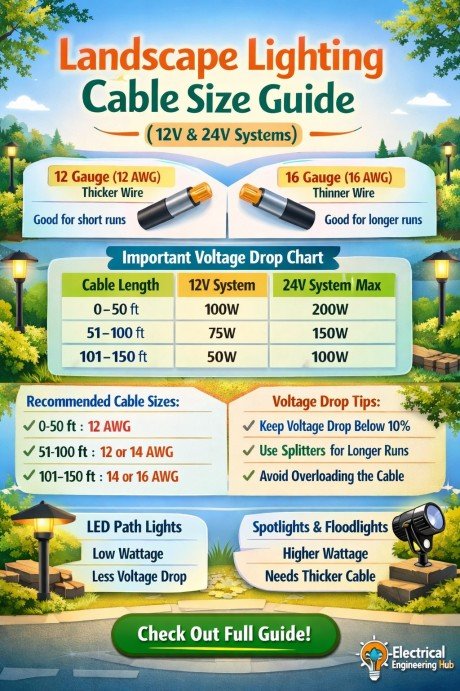
Table of Contents
Table of Contents
Why Cable Size Matters in Landscape Lighting
Low-voltage landscape lighting systems usually operate at 12V or 24V. Since the voltage is lower than standard residential power, current increases for the same wattage. Higher current means cable resistance becomes more critical.
Know more about How to Size Cable for Street Lighting Circuits
The correct Landscape Lighting Cable Size helps in:
- Reducing voltage drop
- Maintaining equal brightness across fixtures
- Preventing cable overheating
- Improving energy efficiency
- Extending LED fixture life
For example, a 100W lighting load on 12V draws much more current than the same load on 24V.
Current formula:
Current (A) = Power (W) ÷ Voltage (V)
Example:
| Load Power | Voltage | Current |
|---|---|---|
| 100W | 12V | 8.33A |
| 100W | 24V | 4.16A |
This clearly shows why wire sizing is critical.
Understanding Voltage Drop in Landscape Lighting
Voltage drop is the reduction in voltage as electricity travels through a cable. It is one of the biggest challenges in low-voltage lighting systems.
A high voltage drop causes:
- Uneven light output
- Reduced fixture performance
- Flickering lights
- Shortened equipment life
The recommended voltage drop is:
- Maximum 3% for critical lighting
- Up to 5% acceptable for general landscape lighting
To calculate voltage drop accurately, use our Landscape Lighting Voltage Drop Calculator for instant results.
Find the exact street lights cable size with Street Light Cable Size Chart
Factors That Affect Landscape Lighting Cable Size
Several factors determine the ideal wire size.
System Voltage
12V systems need thicker cables because they carry higher current.
24V systems can use smaller wires for the same load.
Total Wattage
Higher wattage means higher current.
Example:
- 50W load at 12V = 4.16A
- 150W load at 12V = 12.5A
Cable Length
Longer cable runs increase resistance.
The longer the wire, the larger the cable required.
Fixture Distribution
If lights are spread far apart, voltage drop becomes uneven.
Proper loop design can reduce losses.
Know more about Smart Solar Street Light System with IoT Integration
Standard Wire Sizes for Landscape Lighting
Here are common cable sizes used.
| AWG Size | mm² Approx | Max Current | Typical Use |
|---|---|---|---|
| 18 AWG | 0.82 mm² | 5A | Small garden lights |
| 16 AWG | 1.31 mm² | 10A | Path lights |
| 14 AWG | 2.08 mm² | 15A | Medium runs |
| 12 AWG | 3.31 mm² | 20A | Larger systems |
| 10 AWG | 5.26 mm² | 30A | Long runs/high loads |
| 8 AWG | 8.37 mm² | 40A | Heavy-duty installations |
Knowing the proper street light wire size can also help when scaling up to commercial outdoor lighting.
Landscape Lighting Cable Size Chart for 12V Systems
This chart shows recommended wire sizes based on wattage and distance.
| Total Load | Distance (Feet) | Recommended Cable |
|---|---|---|
| 50W | 50 ft | 16 AWG |
| 100W | 50 ft | 14 AWG |
| 150W | 50 ft | 12 AWG |
| 200W | 50 ft | 10 AWG |
| 100W | 100 ft | 12 AWG |
| 150W | 100 ft | 10 AWG |
| 200W | 100 ft | 8 AWG |
12V systems are more sensitive to voltage loss.
Download Free Street Lighting Voltage Drop Calculator in Excel
Landscape Lighting Cable Size Chart for 24V Systems
24V systems allow longer runs with smaller wires.
| Total Load | Distance (Feet) | Recommended Cable |
|---|---|---|
| 50W | 100 ft | 18 AWG |
| 100W | 100 ft | 16 AWG |
| 150W | 100 ft | 14 AWG |
| 200W | 100 ft | 12 AWG |
| 300W | 150 ft | 10 AWG |
This makes 24V systems ideal for larger landscapes.
How to Calculate Landscape Lighting Cable Size
Follow these steps.
Step 1: Calculate Total Load
Add all fixture wattages.
Example:
10 lights × 8W = 80W
Step 2: Find Current
Current = Power ÷ Voltage
80W ÷ 12V = 6.67A
Step 3: Measure Total Distance
Use the round-trip distance.
If one-way distance is 50 ft:
Total = 100 ft
Step 4: Select Cable
Use the chart or calculator.
For more advanced outdoor electrical planning, the street light cable size calculation tool can help compare larger feeder cables.
Best Wiring Methods for Landscape Lighting
Cable layout affects performance.
Daisy Chain
Simple and easy.
Best for small systems.
Drawback:
Voltage drops at the last fixture.
T-Method
Improves voltage balance.
Suitable for medium layouts.
Loop Method
Best voltage distribution.
Ideal for large systems.
Key Takeaways
- Landscape Lighting Cable Size directly affects brightness and efficiency
- 12V systems need thicker wires compared to 24V
- Voltage drop should stay under 5%
- Longer cable runs require larger AWG sizes
- Always calculate total wattage before selecting wire
- Use calculators for precise results
- Loop wiring gives better voltage distribution than daisy chaining
Proper cable selection reduces maintenance costs and improves lighting quality.
Use our free street light cable size calculator
Common Mistakes to Avoid
Using Undersized Wire
This causes excessive voltage drop.
Ignoring Distance
Many installers calculate load but forget cable length.
Mixing Fixture Types
Different wattages create imbalance.
Overloading Transformers
Always keep transformer loading below 80%.
Copper vs Aluminum Cable for Landscape Lighting
Copper is the preferred choice because:
- Lower resistance
- Better conductivity
- Longer life
- More flexible
Aluminum is cheaper but less efficient.
For most landscape lighting systems, stranded copper wire is recommended. Know more about How to Wire a 480/277 Lighting System: Step-By-Step Guide for Safe Commercial Installation
Final Thoughts
Selecting the right Landscape Lighting Cable Size is essential for maintaining reliable and bright outdoor lighting. Whether you are installing a simple garden path system or a large multi-zone landscape setup, wire sizing should never be guessed.
For 12V systems, always pay close attention to voltage drop because losses are much higher. For 24V systems, cable runs can be longer with better efficiency.
Using the proper charts, understanding wire resistance, and applying voltage drop calculations will help you design a better system. To simplify your work, use the Landscape Lighting Voltage Drop Calculator and related sizing tools for accurate planning.
Use our online tool Lighting Load Calculation per Square Foot: Download Excel Sheet
FAQs
What size wire should I use for 12V landscape lighting?
For short runs under 50 feet, 16 AWG or 14 AWG is common. Larger loads may require 12 AWG or 10 AWG.
Is 12 AWG enough for landscape lighting?
Yes, 12 AWG works well for medium-sized systems with moderate cable lengths and loads.
How much voltage drop is acceptable in landscape lighting?
A voltage drop between 3% and 5% is generally acceptable for most installations.
Should I use 12V or 24V for landscape lighting?
12V is common for small residential setups. 24V is better for larger systems because it reduces current and voltage drop.
Uncover insights on iec standard for lighting lux level, download a calculator in excel to calculate the required lux level according to IEC standards.
Follow Us on Social:
Subscribe our Newsletter on Electrical Insights for latest updates from Electrical Engineering Hub
LandscapeLightingCableSizeGuide, #LandscapeLightingWireSize, #12VLightingSystem, #24VLightingSystem, #VoltageDropCalculation, #OutdoorLightingInstallation, #LowVoltageLighting, #CableSizingGuide, #GardenLightingTips, #ElectricalDesignGuide