Best Multimeter for Solar Panels: Top Reliable Choices for 2026
Solar power systems require accurate testing and troubleshooting to maintain peak performance. Whether you are a professional solar installer, electrical engineer, technician, or DIY solar enthusiast, choosing the Best Multimeter for Solar Panels can make a significant difference in measurement accuracy and safety.
Solar panels operate with DC voltage, current, and resistance values that require specialized testing capabilities. A quality multimeter helps verify panel output, diagnose wiring faults, check continuity, measure open-circuit voltage, and ensure overall system reliability.
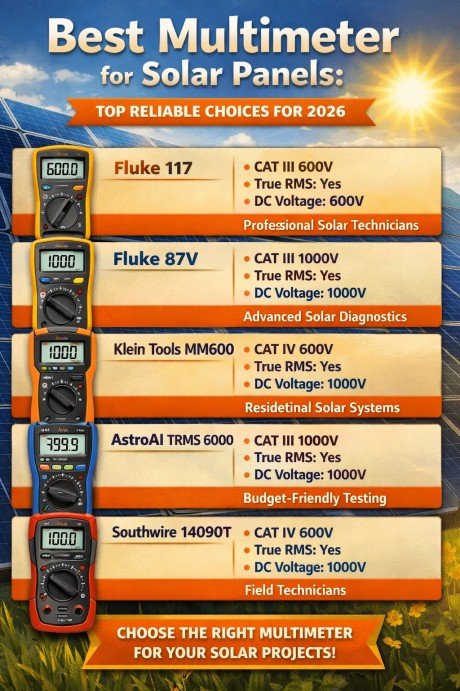
Table of Contents
Table of Contents
In this guide, we will review the Best Multimeter for Solar Panels available in 2026, discuss important buying factors, and help you select the right model for your solar testing needs.
Why You Need a Multimeter for Solar Panel Testing
Solar photovoltaic systems require regular inspection and maintenance. A standard household meter may not always provide the accuracy, safety rating, or measurement range needed for solar applications.
Find all about How to Test Resistance With Multimeter
A solar-compatible multimeter can help you:
- Measure solar panel DC voltage
- Verify open-circuit voltage (Voc)
- Check short-circuit current (Isc)
- Test continuity of solar cables
- Identify wiring faults
- Measure resistance values
- Troubleshoot inverter connections
- Verify battery bank performance
- Inspect charge controller operation
Investing in the Best Multimeter for Solar Panels allows you to perform these tasks safely and accurately.
Read our detailed Kaiweets Multimeter Review
Quick Comparison Table
| Multimeter Model | CAT Rating | True RMS | DC Voltage Range | Best For |
|---|---|---|---|---|
| Fluke 117 | CAT III 600V | Yes | 600V | Professional Solar Technicians |
| Fluke 87V | CAT III 1000V | Yes | 1000V | Advanced Solar Diagnostics |
| Klein Tools MM600 | CAT IV 600V | Yes | 1000V | Residential Solar Systems |
| AstroAI TRMS 6000 | CAT III 1000V | Yes | 1000V | Budget-Friendly Testing |
| Southwire 14090T | CAT IV 600V | Yes | 1000V | Field Technicians |
Find all about How to Test Resistance With Multimeter
Top Picks for the Best Multimeter for Solar Panels
Fluke 117 Digital Multimeter
The Fluke 117 remains one of the most trusted meters among electricians and solar professionals.
Key Features:
- True RMS measurements
- Non-contact voltage detection
- AutoVolt technology
- Compact design
- Excellent build quality
- Reliable accuracy
Pros:
- Highly accurate readings
- Durable construction
- Trusted professional brand
- Easy-to-read display
Cons:
- Higher price than entry-level models
For residential and commercial solar installations, the Fluke 117 is often considered among the Best Multimeter for Solar Panels due to its reliability and precision.
👉 Check Current Price and Availability Here
Fluke 87V Industrial Multimeter
The Fluke 87V is designed for demanding industrial environments and large-scale solar farms.
Key Features:
- CAT III 1000V safety rating
- True RMS measurement
- Temperature testing
- Frequency measurement
- Min/Max recording
Know more about How to Test Solar Panel With Multimeter
Pros:
- Exceptional accuracy
- Suitable for high-voltage systems
- Extremely durable
- Advanced troubleshooting capabilities
Cons:
- Premium pricing
If you frequently work on utility-scale solar projects, this model is a strong contender for the Best Multimeter for Solar Panels.
Klein Tools MM600
Klein Tools has built a strong reputation among electricians, and the MM600 offers excellent value.
Key Features:
- True RMS technology
- CAT IV 600V safety rating
- Measures AC/DC voltage
- Temperature testing
- Rugged housing
Pros:
- Affordable price
- Strong safety ratings
- User-friendly operation
- Durable design
Cons:
- Display visibility could be improved in direct sunlight
Many solar installers prefer this meter because it balances performance and affordability.
👉 View Latest Deals Before Prices Change
AstroAI TRMS 6000 Counts Multimeter
The AstroAI TRMS 6000 is a popular budget option for homeowners and DIY solar users.
Key Features:
- True RMS readings
- Auto-ranging functionality
- Backlit display
- Data hold feature
- NCV detection
Pros:
- Budget-friendly
- Easy to use
- Good measurement accuracy
- Lightweight design
Know more about How to Check Transistor With Multimeter
Cons:
- Not as rugged as professional models
For occasional solar panel maintenance, this meter delivers impressive value.
Southwire 14090T Multimeter
Southwire offers a versatile multimeter designed for electrical and renewable energy applications.
Key Features:
- CAT IV 600V rating
- True RMS measurements
- Temperature testing
- Built-in flashlight
- Durable enclosure
Pros:
- Excellent safety features
- Suitable for outdoor use
- Reliable performance
- Competitive pricing
Cons:
- Learning curve for beginners
Its combination of durability and measurement capability places it among the Best Multimeter for Solar Panels available today.
To simplify electrical troubleshooting, consider one of the options featured in our Best Multimeter Under $50 buying guide.
Important Features to Consider
Before purchasing a solar testing meter, evaluate the following factors.
True RMS Measurement
Solar systems can generate fluctuating electrical signals. True RMS technology ensures accurate readings under varying conditions.
High DC Voltage Capability
Modern solar arrays often operate at elevated DC voltages. Select a meter capable of measuring at least 600V DC, while 1000V DC capability is preferred for larger systems.
Safety Ratings
Always verify the meter’s safety category.
| Safety Category | Application |
|---|---|
| CAT II | Household circuits |
| CAT III | Distribution systems |
| CAT IV | Utility connections and outdoor installations |
For solar work, CAT III or CAT IV ratings are recommended.
Auto-Ranging Function
Auto-ranging simplifies operation and reduces measurement errors.
Know more about How to Check 3 Phase Motor Winding with Multimeter
Durability
Solar inspections frequently occur outdoors. Look for:
- Rugged casing
- Drop protection
- Dust resistance
- Weather-resistant design
Backlit Display
Solar installations often involve rooftop work or equipment rooms with limited lighting. A backlit display improves visibility.
How to Test Solar Panels with a Multimeter
A multimeter is one of the most important solar maintenance tools.
Step 1: Measure Open-Circuit Voltage
Disconnect the panel from the system.
Set the meter to DC voltage mode.
Connect probes to the panel terminals.
Compare the measured value with the manufacturer’s specified Voc rating.
Step 2: Check Short-Circuit Current
Switch to current measurement mode.
Follow manufacturer instructions carefully.
Measure current output under full sunlight conditions.
Step 3: Verify Continuity
Use continuity mode to check wiring integrity and identify broken conductors.
Step 4: Test Resistance
Measure resistance across connectors and wiring paths to identify potential faults.
Step 5: Inspect Battery Systems
Solar batteries can also be tested for voltage levels and charging performance using a quality digital multimeter.
Comparison of Recommended Models
| Model | True RMS | CAT Rating | Best Use | Value |
|---|---|---|---|---|
| Fluke 117 | Yes | CAT III 600V | Residential Solar | Excellent |
| Fluke 87V | Yes | CAT III 1000V | Industrial Solar | Premium |
| Klein MM600 | Yes | CAT IV 600V | Professional Use | Excellent |
| AstroAI TRMS 6000 | Yes | CAT III 1000V | DIY Solar | Budget |
| Southwire 14090T | Yes | CAT IV 600V | Outdoor Work | Very Good |
Which Multimeter Offers the Best Value?
For most users, the Klein Tools MM600 delivers the best balance of safety, accuracy, durability, and affordability.
Professional solar technicians may prefer the Fluke 117 or Fluke 87V due to their proven long-term reliability.
DIY users looking for a cost-effective solution can confidently choose the AstroAI TRMS 6000.
👉 See Customer Reviews and Today’s Best Price
Final Verdict
Selecting the Best Multimeter for Solar Panels depends on your experience level, budget, and testing requirements. Accurate measurements are critical for diagnosing faults, validating solar panel performance, and ensuring safe system operation.
If budget is not a concern, the Fluke 87V offers industry-leading performance. For most professionals, the Fluke 117 and Klein MM600 provide an excellent combination of precision and durability. Homeowners and hobbyists can achieve reliable results with the AstroAI TRMS 6000 without spending a premium.
A quality multimeter is one of the smartest investments for anyone working with photovoltaic systems, solar batteries, charge controllers, and inverters.
👉 Compare Prices Now and Choose the Right Solar Multimeter for Your System
Frequently Asked Questions
What is the Best Multimeter for Solar Panels?
The Fluke 117, Fluke 87V, Klein MM600, AstroAI TRMS 6000, and Southwire 14090T are among the top-rated options for solar panel testing in 2026.
Can a regular multimeter test solar panels?
Yes, but it should have sufficient DC voltage range and proper safety ratings. Solar-specific testing is safer with CAT III or CAT IV rated meters.
What voltage should a solar panel produce?
The output depends on the panel rating. Most residential panels produce open-circuit voltages ranging from 20V to 50V per panel.
Why is True RMS important for solar testing?
True RMS technology provides more accurate measurements when electrical signals fluctuate or contain distortions.
What safety rating should a solar multimeter have?
A CAT III or CAT IV safety rating is recommended for testing solar power systems and associated electrical equipment.
Follow Us on Social:
Subscribe our Newsletter on Electrical Insights for latest updates from Electrical Engineering Hub
#bestmultimeterforsolarpanels,#solarmultimeter,#solarpaneltesting,#electricaltesting,#multimeterreview,#solarenergytools,#digitalmultimeter,#solarmaintenance,#renewableenergy,#electricalengineering