
Bending Radius of Armoured Cable: Comprehensive Guide
The Bending Radius of Armoured Cable is one of the most critical parameters in electrical installation work, directly affecting cable life, safety, and system reliability. Ignoring this basic requirement can lead to conductor damage, insulation stress, and premature failure of the entire system.
In industrial and commercial power distribution, proper handling of cable bending ensures compliance with engineering standards and avoids costly downtime. Understanding the Bending Radius of Armoured Cable helps electricians, engineers, and installers maintain mechanical integrity during laying, pulling, and termination stages.
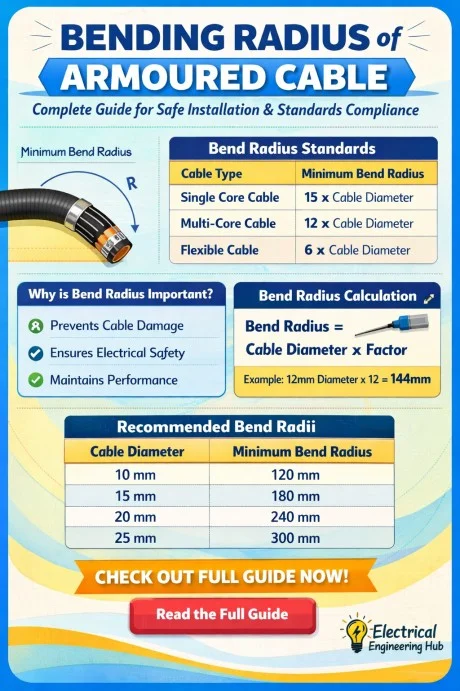
Table of Contents
In practical field applications, armoured cables are often routed through trenches, trays, conduits, and cable ladders. Each installation environment demands careful attention to bending limits. The Bending Radius of Armoured Cable is not a random value; it is derived from cable diameter, armour type, and manufacturer specifications. Following these limits ensures the cable performs efficiently under mechanical and electrical stress.
Know more about IEC Standard for Neutral to Earth Voltage
What is Bending Radius and Why It Matters
The bending radius refers to the minimum radius a cable can be bent without causing internal damage. For armoured cables, this becomes even more important due to the presence of steel wire armour or aluminium armour layers. Exceeding this limit can deform the protective layers and compromise insulation integrity. Use our online tool HV Cable Bending Radius Calculator
The Bending Radius of Armoured Cable is essential because it prevents micro-cracks in insulation and avoids stress on conductor strands. These issues may not appear immediately but can lead to insulation breakdown over time. Proper bending practices also ensure compliance with safety inspections and electrical codes used in modern infrastructure projects.
Key Factors That Affect Bending Radius
Several technical and environmental factors influence cable bending behavior. Engineers consider these variables during design and installation planning:
- Cable outer diameter
- Type of armour (SWA, AWA, or tape armour)
- Number of cores in the cable
- Installation temperature conditions
- Manufacturer design standards
The Bending Radius of Armoured Cable varies depending on these factors, which is why a one-size-fits-all approach does not work in real installations. For example, multi-core cables generally require a larger bending radius compared to single-core variants.
Know more about Wire Sizing for Motors
Standard Values and Engineering Reference
Electrical engineers rely on international standards to determine safe bending practices. A useful reference guide for compliance can be found in this detailed resource: cable bending radius iec standard. These standards help ensure uniformity across global installations and reduce risks associated with improper handling.
In most cases, the Bending Radius of Armoured Cable is expressed as a multiple of the cable’s outer diameter. Typical values range from 6D to 15D depending on construction type and installation conditions. Maintaining these values ensures mechanical stability and long-term performance.
Installation Guidelines for Safe Handling
Proper installation techniques play a major role in maintaining cable health. Below is a practical overview used by field engineers:
| Installation Stage | Recommended Practice | Risk if Ignored |
|---|---|---|
| Cable pulling | Use rollers and controlled tension | Jacket damage, conductor stress |
| Tray laying | Maintain gradual bends | Insulation cracking |
| Underground installation | Avoid sharp turns in trenches | Armour deformation |
| Termination points | Provide adequate loop space | Terminal strain |
Following these practices ensures that the Bending Radius of Armoured Cable remains within safe operational limits during all stages of installation.
Find all about 11kV Cable Bending Radius
Common Mistakes During Cable Installation
Many installation failures occur due to simple yet critical mistakes. Some of the most common issues include:
- Over-tight bending near junction boxes
- Pulling cables without proper lubrication
- Ignoring manufacturer specifications
- Improper storage leading to pre-installation deformation
- Using incorrect cable support spacing
Each of these errors directly impacts the Bending Radius of Armoured Cable, leading to reduced lifespan and potential system failure. Training and awareness among installation teams can significantly reduce these risks. Find all about Phase to Phase Clearance in 132 kV
Mechanical Stress and Long-Term Performance
Armoured cables are designed to withstand mechanical stress, but only within defined limits. Repeated bending beyond safe radius limits weakens the armour layer and affects conductivity stability. Over time, this can lead to heat buildup and insulation breakdown.
The Bending Radius of Armoured Cable also influences electrical performance by maintaining consistent conductor alignment. This reduces resistance variations and improves overall system efficiency, especially in high-load industrial applications.
Know more about Wire Bending Radius NEC
Field Testing and Quality Checks
Before energizing any installation, engineers perform visual and mechanical checks to ensure proper cable placement. These checks include bend inspection, tray alignment verification, and tension analysis. Any deviation from standard radius requirements must be corrected immediately.
Ensuring the Bending Radius of Armoured Cable is maintained throughout installation is a key part of quality assurance and long-term reliability testing.
See our comprehensive guide on cable bending radius iec standard
FAQs
1. What is the standard bending radius for armoured cables?
It usually ranges between 6 to 15 times the cable diameter, depending on construction and manufacturer guidelines.
2. Why is bending radius important in armoured cable installation?
It prevents damage to insulation and armour layers, ensuring long-term safety and performance.
3. Can I bend armoured cables more tightly than recommended?
No, tighter bends can damage the cable structure and reduce its operational lifespan.
4. Does temperature affect bending radius?
Yes, low temperatures make cables more rigid, increasing the risk of damage during bending.
5. How do I calculate the bending radius of armoured cable?
Multiply the cable’s outer diameter by the manufacturer-specified factor, usually provided in technical datasheets.
Conclusion
Proper handling of electrical cables is essential for safe and efficient power systems. The Bending Radius of Armoured Cable is a fundamental parameter that ensures mechanical protection and electrical stability throughout its service life.
By following engineering standards, using correct installation practices, and referring to reliable guidelines, installers can significantly reduce system failures and maintenance costs. Careful planning and adherence to technical specifications will always result in safer and more durable electrical infrastructure.
Follow Us on Social:
Subscribe our Newsletter on Electrical Insights for latest updates from Electrical Engineering Hub
#bendingradiusofarmouredcable,#armouredcable,#cableinstallation,#electricalengineering,#powercables,#cablebending,#cablemanagement,#industrialwiring,#electricalsafety,#civilelectrical