ESP8266MOD vs ESP8266EX: Important Key Differences, Features and Which One to Choose
The comparison of esp8266mod vs esp8266ex often creates confusion for beginners and even for experienced electronics enthusiasts. Both are closely related to the popular ESP8266 WiFi platform developed by Espressif, but they serve different purposes in hardware design and embedded systems. Understanding the difference between these two terms is important when selecting the right component for IoT devices, smart home projects, and wireless communication modules.
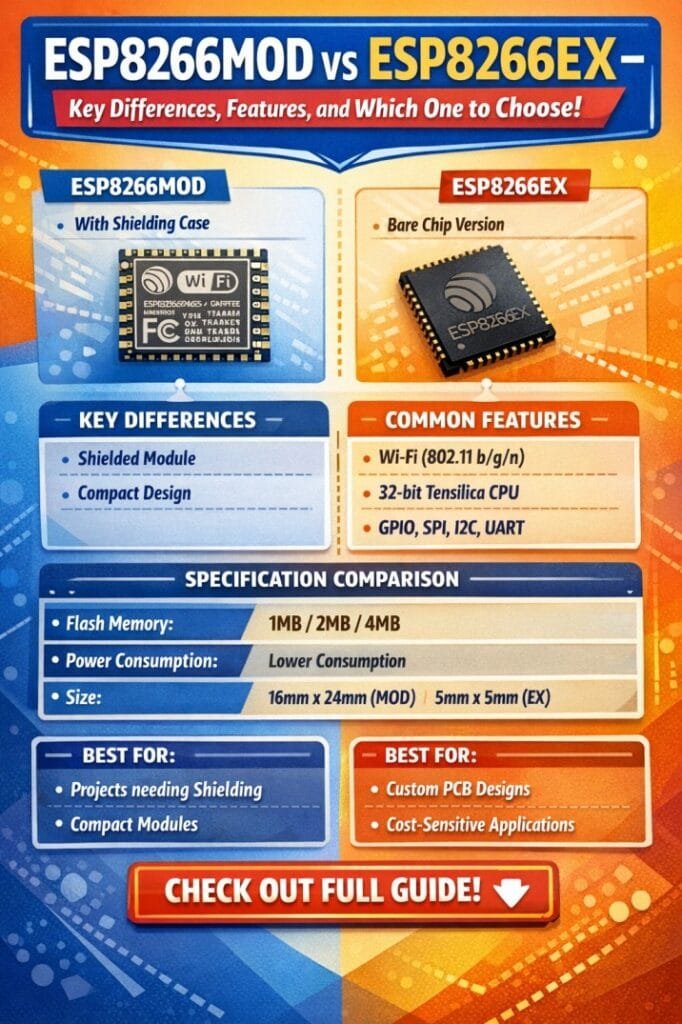
Table of Contents
The ESP8266 platform revolutionized the IoT industry by providing low-cost WiFi connectivity to microcontroller-based systems. However, many users encounter the terms ESP8266EX and ESP8266MOD when purchasing components or reading datasheets. These two are not identical, and the difference mainly lies in their hardware integration and application level.
This article provides a detailed explanation of esp8266mod vs esp8266ex, their architecture, features, specifications, and when to use each option in your electronics projects.
Know more about 28BYJ-48 Stepper Motor with the A4988 Stepper Driver
Understanding ESP8266EX
ESP8266EX is the actual WiFi System-on-Chip (SoC) manufactured by Espressif Systems. It is the core integrated circuit that contains the processor, WiFi transceiver, memory interface, and GPIO controllers required for wireless communication.
In simple terms, ESP8266EX is the main chip that powers most ESP8266-based modules available in the market.
This chip integrates a powerful 32-bit Tensilica L106 microcontroller along with a built-in TCP/IP stack and WiFi connectivity. Because of this integration, the chip can either act as a standalone microcontroller or function as a WiFi communication module connected to another MCU.
Some important internal blocks inside the ESP8266EX include:
- 32-bit microcontroller core
- WiFi radio and RF front end
- SRAM memory
- SPI interface for external flash
- GPIO pins
- ADC and PWM controllers
- UART and I2C communication interfaces
Due to its compact design, ESP8266EX is mainly used by hardware manufacturers when building WiFi modules or designing custom IoT boards.
Explore all about A4988 ESP32 GPIO Pinout
Key Features of ESP8266EX
| Feature | Description |
|---|---|
| Chip Type | WiFi SoC |
| CPU | 32-bit Tensilica L106 |
| Clock Speed | Up to 160 MHz |
| WiFi Standard | IEEE 802.11 b/g/n |
| GPIO Pins | Up to 17 |
| ADC | 10-bit ADC |
| Interfaces | UART, SPI, I2C, PWM |
| Operating Voltage | 3.0V – 3.6V |
Because ESP8266EX is a bare chip, it requires additional components such as an external flash memory, crystal oscillator, antenna circuit, and power regulation before it can function in a circuit.
Understanding ESP8266MOD
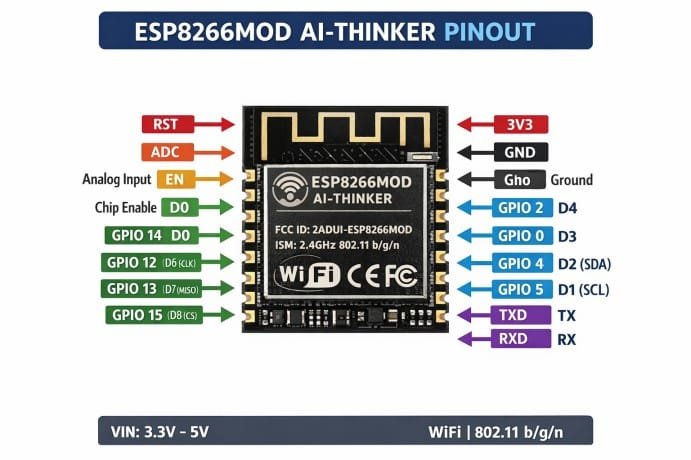
When comparing esp8266mod vs esp8266ex, ESP8266MOD refers to a ready-to-use module that contains the ESP8266EX chip along with all the required supporting components.
Manufacturers build these modules to simplify development and hardware integration. Instead of designing RF circuits and power management from scratch, engineers can simply integrate the module into their PCB.
Find all about How to Connect A4988 to ESP32
The ESP8266MOD package typically includes:
- ESP8266EX chip
- Flash memory
- Crystal oscillator
- Antenna or antenna connector
- RF matching circuit
- Voltage regulation support
Common examples of ESP8266 modules include:
- ESP-01
- ESP-07
- ESP-12E
- ESP-12F
- ESP-WROOM-02
These modules are widely used in IoT development boards, smart devices, and wireless sensors.
Key Features of ESP8266MOD
| Feature | Description |
|---|---|
| Product Type | Complete WiFi module |
| Core Chip | ESP8266EX |
| Integrated Components | Flash, antenna, oscillator |
| Development Complexity | Low |
| PCB Integration | Simple |
| Certification | Often FCC/CE certified |
| Ideal Use | IoT devices and prototypes |
Because the module integrates multiple components, developers can connect it directly to a microcontroller or power supply without designing RF circuitry.
Know more about ESP8266MOD Pinout
ESP8266MOD vs ESP8266EX: Key Differences
To clearly understand esp8266mod vs esp8266ex, it is helpful to compare them side by side. The primary difference lies in their level of integration and usability.
| Parameter | ESP8266EX | ESP8266MOD |
|---|---|---|
| Type | WiFi SoC Chip | Complete WiFi Module |
| Integration Level | Bare IC | Fully integrated module |
| Additional Components Required | Yes | No |
| Hardware Complexity | High | Low |
| Application | Custom hardware design | IoT product development |
| RF Design Needed | Yes | No |
| Development Speed | Slower | Faster |
From this comparison, it becomes clear that ESP8266EX is the core chip, while ESP8266MOD is the module built around that chip.
Find all about ESP8266MOD Programming WLED
Hardware Design Considerations
One of the biggest reasons engineers evaluate esp8266mod vs esp8266ex is related to hardware design complexity.
Using ESP8266EX
If you choose the ESP8266EX chip directly, you must design several supporting circuits including:
- RF antenna matching network
- External SPI flash
- Crystal oscillator
- Power supply filtering
- PCB antenna layout
RF design requires careful impedance matching and layout techniques. Any mistake can degrade WiFi performance or completely prevent communication.
Therefore, using the chip directly is usually recommended only for:
- Large scale production
- Custom PCB manufacturing
- Cost optimization in mass production
Know more about ESP12F vs ESP32
Using ESP8266MOD
Modules simplify hardware design significantly. The RF section and antenna tuning are already optimized by the manufacturer.
Advantages of using modules include:
- Faster development time
- Minimal RF design effort
- Better reliability
- Certified wireless performance
Because of these benefits, ESP8266MOD is widely used in prototyping and small-scale product development.
Performance Comparison
From a performance perspective, the esp8266mod vs esp8266ex comparison shows very little difference.
Since the module uses the same ESP8266EX chip internally, the processing capability and WiFi performance remain the same.
Both support:
- 802.11 b/g/n WiFi
- TCP/IP stack
- Station mode
- Access point mode
- Smart configuration
- Low power operation
The main difference lies not in performance but in hardware integration and ease of implementation.
Find all about a4988 microstepping
Power Consumption
Power efficiency is important for battery-powered IoT devices.
Both ESP8266EX and ESP8266MOD support multiple power modes:
| Power Mode | Description |
|---|---|
| Active Mode | Full WiFi communication |
| Modem Sleep | CPU active, WiFi idle |
| Light Sleep | Reduced power consumption |
| Deep Sleep | Ultra low power mode |
Because the same chip is used, power consumption values are almost identical between modules and the standalone chip.
Typical Applications
Understanding practical use cases helps clarify the esp8266mod vs esp8266ex decision.
Applications of ESP8266EX
ESP8266EX is typically used by hardware manufacturers in:
- Custom IoT devices
- Smart appliances
- Industrial controllers
- Smart meters
- Consumer electronics
These applications often require optimized PCB design and cost reduction in high-volume manufacturing.
Know more about nema 17 arduino a4988
Applications of ESP8266MOD
ESP8266MOD is widely used in:
- IoT prototypes
- Smart home devices
- WiFi sensors
- Arduino projects
- Wireless automation systems
- Embedded development boards
Because modules require fewer external components, they are perfect for quick development cycles.
Advantages and Disadvantages
The esp8266mod vs esp8266ex comparison becomes clearer when evaluating their advantages and limitations.
ESP8266EX Advantages
- Lower cost in mass production
- Full hardware design control
- Flexible antenna configuration
- Smaller footprint in custom designs
ESP8266EX Disadvantages
- Complex RF design
- Requires additional components
- Longer development time
- Higher design risk
Explore details on a4988 esp32
ESP8266MOD Advantages
- Plug-and-play integration
- Faster development
- Pre-tested RF design
- Suitable for beginners and professionals
ESP8266MOD Disadvantages
- Slightly higher cost per unit
- Larger PCB footprint
- Less hardware customization
Which One Should You Choose?
When deciding between esp8266mod vs esp8266ex, the best option depends on your project requirements and manufacturing scale.
Choose ESP8266MOD if:
- You are developing prototypes
- You want quick implementation
- You lack RF design experience
- You are building small-scale IoT devices
Choose ESP8266EX if:
- You are designing a custom PCB
- Your product will be mass produced
- You want to reduce per-unit manufacturing cost
- You have RF engineering expertise
Know more about ESP12F vs ESP8266: Comprehensive Comparison for IoT Projects and Smart Applications
For most developers, startups, and hobbyists, ESP8266MOD is the practical and convenient choice.
Final Thoughts
The debate around esp8266mod vs esp8266ex mainly revolves around integration and hardware complexity rather than performance. ESP8266EX is the powerful WiFi SoC at the heart of the platform, while ESP8266MOD packages this chip into an easy-to-use module with supporting components.
Both options deliver the same wireless capabilities, processing power, and IoT connectivity. The difference lies in how much hardware design work you want to handle.
For rapid development and reliable wireless performance, ESP8266MOD remains the preferred solution. On the other hand, ESP8266EX offers flexibility and cost benefits when designing custom products at scale.
Know more about esp8266 pinout
Understanding these differences helps engineers choose the right component and build efficient, reliable IoT systems using the ESP8266 ecosystem.
Follow Us on Social:
Subscribe our Newsletter on Electrical Insights for latest updates from Electrical Engineering Hub
#esp8266modvsexp8266ex, #esp8266, #iotdevelopment, #embeddedengineering, #wifimodule, #esp8266projects, #electronicsengineering, #microcontroller, #iotmodules, #esp8266guide