How to Size Motor Overload Protection: Step-by-Step Guide
Knowing how to Size Motor Overload Protection correctly is essential for keeping motors safe from overheating, winding damage, and unexpected shutdowns. Many motor failures happen because overload devices are either undersized or oversized. A properly selected overload relay improves motor life, prevents downtime, and ensures compliance with IEC and NEC standards.
Motor overload protection works by monitoring current over time. Unlike short-circuit protection, which reacts instantly, overload protection allows temporary inrush current while protecting against prolonged overcurrent conditions. This is why learning how to Size Motor Overload Protection is one of the most important steps in motor circuit design.
Whether you are working on industrial motors, pumps, conveyors, compressors, or HVAC systems, this guide explains the complete sizing process step by step.
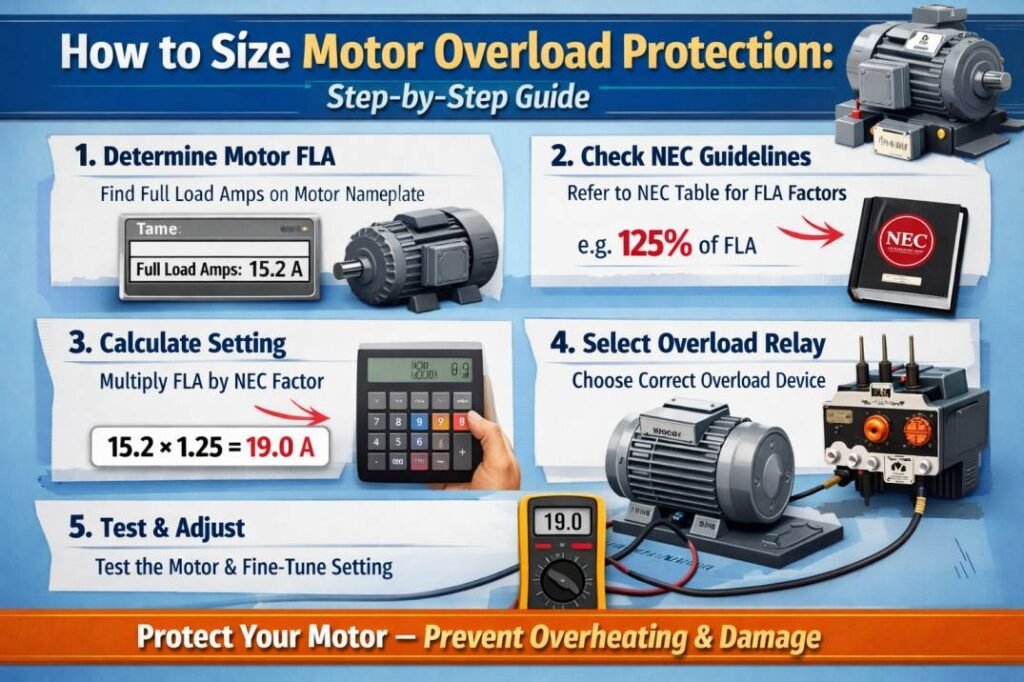
Table of Contents
Table of Contents
What Does “Sizing” Motor Overload Protection Mean?
Before you Size Motor Overload Protection, it is important to understand the difference between sizing and setting.
Many electricians confuse these two terms.
| Term | Meaning |
|---|---|
| Sizing | Selecting the correct overload relay range for the motor |
| Setting | Adjusting the dial or programmed value based on motor current |
For example, if a motor has an FLA of 32A, you may choose an overload relay with an adjustable range of 28–36A. That is sizing. If you set that relay at 34A, that is setting.
Find the exact setting using our Motor Overload Setting Table which includes 3 Phase Chart & Complete Guide
- Sizing comes first. Setting comes second.
- Choosing the wrong overload range can make the relay ineffective, even if the setting is correct.
- This is why the process to Size Motor Overload Protection must always start with accurate motor data.
Step 1 – Determine Motor Full Load Amps (FLA)
The first step to Size Motor Overload Protection is finding the motor’s Full Load Amps (FLA).
FLA is the current drawn by the motor when operating at rated load and voltage.
You can find it from:
- Motor nameplate
- Manufacturer datasheet
- Electrical code tables
- Motor current calculator
Typical motor nameplate values include:
| Parameter | Example |
|---|---|
| Voltage | 415V |
| Power | 15kW |
| Frequency | 50Hz |
| Full Load Current | 28A |
| Service Factor | 1.15 |
If the nameplate is missing, calculate FLA using:
FLA = P ÷ (√3 × V × PF × Efficiency)
Where:
- P = Motor power in watts
- V = Supply voltage
- PF = Power factor
- Efficiency = Motor efficiency
Use our online tool motor cable size calculator
For accurate results, it is better to use a dedicated motor FLA calculator instead of manual calculations.
Without correct FLA, it is impossible to Size Motor Overload Protection accurately.
Step 2 – Apply the Correct Sizing Margin
Once FLA is known, the next step is applying the proper overload margin.
Most standards recommend overload sizing between 115% and 125% of FLA.
The exact value depends on service factor.
Use this formula:
Overload Size = FLA × Margin %
Example:
Motor FLA = 30A
Margin = 115%
Overload size = 30 × 1.15 = 34.5A
This means the overload relay should cover this current range.
Standard sizing recommendations:
| Motor Type | Typical Margin |
|---|---|
| Standard motors | 115% |
| Motors with SF 1.15 or higher | 125% |
| Heavy-duty motors | 125% |
| Continuous duty motors | 115% |
Why not size exactly at FLA?
Because motors naturally draw slight overload current under changing load conditions. If you do not allow margin, nuisance tripping becomes common.
Correctly applying this margin is the foundation of how to Size Motor Overload Protection.
Know more about Types of Electric Motor Testing
Step 3 – Account for Service Factor and Ambient Temperature
This step is often ignored, but it can greatly affect overload performance.
Service Factor Impact
Service factor (SF) tells you how much overload the motor can safely handle.
Common values:
| Service Factor | Overload Multiplier |
|---|---|
| 1.0 | 115% |
| 1.15 | 125% |
Example:
FLA = 20A
SF = 1.15
Overload setting range:
20 × 1.25 = 25A
Ignoring service factor can lead to undersizing.
Ambient Temperature Impact
- Thermal overload relays are sensitive to temperature.
- High ambient temperatures can cause early tripping.
- Low ambient temperatures can delay tripping.
Temperature effects:
| Temperature | Impact |
|---|---|
| Above 40°C | Faster trip |
| Below 20°C | Slower trip |
If the motor panel is installed outdoors, near furnaces, or in hot process areas, choose temperature-compensated overload relays.
When engineers Size Motor Overload Protection, they must always consider operating environment.
Step 4 – Select the Overload Relay Type
Not all overload relays work the same way.
The type you choose affects accuracy and performance.
Thermal Overload Relays
These use bimetal strips.
Advantages:
- Simple
- Low cost
- Reliable
Best for:
- Standard induction motors
- Pumps
- Fans
Know more about Thermal Overload Relay
Electronic Overload Relays
These monitor current electronically.
Advantages:
- High accuracy
- Adjustable trip class
- Better temperature compensation
Best for:
- Industrial motors
- Variable loads
Know more about motor overload protection chart
Solid-State Overload Relays
Advanced protection with programmable features.
Advantages:
- Precise motor protection
- Data logging
- Fault diagnostics
Best for:
- Critical applications
- Automation systems
Comparison table:
| Type | Accuracy | Cost | Best Use |
|---|---|---|---|
| Thermal | Medium | Low | General use |
| Electronic | High | Medium | Industrial loads |
| Solid-state | Very High | High | Critical systems |
To properly Size Motor Overload Protection, relay type must match motor duty.
Sizing Motor Overload Protection for Special Applications
Some motor applications need special attention.
High-Inertia Loads
Examples:
- Crushers
- Conveyors
- Centrifuges
These motors have long acceleration times.
Use:
- Higher trip class (Class 20 or 30)
- Slightly higher overload range
Standard Class 10 may trip too early.
Frequent Start/Stop Duty
Examples:
- Hoists
- Elevators
- Press machines
Frequent starts generate heat quickly.
Recommendations:
- Electronic overload relays
- Monitor starts per hour
- Use higher thermal capacity
This improves motor protection coordination.
Know more about 3 phase motor winding resistance values formula
Ambient Temperature Extremes
Hot or cold environments change thermal relay behavior.
Best practice:
- Use ambient-compensated relays
- Avoid thermal-only protection in unstable environments
Application-specific conditions change how you Size Motor Overload Protection.
Common Motor Overload Sizing Mistakes
Even experienced electricians make mistakes.
Here are the most common ones.
1. Using Breaker Size Instead of FLA
Circuit breaker size is not motor current.
Always use motor FLA.
Wrong:
Breaker = 50A
Overload = 50A
Correct:
Motor FLA = 34A
Overload = based on 34A
2. Ignoring Service Factor
A motor with SF 1.15 can tolerate more load.
Ignoring it causes nuisance trips.
3. Choosing Too Wide a Relay Range
Example:
Motor FLA = 12A
Relay range = 8–32A
This reduces accuracy.
Choose tighter ranges.
4. Ignoring Ambient Temperature
Thermal relays behave differently in heat.
Always consider enclosure conditions.
5. Using Standard Trip Class for High Inertia Loads
Class 10 is not suitable for every application.
Sometimes Class 20 or Class 30 is needed.
Avoiding these mistakes makes it easier to Size Motor Overload Protection properly.
Know more about Best 7 Electric Motor Vibration Testers
Motor Overload Sizing Reference Table
This quick reference table helps in selecting overload relay ranges.
| Motor FLA Range | Recommended Overload Range | Notes |
|---|---|---|
| 1–5A | 1.15–6A | Small motors |
| 6–10A | 7–12A | Light duty |
| 11–20A | 12–24A | Standard applications |
| 21–40A | 24–45A | Medium motors |
| 41–60A | 45–70A | Heavy loads |
| 61–100A | 70–110A | Industrial motors |
| 101–150A | 110–160A | Large machinery |
Selection tips:
- Keep FLA near the middle of relay range
- Allow room for service factor
- Match trip class with load type
This table simplifies how to Size Motor Overload Protection in the field.
Know more about Motor Overload Protection Chart
Frequently Asked Questions
How do you size motor overload protection?
To Size Motor Overload Protection, first find the motor FLA from the nameplate. Then apply the correct multiplier, usually 115% to 125%, based on service factor and duty conditions. Finally, select an overload relay whose adjustable range covers that value.
What sizing margin should be used for motor overloads?
Most motors use 115% of FLA. Motors with a service factor of 1.15 often use 125%. Heavy-duty or high-inertia applications may need higher trip classes instead of larger current settings.
Does service factor affect overload sizing?
Yes. Service factor directly affects overload sizing. Motors with higher service factors can handle more current, allowing larger overload settings without causing damage.
What’s the difference between sizing and setting a motor overload?
Sizing means choosing the correct relay range. Setting means adjusting the relay to the actual trip current. Both are important, but sizing must always come first.
Correctly learning how to Size Motor Overload Protection improves reliability, protects motor windings, and reduces maintenance costs. Whether you are sizing protection for a small pump or a large industrial conveyor, always start with FLA, apply the right margin, and match the overload type to the application.
Follow Us on Social:
Subscribe our Newsletter on Electrical Insights for latest updates from Electrical Engineering Hub