220kv Cable Installation Underground: Step by Step
Introduction
The demand for reliable and space-efficient power transmission has increased the use of extra high voltage systems in modern grids. One of the most critical processes in this field is 220kv Cable Installation Underground, which allows bulk power transfer in urban and industrial zones without overhead line constraints. A well-planned installation ensures safety, minimal losses, and long-term system stability.
In large-scale projects, 220kv Cable Installation Underground requires detailed engineering studies, route optimization, and strict compliance with international standards. Any mistake at this voltage level can lead to costly outages or insulation failure, so each step must be carefully executed.
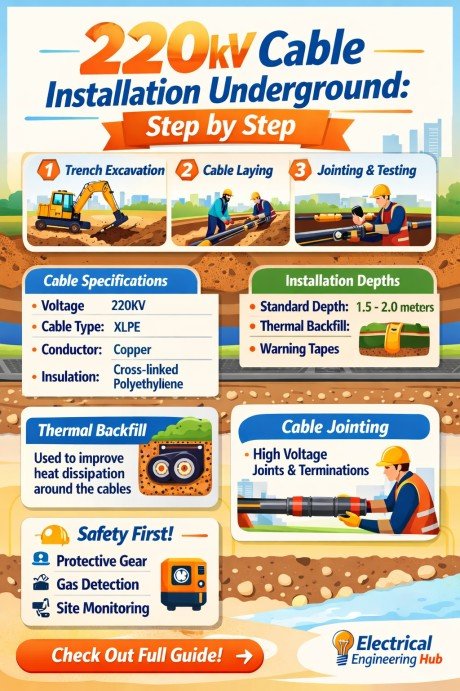
Table of Contents
Table of Contents
Planning and Safety Assessment
Before starting 220kv Cable Installation Underground, engineers conduct a comprehensive planning phase. This includes soil resistivity testing, environmental impact assessment, and load forecasting. Safety is the top priority because high-voltage underground systems operate under extreme electrical stress.
Know more about Why Power Cables Insulation Rated for High Voltage
A risk assessment is carried out to identify potential hazards such as thermal buildup, electromagnetic interference, and excavation risks. Proper grounding design and protective systems are also finalized at this stage.
Key Planning Parameters
| Parameter | Purpose | Typical Consideration |
|---|---|---|
| Soil Thermal Resistivity | Heat dissipation analysis | 0.8–1.5 K·m/W |
| Route Survey | Avoid obstacles | Roads, rivers, buildings |
| Load Forecast | Cable sizing | Peak + future expansion |
| Safety Clearance | Fault protection | Regulatory standards |
Route Survey and Alignment Design
Accurate route selection plays a vital role in 220kv Cable Installation Underground. Engineers use GIS mapping, drone surveys, and geotechnical investigations to finalize the cable path. The objective is to minimize bends, avoid unstable soil zones, and reduce installation cost.
During this phase, coordination with utilities such as water pipelines, gas lines, and telecom networks is essential. Proper separation distances are maintained to prevent interference and future maintenance issues.
The process is closely aligned with best practices in underground cable laying, ensuring long-term reliability and ease of access for maintenance teams.
Find all about IEC 60634 Cable Design
Cable Selection and System Design
Selecting the right cable type is crucial for 220kv Cable Installation Underground. Typically, cross-linked polyethylene (XLPE) insulated cables are preferred due to their high thermal resistance and dielectric strength.
Engineers also evaluate conductor size, metallic sheath type, and insulation thickness based on load demand and fault levels. Thermal backfill materials and duct bank systems are designed to enhance heat dissipation.
Cable System Components
| Component | Function | Material Used |
|---|---|---|
| Conductor | Current flow | Copper/Aluminum |
| Insulation | Electrical protection | XLPE |
| Metallic Sheath | Fault current return | Lead/Aluminum |
| Outer Jacket | Mechanical protection | HDPE |
Proper system design ensures that 220kv Cable Installation Underground operates efficiently under high load conditions without overheating or insulation stress.
Trenching, Ducting, and Civil Works
Civil construction is one of the most labor-intensive stages of 220kv Cable Installation Underground. Trenches are excavated according to design depth, usually ranging from 1.2 to 2 meters depending on soil conditions and protection requirements.
Duct banks made of concrete or HDPE pipes are installed to protect the cables from mechanical damage. Sand bedding and thermal backfill materials are placed to ensure uniform heat dissipation.
For Accurate and Easy Cable Capacity, use our online tool Cable Trench Fill Calculator
Drainage systems are also integrated to prevent water accumulation, which could affect insulation performance.
Cable Pulling and Installation Process
Once the ducts are ready, the actual 220kv Cable Installation Underground begins with cable pulling. Special tension-controlled winches are used to avoid excessive mechanical stress on the cable.
Lubricants are applied to reduce friction inside ducts, and pulling speed is carefully monitored. Communication between teams is essential to prevent sudden jerks or bending beyond permissible limits.
Intermediate pulling pits are used for long routes to reduce strain and ensure smooth installation.
Jointing and Termination Work
Jointing is one of the most sensitive stages in 220kv Cable Installation Underground. High-voltage joints must be installed in controlled environments to avoid contamination and partial discharge risks.
Skilled technicians perform straight-through joints and terminations using heat-shrink or cold-shrink technologies. Proper stress control layers are applied to maintain uniform electric field distribution.
Any minor error in this stage can significantly impact system reliability, making precision extremely important.
Discover our Electrical Cable Sizing Tools, a great resource for all types of cable calculations. It includes cable calculators for generators, transformers, earthing, and more.
Testing and Commissioning
After installation, 220kv Cable Installation Underground undergoes a series of electrical tests to verify insulation integrity and system readiness. These include high voltage withstand tests, partial discharge testing, and sheath integrity checks.
Testing Checklist
| Test Type | Purpose | Acceptance Criteria |
|---|---|---|
| HV Test | Insulation strength | No breakdown |
| Partial Discharge | Detect defects | Within limits |
| Continuity Test | Conductor check | Zero interruption |
| Sheath Test | Leakage detection | No faults |
Once all tests are successfully completed, the system is gradually energized under controlled conditions.
Know more about Cable Gland Size Chart Hawke: Best NEC-Compliant Sizing & Industrial Application Guide
Key Takeaways
- 220kv systems require precise engineering at every stage to ensure reliability.
- Proper route selection reduces installation risks and long-term maintenance issues.
- XLPE cables are widely used due to superior thermal and dielectric properties.
- Jointing and termination are the most sensitive steps in the entire process.
- Testing ensures that the system is safe before energization and grid integration.
Maintenance Considerations
Even after successful installation, 220kv Cable Installation Underground requires periodic monitoring. Thermal scanning, sheath voltage checks, and insulation resistance tests help in identifying early-stage faults. Preventive maintenance extends cable life and reduces unexpected outages.
Environmental and Urban Challenges
In modern cities, underground high-voltage systems must coexist with dense infrastructure. 220kv Cable Installation Underground often faces challenges such as limited excavation space, traffic management, and environmental restrictions. Proper planning and stakeholder coordination help in overcoming these constraints effectively.
Use this tool if you are trying to calculate cable size for underground cables. Try here Underground Cable Size Calculator – Find Correct Wire Size for Long Distance Runs
Conclusion
A well-executed 220kv Cable Installation Underground project ensures efficient power transmission with minimal environmental impact. From planning and design to testing and commissioning, each stage demands technical accuracy and coordination. When properly implemented, underground transmission systems provide long-term stability, improved safety, and enhanced urban infrastructure reliability.
FAQs
1. What is the typical depth for 220kv underground cable installation?
The depth usually ranges between 1.2 to 2 meters depending on soil conditions and protection requirements.
2. Why is XLPE used in high voltage underground cables?
XLPE offers excellent thermal resistance and high dielectric strength, making it ideal for high-voltage applications. We recommend this tool for anyone struggling with the sizing of subpanels. Try here Wire Size Calculator for Subpanels and Feeders – NEC Guidelines Included
3. How long does a 220kv underground cable installation project take?
It depends on route length and conditions, but large projects can take several months to over a year.
4. What are the main risks in underground high voltage installation?
Common risks include insulation failure, thermal overheating, mechanical damage, and jointing defects.
5. How is safety ensured during installation?
Safety is ensured through proper planning, insulation testing, grounding systems, and strict adherence to international standards.
You might find this tool useful for tackling similar tasks Sub Panel Wire Size Calculator – Accurate Wire Gauge & Load Sizing Tool
Follow Us on Social:
Subscribe our Newsletter on Electrical Insights for latest updates from Electrical Engineering Hub
#220kVCableSystem,#UndergroundCableInstallation,#HighVoltageCables,#220kVTransmission,#CableLayingStandards,#PowerCableEngineering,#UndergroundPowerSystem,#HVInstallationGuide,#ElectricalInfrastructure,#CableSystemDesign