
DC Busway Size Calculator
Choosing the right DC busway size is one of the most important steps in any direct current power distribution system. Whether you are working on battery banks, solar installations, EV charging systems, or industrial DC panels, proper sizing improves safety, efficiency, and performance.
A DC Busway Size Calculator helps engineers, technicians, and installers determine the required busway dimensions based on current, voltage drop, conductor material, and temperature rise. Without proper calculation, a busway may overheat, waste energy, or fail under load.
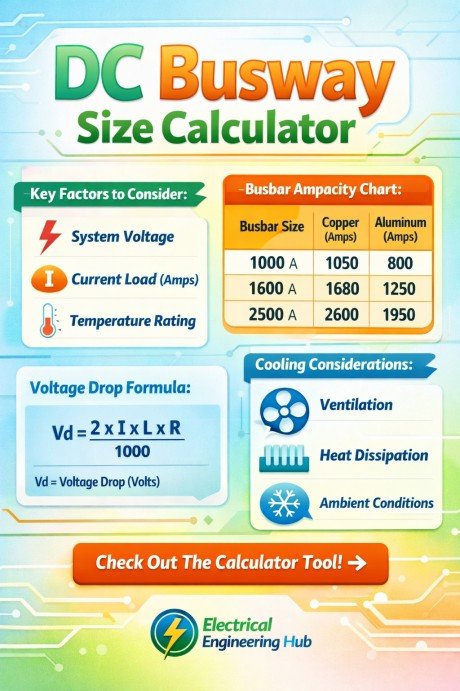
Table of Contents
Table of Contents
This guide explains how a DC Busway Size Calculator works, why it matters, and how to use it correctly in practical applications.
Use our online tool Busbar Size Calculator – Accurate Sizing According to IEC and NEC Standards
What Is a DC Busway?
A DC busway is a metal conductor system designed to carry direct current from one point to another. Unlike AC systems, DC systems have continuous current flow, which makes conductor sizing more critical due to heat buildup and voltage drop.
Busways are widely used in:
- Solar power plants
- Battery storage systems
- Data centers
- Telecom systems
- Electric vehicle charging stations
- Industrial automation
The right busway size ensures stable current flow and reduces system losses.
Find out more about Busbar Stability Test Procedure – Step-by-Step Method to Ensure Safe and Reliable Busbars
DC Busway Size Calculator
DC Busway Size Calculator
Estimate ampacity-based busway size, voltage drop, and power loss for DC distribution systems
System Inputs
Results
How to Use This Calculator
- Select the application type that best matches your DC system, such as solar arrays, battery banks, EV charging buses, or industrial DC distribution.
- Enter the system DC voltage and the actual or expected load current that the busway must carry continuously.
- Specify the one-way cable or busway run length between source and load, and the number of parallel busway runs if the load is split across more than one path.
- Choose the conductor material, ambient temperature range, allowable voltage drop, and installation enclosure type to reflect real site conditions.
- Click Calculate to view the recommended current rating class, voltage drop percentage, estimated power loss, and any sizing warnings.
- Always confirm the final busway selection against the manufacturer datasheet and a licensed electrical engineer before procurement or installation.
Technical Notes
Why DC Busway Sizing Differs From AC
DC distribution does not experience reactance or skin effect in the same way AC systems do, so busway sizing for DC service is driven primarily by continuous current capacity, conductor temperature rise, and the permissible voltage drop over the run length. Because DC voltage drop accumulates linearly along the full circuit length without the partial cancellation effects seen in some AC arrangements, longer DC runs at low system voltages are especially sensitive to undersizing.
Continuous Current and Derating
A busway should be selected so its rated continuous current capacity comfortably exceeds the actual operating current, with margin reserved for ambient temperature rise, enclosure ventilation limits, and any future load growth. Hot enclosures and outdoor installations reduce the effective current-carrying capacity of a given busway size compared to open, well-ventilated conditions, which is why ambient and enclosure conditions are treated as independent derating factors rather than being ignored.
Voltage Drop Sensitivity in Low Voltage DC Systems
Low voltage DC systems such as 12V, 24V, and 48V solar or battery installations are far more sensitive to voltage drop in percentage terms than higher voltage industrial DC buses, because the same absolute voltage loss represents a much larger fraction of the total system voltage. This is why solar and battery applications typically target tighter voltage drop limits than industrial DC distribution operating at higher bus voltages.
Parallel Busway Runs
Splitting a large DC load across multiple parallel busway runs reduces the current carried by each individual run and can also reduce effective resistance of the combined path, which lowers overall voltage drop and heat generation. Parallel runs must be sized, terminated, and balanced carefully so that current divides evenly; uneven terminations or mismatched run lengths can cause one busway to carry a disproportionate share of the load.
Material Selection
Copper busbar offers higher conductivity for a given cross section and is generally preferred for compact, high-current, or space-constrained installations such as battery banks and EV charging buses. Aluminum busbar is lighter and more economical for larger industrial DC distribution runs where additional cross-sectional area is acceptable in exchange for material cost savings.
Termination and Connection Quality
Busway performance depends heavily on connection quality at joints, lugs, and termination points, since a poorly torqued or corroded joint introduces localized resistance that can cause hotspots regardless of how well the busway itself is sized. Routine thermal inspection of termination points is considered good practice for high current DC busway installations.
Why Use a DC Busway Size Calculator?
Manual calculations can take time and may lead to mistakes. A DC Busway Size Calculator simplifies this process by providing quick and accurate results.
Here are the main benefits:
| Benefit | Description |
|---|---|
| Accuracy | Reduces sizing errors |
| Safety | Prevents overheating |
| Efficiency | Minimizes voltage losses |
| Time Saving | Faster than manual methods |
| Cost Control | Avoids oversizing |
By using a calculator, you can design your DC distribution system with confidence.
Find all about Busbar Bending Calculation
Key Factors in DC Busway Sizing
A DC Busway Size Calculator usually considers several important factors.
Current Load
Current is the primary factor. Higher current requires a larger conductor cross-section.
For example:
| Load Current | Recommended Busway Thickness |
|---|---|
| 100A | Small |
| 300A | Medium |
| 600A | Large |
| 1000A+ | Extra Large |
Always include future expansion when sizing.
Find all about Busbar Size Chart in mm
Voltage Drop
Voltage drop affects system efficiency. In DC systems, excessive voltage drop can cause major performance issues.
The common acceptable values are:
- 2% for critical systems
- 3% for general systems
- 5% maximum for non-critical systems
A good DC Busway Size Calculator helps maintain voltage within these limits.
Material Type
Busways are mainly made from copper or aluminum.
| Material | Conductivity | Cost |
|---|---|---|
| Copper | High | Higher |
| Aluminum | Moderate | Lower |
Copper allows smaller dimensions for the same current.
Ambient Temperature
Higher temperatures reduce current-carrying capacity. If the installation area is hot, the busway size may need adjustment.
Installation Method
Busways inside enclosed panels need better thermal consideration compared to open-air installations.
Know more about Busbar Distance Calculation – Complete Guide, Formula, Standards & Design Tips
How a DC Busway Size Calculator Works
The basic formula behind most calculators is simple.
Current density formula:
| Formula | Meaning |
|---|---|
| A = I / J | Area = Current / Current Density |
Where:
- A = Cross-sectional area
- I = Current
- J = Current density
For copper, common current density values are:
| Application | Current Density |
|---|---|
| Normal Duty | 1.2–1.5 A/mm² |
| Heavy Duty | 0.8–1.0 A/mm² |
For example:
If current is 500A and current density is 1.2 A/mm²:
Area = 500 / 1.2
Area = 416.6 mm²
This gives the minimum required busway area.
Know more about Busbar Heating Calculation | Important Guide for Electrical Design & Thermal Analysis
Key Takeaways
- A DC Busway Size Calculator improves accuracy and speeds up design.
- Current load, voltage drop, and temperature are the main sizing factors.
- Copper busways offer better conductivity than aluminum.
- Always consider future load growth.
- Proper busway sizing reduces energy losses and increases system life.
Step-by-Step Example of DC Busway Sizing
Let’s consider a real-world example.
System details:
| Parameter | Value |
|---|---|
| Voltage | 48V DC |
| Current | 800A |
| Length | 10 meters |
| Material | Copper |
| Max Voltage Drop | 2% |
Step 1: Determine allowable voltage drop.
2% of 48V = 0.96V
Find all about Busbar Kg Calculation | Accurate Copper & Aluminum Busbar Weight Formula for Electrical Design
Step 2: Calculate conductor area.
Using 1.2 A/mm²:
Area = 800 ÷ 1.2
Area = 666.7 mm²
Step 3: Check thermal rise.
Step 4: Verify voltage drop.
Step 5: Finalize dimensions.
This is where a DC Busway Size Calculator makes the process much faster.
DC Busway Size vs Busbar Size
Many users confuse busways with busbars. Both carry current, but their applications differ.
| Feature | DC Busway | Busbar |
|---|---|---|
| Structure | Enclosed system | Open conductor |
| Safety | Higher | Moderate |
| Cooling | Controlled | Natural |
| Installation | Modular | Fixed |
If you also work with open conductor systems, try our Busbar Size Calculator for fast and accurate sizing.
This tool helps compare both options and improves system planning.
Find also about Busbar Sizing Rule of Thumb: Practical Engineer’s Guide for Accurate Panel Busbar Selection
Common Mistakes in Busway Sizing
Even with a DC Busway Size Calculator, some mistakes are common.
Ignoring Temperature Derating
This can lead to overheating.
Not Considering Expansion
Future loads may exceed capacity.
Choosing Based on Cost Only
Cheaper materials may increase losses.
Skipping Voltage Drop Check
This affects equipment performance.
Wrong Current Density Assumptions
Always follow design standards.
Avoiding these mistakes improves system reliability.
Know more about Bus Bar Current Rating Calculation: Practical Method for Accurate Sizing and Load Capacity
Applications of DC Busway Systems
DC busways are becoming more popular due to the rise of renewable energy and battery storage.
Main applications include:
- Solar DC combiner systems
- Battery energy storage systems
- Electric buses
- Railway traction systems
- UPS systems
- Telecom power systems
A DC Busway Size Calculator is especially useful in these systems because DC loads are often continuous.
Best Practices for Accurate Busway Calculation
To get the best results:
- Use actual load values
- Apply diversity factors carefully
- Choose correct conductor material
- Check ambient temperature
- Verify voltage drop
- Follow IEC and NEC guidelines
These practices improve both safety and efficiency.
Use our online tool Bus Duct Size Calculator
Conclusion
A DC Busway Size Calculator is an essential tool for designing safe and efficient DC power systems. It simplifies complex calculations and helps prevent costly design errors.
From solar farms to battery storage and industrial systems, correct busway sizing ensures smooth operation and long-term reliability.
By considering current, voltage drop, temperature, and conductor material, you can select the ideal busway size for your application. Using proper calculation tools saves time, improves safety, and increases system efficiency.
If your project also involves busbars, the Busbar Size Calculator can help you quickly size open conductors for better system planning.
FAQs
What is a DC Busway Size Calculator?
A DC Busway Size Calculator is a tool used to determine the correct conductor size for direct current systems based on load and design factors.
Why is DC busway sizing important?
Proper sizing prevents overheating, voltage drop, and energy loss.
Which is better for DC busways, copper or aluminum?
Copper is usually better because of higher conductivity, but aluminum is cheaper.
How much voltage drop is acceptable in DC systems?
Most systems use 2% to 3% as the acceptable voltage drop range.
Can I use the same calculator for AC and DC busways?
No. AC and DC systems have different design considerations, so separate calculators are recommended.
Follow Us on Social:
Subscribe our Newsletter on Electrical Insights for latest updates from Electrical Engineering Hub
#DCBuswaySizeCalculator,#DCBusway,#BuswayCalculator,#ElectricalEngineering,#PowerDistribution,#DCCalculation,#BusbarSizing,#ElectricalTools,#EngineeringCalculator,#PowerSystemDesign
DC Busway Size Calculator : Electrical Engineering Hub

Use the DC Busway Size Calculator to quickly determine the correct busway size for your DC power system with accurate and reliable results.
Price Currency: USD
Operating System: Web Browser
Application Category: UtilitiesApplication