Hipot Leakage Current Test Setting
Electrical insulation testing is one of the most critical safety checks in electrical engineering, especially when verifying the integrity of cables, motors, transformers, and switchgear. Among these tests, high potential testing plays a key role in ensuring that equipment can withstand overvoltage conditions without failure.
In practical applications, engineers often focus on correct configuration, especially the leakage current Test Setting limit, test voltage level, and trip settings to avoid false failures while still ensuring safety compliance. Proper configuration directly affects reliability, safety margins, and compliance with international standards such as IEC and IEEE.
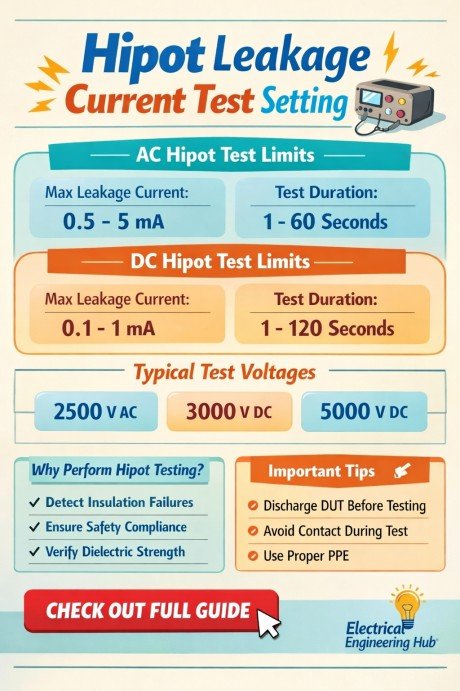
Table of Contents
Table of Contents
Understanding High Potential Testing in Electrical Systems
High potential testing, commonly known as hipot testing, is used to verify the dielectric strength of insulation. The test applies a voltage significantly higher than the normal operating voltage to detect weaknesses in insulation systems. If the insulation is weak, current will leak through unintended paths, indicating potential breakdown risks.
Findt all about AC Hipot Test Procedure for Cables
This method is widely used in manufacturing, maintenance, and commissioning stages. It helps identify defects such as pinholes in cable insulation, contamination, moisture ingress, and aging effects. Engineers also rely on insulation resistance measurements before performing this test to ensure baseline safety.
For a deeper technical breakdown of insulation testing methods, you can refer to hipot testing which explains how dielectric strength evaluation is performed in different electrical equipment.
Importance of Leakage Current Test Setting Control
Leakage current is the small amount of current that flows through insulation when high voltage is applied. In ideal insulation, this current should be extremely low. However, every material has some degree of leakage depending on temperature, humidity, and material quality.
The correct leakage current Test Setting is important because:
- Too low a limit may cause false tripping even in healthy equipment
- Too high a limit may allow defective insulation to pass the test
- Environmental conditions can influence measured leakage values
- Equipment class and voltage rating determine acceptable limits
Know more about Top 12 AC Hipot Tester Phenix Suppliers in USA
Modern hipot testers allow programmable leakage current thresholds to ensure consistency across repeated tests. This is especially important in mass production environments where repeatability is essential.
Typical Test Parameters and Their Role
Electrical engineers configure multiple parameters before performing dielectric testing. These settings must be aligned with product specifications and safety requirements.
Common Test Settings Overview
| Parameter | Description | Typical Range |
|---|---|---|
| Test Voltage | Applied high voltage for insulation stress | 500V to 10kV+ |
| Leakage Current Limit | Maximum allowable current before trip | 0.1 mA to 10 mA |
| Ramp Time | Time taken to reach test voltage | 1 to 60 seconds |
| Dwell Time | Duration of applied voltage | 1 to 300 seconds |
| Trip Sensitivity | Response level for fault detection | Adjustable |
Correct adjustment of these parameters ensures that insulation defects are detected without damaging good equipment.
Find all about AC Hipot Tester TOS5200 Suppliers in USA
Relationship Between Test Voltage and Insulation Stress
The applied voltage is usually calculated based on equipment rated voltage. A common rule is to apply twice the rated voltage plus an additional safety margin. This ensures that insulation is tested beyond normal operating stress conditions.
During testing, the insulation behaves like a capacitor, and the current includes both capacitive and resistive components. The resistive component is the leakage current, which is the primary indicator of insulation quality.
Temperature and humidity can significantly affect readings, so tests are often conducted under controlled environmental conditions.
Safety Standards and Compliance Considerations
International standards such as IEC 60270 and IEC 60060 define guidelines for high voltage testing and acceptable leakage limits. Compliance ensures safety and reliability across different industries including power generation, manufacturing, and renewable energy systems.
Understanding these standards is essential for engineers to avoid over-testing or under-testing equipment. It also helps in maintaining consistency between different testing facilities.
For conceptual clarity on industry standards and methods, refer to hi-pot testing explained which provides a practical breakdown of testing procedures and safety considerations.
Know more about Hipot Test Parameters UL 60335
Step-by-Step Configuration Approach
Setting up a dielectric withstand test requires careful planning. Engineers typically follow a structured approach to ensure accuracy and safety.
Standard Configuration Steps
- Identify rated voltage of equipment
- Determine appropriate test voltage based on standards
- Set leakage current threshold according to device class
- Configure ramp-up and dwell time
- Perform pre-check insulation resistance test
- Execute test under controlled conditions
- Record leakage current trend and final readings
This systematic approach minimizes errors and improves repeatability in industrial environments.
Know more about VLF Testing vs Hipot
Key Takeaways
- Leakage current reflects insulation health under high voltage stress
- Proper configuration prevents false failures and ensures accurate results
- Test voltage selection is based on equipment rating and safety standards
- Environmental conditions can significantly influence test outcomes
- Compliance with IEC standards ensures safe and reliable testing practices
- Structured setup improves repeatability in production and maintenance environments
Common Problems and Troubleshooting Insights
In real-world applications, engineers often face issues during testing. Some common problems include unexpected tripping, unstable readings, and inconsistent results across batches.
Possible causes include:
- Moisture or contamination on insulation surfaces
- Incorrect grounding or poor test setup
- Inappropriate leakage current threshold
- Aging cables or degraded insulation material
- Electromagnetic interference in the test environment
Correcting these issues usually involves recalibration, cleaning test specimens, or adjusting environmental conditions.
Application Areas of High Voltage Insulation Testing
This testing method is widely applied across several industries:
- Power distribution equipment
- Electric motors and transformers
- Cable manufacturing plants
- Renewable energy systems such as solar inverters
- Industrial control panels and switchgear
Know more about AC Hipot Test Acceptable Leakage Current
Each application requires slightly different settings depending on voltage class and insulation design.
FAQs
1. Why is leakage current important in high voltage testing?
Leakage current indicates how much current is passing through insulation. Higher values suggest weak or damaged insulation, which may fail under operating conditions.
2. What happens if the leakage current limit is set too low?
If set too low, even good insulation may cause false tripping, leading to unnecessary rejection of healthy equipment.
3. Can environmental conditions affect test results?
Yes, humidity, temperature, and surface contamination can significantly change leakage current readings during testing.
4. Is hipot testing safe for all electrical equipment?
It is safe when performed according to standards and manufacturer guidelines. However, sensitive electronics may require special precautions.
5. How often should high voltage insulation testing be performed?
It depends on equipment type. Manufacturing units may test every unit, while maintenance testing is usually done periodically based on operational criticality.
Final Engineering Insight
Correct configuration of leakage thresholds, voltage levels, and timing parameters ensures reliable insulation evaluation. When performed with proper understanding and compliance, high voltage testing becomes a powerful tool for preventing electrical failures and improving system safety across industrial applications.
Follow Us on Social:
Subscribe our Newsletter on Electrical Insights for latest updates from Electrical Engineering Hub
#hipotleakagecurrenttestsetting,#hipottest,#leakagecurrent,#highvoltagetest,#electricaltesting,#insulationtest,#hipottester,#safetytesting,#dielectrictest,#electricalmaintenance