Hipot Test Parameters UL 60335: Ultimate Guide for Safe Testing
Electrical safety verification is a critical requirement for household and commercial appliances, and one of the most important procedures in this process is dielectric withstand testing. In UL standards, engineers often refer to Hipot Test Parameters UL 60335 when designing, validating, and certifying products for market compliance. This guide explains everything in a practical and structured way so technicians, engineers, and quality inspectors can apply it confidently in real testing environments.
Understanding insulation integrity is not just about passing a certification test; it directly impacts user safety, product lifespan, and regulatory approval. That is why clear interpretation of Hipot Test Parameters UL 60335 is essential for manufacturers dealing with motors, heating devices, kitchen appliances, and power equipment.
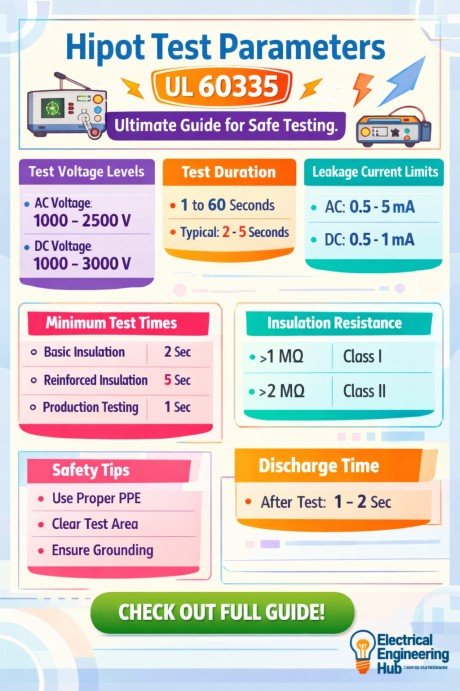
Table of Contents
Table of Contents
What is Hipot Testing in UL 60335 Applications
Hipot testing, also known as dielectric withstand testing, is used to verify whether insulation between live parts and exposed metal parts can handle high voltage without breakdown. In UL 60335 appliances, this ensures that users are protected from electric shock even under fault conditions.
In simple terms, the test applies a high voltage between conductors and ground to confirm insulation strength. Any leakage current beyond acceptable limits indicates insulation failure.
For deeper technical understanding, you can explore this guide on hipot testing which explains the fundamentals in industrial applications.
When analyzing Hipot Test Parameters UL 60335, engineers typically focus on test voltage level, duration, leakage current limits, and environmental conditions during testing.
Know more about VLF Testing vs Hipot
Key Parameters Defined Under UL 60335
The structure of Hipot Test Parameters UL 60335 revolves around controlled electrical stress applied to insulation systems. These parameters ensure consistency and repeatability across laboratories and production lines.
Core Electrical Parameters
Below is a simplified table showing typical parameters used in compliance testing:
| Parameter Type | Description | Typical Requirement (UL 60335) |
|---|---|---|
| Test Voltage | Applied AC or DC high voltage | 1000V to 3000V AC depending on device |
| Test Duration | Time for voltage application | 1 to 60 seconds |
| Leakage Current Limit | Maximum allowable current flow | Usually < 5 mA |
| Ramp-Up Time | Time to reach test voltage | Controlled gradual increase |
| Environmental Condition | Ambient temperature & humidity | Standard lab conditions |
Every element of Hipot Test Parameters UL 60335 is designed to simulate real-world stress conditions that insulation may face during operation or surge events.
Importance of Safety Compliance in Electrical Testing
Safety compliance is not optional when dealing with electrical appliances. UL 60335 ensures that even under abnormal voltage spikes, insulation does not fail catastrophically.
Know more about AC Hipot Test Acceptable Leakage Current
Manufacturers who ignore proper Hipot Test Parameters UL 60335 risk product recalls, fire hazards, and regulatory rejection. Therefore, compliance testing is integrated into production and quality assurance workflows.
For a deeper breakdown of test methodology, refer to hi-pot testing explained which provides a structured overview of equipment setup and measurement principles.
Equipment Setup and Testing Procedure
To maintain accuracy in Hipot Test Parameters UL 60335, proper test equipment configuration is essential. A typical setup includes a hipot tester, grounding system, safety interlocks, and calibration-certified probes.
Standard Testing Procedure
- Connect the device under test (DUT) securely
- Ensure grounding continuity
- Set required voltage based on insulation class
- Gradually increase voltage to target level
- Hold for specified duration
- Monitor leakage current continuously
- Record pass or fail result
Common Equipment Used
| Equipment Type | Function |
|---|---|
| Hipot Tester | Generates high voltage output |
| Insulation Tester | Measures resistance levels |
| Safety Interlock | Prevents accidental operator exposure |
| Leakage Current Meter | Detects breakdown in insulation |
Correct application of Hipot Test Parameters UL 60335 ensures that test results are reliable and compliant with UL certification standards.
Explore all about AC Hipot Tester Price in Canada
Key Takeaways
- Hipot testing validates insulation strength under high voltage stress
- UL 60335 defines strict safety requirements for household appliances
- Proper setup reduces risk of false failure or equipment damage
- Leakage current is a critical indicator of insulation quality
- Controlled voltage ramping improves measurement accuracy
- Compliance ensures product safety and regulatory approval
Understanding these points helps engineers apply Hipot Test Parameters UL 60335 effectively in real-world environments.
Acceptance Criteria and Failure Conditions
In UL 60335 testing environments, pass/fail decisions are based on strict electrical thresholds. Any deviation from defined Hipot Test Parameters UL 60335 can indicate insulation weakness or manufacturing defects.
Acceptance Criteria Table
| Condition | Result Interpretation |
|---|---|
| Stable leakage current | Pass |
| Sudden current spike | Fail |
| Insulation breakdown | Fail |
| No visible arc | Pass |
A proper evaluation system ensures consistency across production batches and prevents unsafe products from reaching consumers.
Find all about AC Hipot Tester TOS5200 Suppliers in USA
Common Mistakes in Hipot Testing
Even experienced technicians sometimes misinterpret Hipot Test Parameters UL 60335, leading to inaccurate results. Common issues include incorrect grounding, improper voltage selection, and ignoring environmental factors.
Avoiding these mistakes improves reliability and reduces testing rework significantly. Know more about Top 12 AC Hipot Tester Phenix Suppliers in USA
Frequently Asked Questions
1. What is the purpose of Hipot Test Parameters UL 60335?
It defines standardized electrical stress conditions to verify insulation safety in appliances under UL 60335 requirements.
2. How long is a typical hipot test performed?
Most tests last between 1 and 60 seconds depending on product category and safety classification.
3. What happens if leakage current exceeds limits?
If leakage current exceeds defined limits, the product fails the Hipot Test Parameters UL 60335 evaluation and requires redesign or insulation improvement.
4. Is hipot testing destructive?
Normally it is non-destructive, but weak insulation may fail during testing, revealing hidden defects.
5. Why is UL 60335 important in electrical safety?
It ensures household appliances meet strict international safety standards, reducing risk of electric shock and fire hazards.
Findt all about AC Hipot Test Procedure for Cables
Conclusion
Proper understanding and implementation of Hipot Test Parameters UL 60335 is essential for ensuring electrical safety, regulatory compliance, and product reliability. Manufacturers who follow structured testing methods reduce failure rates and improve consumer trust.
From voltage selection to leakage current monitoring, every detail in Hipot Test Parameters UL 60335 contributes to a safer electrical ecosystem. Engineers and quality inspectors must treat these parameters as a core part of product validation rather than a final checkpoint alone.
Follow Us on Social:
Subscribe our Newsletter on Electrical Insights for latest updates from Electrical Engineering Hub
#HipotTestParametersUL60335,#HipotTest,#UL60335,#ElectricalSafety,#DielectricWithstandTest,#HighVoltageTest,#ComplianceTesting,#SafetyStandards,#QualityAssurance,#HVTesting