IEC 60634 Cable Design: Essential Guide for Reliable Cable Systems
Reliable electrical infrastructure depends heavily on correct cable engineering, installation practices, and compliance with international standards. One of the important references used in modern electrical projects is IEC 60634 Cable Design, which guides engineers in developing safe, efficient, and long-lasting cable systems. Proper understanding of IEC 60634 Cable Design ensures reduced failures, improved safety, and optimized performance in industrial and commercial installations.
In today’s power systems, cable selection is not just about current rating but also about insulation coordination, thermal stability, voltage drop control, and environmental considerations. IEC 60634 provides structured guidance that helps engineers address these challenges with consistency and technical accuracy.
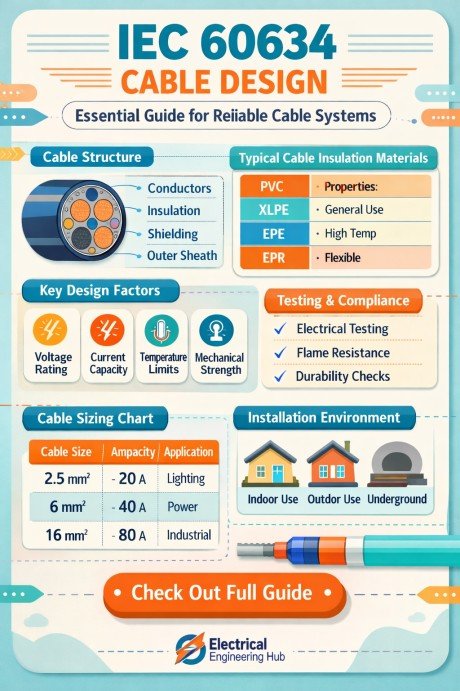
Table of Contents
Importance of Standardized Cable Engineering Practices
In modern electrical networks, uniform engineering practices are essential to avoid inconsistencies and system failures. IEC 60634 Cable Design establishes a framework that supports reliable cable sizing, insulation selection, and installation methodology.
Explore all about IEC 60364 5 52
The first key aspect of IEC 60634 is ensuring compatibility between electrical load demands and conductor capacity. This reduces overheating risks and extends system life. Another important aspect is maintaining mechanical strength under varying environmental conditions, especially in underground and industrial cable routes.
| Parameter | Design Consideration | Engineering Impact |
|---|---|---|
| Current Carrying Capacity | Load demand vs conductor size | Prevents overheating |
| Insulation Type | Voltage level and environment | Enhances safety |
| Thermal Performance | Ambient temperature influence | Improves reliability |
| Mechanical Protection | Installation environment | Reduces physical damage |
In practical engineering projects, IEC 60634 Cable Design is often applied alongside grounding and protection systems. For example, integration with proper earthing practices is critical. You can also explore detailed system coordination through this reference on IEC 60364 earthing which complements cable safety and fault protection design.
Conductor Selection and Electrical Performance Factors
A key element in IEC 60634 Cable Design is the selection of appropriate conductor material and cross-sectional area. Copper and aluminum are widely used depending on cost, conductivity, and installation requirements.
Find all about IEC 60364-6
IEC 60634 Cable Design ensures that conductor sizing is not only based on current rating but also voltage drop limits and short-circuit withstand capacity. This helps maintain system stability during both normal and fault conditions.
Proper design also considers harmonics in modern electrical systems. Non-linear loads can cause additional heating, and IEC 60634 Cable Design addresses this by recommending derating factors in specific conditions.
| Conductor Type | Advantages | Limitations |
|---|---|---|
| Copper | High conductivity, durability | Higher cost |
| Aluminum | Lightweight, economical | Lower conductivity |
| ACSR | High tensile strength | Complex termination |
By following IEC 60634 principles, engineers can ensure balanced performance between efficiency and cost-effectiveness.
Insulation and Sheathing Requirements for Safety
Insulation plays a critical role in electrical safety and system longevity. IEC 60634 Cable Design specifies insulation materials based on voltage class, thermal resistance, and environmental exposure.
Common insulation materials include XLPE, PVC, and EPR, each offering different performance characteristics. IEC 60634 Cable Design emphasizes selecting insulation that can withstand both electrical stress and thermal aging over long operational periods.
Explore all about IEC 60364-5
Another important consideration is cable sheathing. Outer sheaths protect cables from moisture, chemicals, and mechanical damage. In industrial applications, IEC 60634 Cable Design often recommends double-layer sheathing for enhanced durability.
A simplified comparison is shown below:
| Insulation Type | Voltage Suitability | Thermal Resistance | Application |
|---|---|---|---|
| PVC | Low to medium voltage | Moderate | Residential |
| XLPE | Medium to high voltage | High | Industrial |
| EPR | High flexibility use | Very high | Special installations |
In combination with correct grounding practices and protective coordination, IEC 60634 Cable Design ensures safer and more reliable installations.
Thermal Management and Installation Environment
Thermal performance is one of the most critical aspects of IEC 60634 Cable Design. Excess heat generation can significantly reduce cable life and increase failure risks.
Cable temperature depends on load current, ambient temperature, soil resistivity (for underground systems), and installation method. IEC 60634 Cable Design provides guidelines for derating factors under different installation conditions.
Know more about IEC 60364-1
Proper spacing between cables, use of ducts, and ventilation in cable trays are all important considerations. In underground systems, soil thermal resistivity plays a major role in heat dissipation.
A structured view of installation conditions is shown below:
| Installation Type | Heat Dissipation | Key Consideration |
|---|---|---|
| Underground | Low to medium | Soil resistivity |
| Cable tray | High | Air circulation |
| Conduit | Medium | Ventilation space |
| Direct burial | Variable | Soil moisture |
Applying IEC 60634 Cable Design ensures that cables operate within safe thermal limits, reducing long-term degradation and maintenance costs.
Fault Protection and System Coordination
Electrical systems must be designed to handle fault conditions safely. IEC 60634 Cable Design includes guidance for short-circuit withstand calculations and coordination with protective devices such as circuit breakers and fuses.
Know more about Wire Sizing for Motors
Proper fault current calculation ensures that cables are not damaged during abnormal conditions. This also improves system selectivity, allowing only the faulty section to be isolated.
IEC 60634 Cable Design also emphasizes coordination with grounding systems to safely discharge fault currents. Incorrect grounding can lead to severe hazards, making integration with standards like IEC 60364 essential for comprehensive protection design.
Another important aspect is electromagnetic stress during faults, which can affect cable insulation integrity if not properly accounted for in design.
Environmental and Mechanical Stress Considerations
Cables are exposed to various environmental and mechanical stresses during their lifecycle. IEC 60634 Cable Design addresses these by recommending protective measures such as armored cables, conduit systems, and UV-resistant sheathing.
Mechanical stress can occur during installation, bending, or due to external pressure in buried systems. IEC 60634 Cable Design ensures that minimum bending radius and pulling tension limits are maintained to avoid internal damage.
Use our online tool HV Cable Bending Radius Calculator
Environmental factors such as humidity, chemical exposure, and temperature fluctuations also impact cable performance. Proper material selection and protective layering help mitigate these risks effectively.
Practical Application Summary
In real-world engineering projects, IEC 60634 Cable Design is applied in power plants, industrial facilities, commercial buildings, and renewable energy systems. It helps engineers maintain consistency across design, installation, and maintenance phases.
We recommend this tool for anyone struggling with the sizing of subpanels. Try here Wire Size Calculator for Subpanels and Feeders – NEC Guidelines Included
The standard ensures that electrical systems are not only functional but also safe, durable, and efficient over long operational periods. By integrating electrical, mechanical, and thermal considerations, IEC 60634 Cable Design becomes a foundational part of modern power infrastructure.
Conclusion
IEC 60634 Cable Design plays a vital role in ensuring safe and efficient cable systems across diverse electrical installations. It provides structured guidance for conductor sizing, insulation selection, and installation practices, helping engineers build reliable networks. In modern power distribution, IEC 60634 Cable Design also supports improved thermal management and fault protection coordination, reducing long-term operational risks.
Find all about 11kV Cable Bending Radius
From industrial networks to commercial systems, IEC 60634 Cable Design ensures consistent performance under varying electrical and environmental conditions. Proper application of IEC 60634 Cable Design improves system reliability and minimizes unexpected failures. When combined with grounding practices and protection coordination, IEC 60634 Cable Design contributes significantly to electrical safety and long-term infrastructure stability.
FAQs
1. What is IEC 60634 Cable Design used for?
It is used as a guideline for designing safe and efficient electrical cable systems in industrial and commercial installations.
2. How does IEC 60634 Cable Design improve safety?
It ensures proper conductor sizing, insulation selection, and fault protection coordination to prevent overheating and electrical hazards.
3. Does IEC 60634 Cable Design cover underground cable systems?
Yes, it includes guidelines for thermal behavior, soil resistivity, and installation methods for underground cable networks. This tool is perfect for achieving better results in solar system design. Try here Wire Size Calculator for Solar Panels
4. Why is insulation important in IEC 60634 Cable Design?
Insulation protects cables from electrical stress, environmental damage, and thermal aging, ensuring long service life.
5. How is IEC 60634 Cable Design related to earthing systems?
It works in coordination with grounding standards to ensure safe fault current dissipation and system protection.
Follow Us on Social:
Subscribe our Newsletter on Electrical Insights for latest updates from Electrical Engineering Hub
#IEC60634CableDesign,#CableDesignStandards,#ElectricalEngineering,#PowerCableDesign,#IECStandards,#CableEngineering,#ElectricalDesign,#PowerSystems,#IndustrialCables,#EngineeringStandards