
Cable Trench vs Cable Tray: Best Choice | Cabling Systems
Choosing the right cable management system is one of the most important decisions in any electrical installation. The debate around Cable Trench vs Cable Tray often arises in industrial plants, commercial buildings, power distribution networks, and infrastructure projects. Both systems are designed to support and protect electrical cables, but they serve different purposes and perform differently under various environmental conditions.
Understanding the differences between these two cable routing methods helps engineers, contractors, and facility managers select the safest and most cost-effective solution. Factors such as cable protection, maintenance accessibility, installation cost, future expansion, and environmental exposure all influence the final choice.
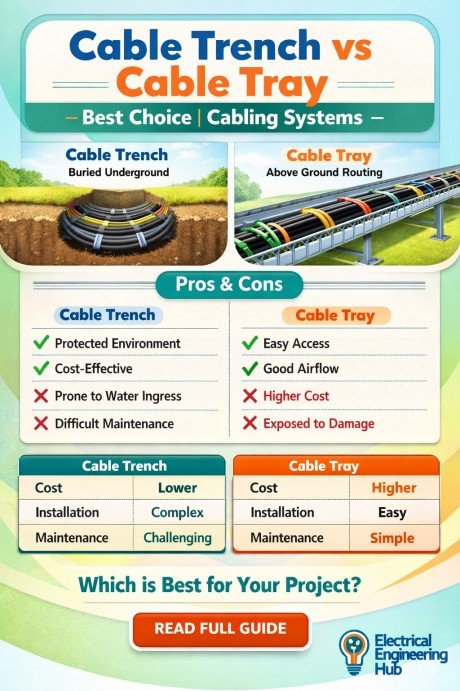
Table of Contents
When evaluating Cable Trench vs Cable Tray, it is essential to consider the project requirements rather than focusing only on initial installation costs. A well-planned cable management system improves safety, reduces downtime, and extends cable life.
Modern electrical installations often contain power cables, control cables, communication cables, and fiber optic lines. Managing these cables efficiently requires a structured approach that aligns with applicable electrical standards and operational needs.
Use our online tool Conduit Fill Calculator for Multi Conductor Cable which measures accurate NEC Based Cable conduit Sizing
Key Takeaways
- Cable trenches provide maximum physical protection for underground cable routing.
- Cable trays offer easier maintenance and future cable expansion.
- Cable trays generally have lower installation costs than cable trenches.
- Cable trenches are suitable for harsh industrial environments.
- Cable trays are preferred in commercial buildings and indoor facilities.
- Project location, environmental conditions, and maintenance requirements determine the best choice.
- Proper design improves cable safety, reliability, and operational efficiency.
What Is a Cable Trench?
A cable trench is a constructed channel, usually built below ground level, used to route and protect electrical cables. Trenches may be made of concrete, brick masonry, precast structures, or reinforced materials depending on project requirements.
Cable trenches are commonly used in:
- Power plants
- Electrical substations
- Industrial facilities
- Water treatment plants
- Oil and gas installations
- Utility distribution networks
Access our powerful online calculator now Conduit Fill Calculator (NEC Standard)
The cables are placed inside the trench and protected by covers such as concrete slabs, steel covers, or FRP panels.
Advantages of Cable Trenches
| Advantage | Description |
|---|---|
| High Protection | Protects cables from mechanical damage |
| Weather Resistance | Suitable for outdoor environments |
| Enhanced Security | Prevents unauthorized cable access |
| Long Service Life | Durable construction materials |
| Fire Separation | Allows segregation of cable circuits |
Disadvantages of Cable Trenches
- Higher construction cost
- Requires excavation work
- Maintenance access may be slower
- Future modifications can be difficult
- Water accumulation may occur without proper drainage
Try our free online tool today Conduit Fill Calculator Canada
What Is a Cable Tray?
A cable tray is an above-ground cable support system designed to carry electrical and communication cables. It provides organized cable routing while allowing easy inspection and maintenance.
Cable trays are available in several types:
- Ladder cable tray
- Perforated cable tray
- Wire mesh tray
- Trough cable tray
- Channel cable tray
They are widely used in commercial buildings, manufacturing facilities, data centers, and utility projects.
Advantages of Cable Trays
| Advantage | Description |
|---|---|
| Easy Installation | Faster than trench construction |
| Lower Cost | Reduced civil work requirements |
| Simple Maintenance | Easy cable inspection |
| Flexible Expansion | Additional cables can be added easily |
| Better Ventilation | Reduces cable heating |
Experience fast and accurate results using our online tool Conduit Fill Calculator for Multiple Wire Sizes
Disadvantages of Cable Trays
- Less protection from physical damage
- Exposure to environmental conditions
- May require additional fire protection
- Vulnerable to accidental impacts
- Security concerns in open areas
Cable Trench vs Cable Tray: Detailed Comparison
The decision between Cable Trench vs Cable Tray depends on several technical and operational factors.
| Parameter | Cable Trench | Cable Tray |
|---|---|---|
| Installation Location | Underground | Above Ground |
| Mechanical Protection | Excellent | Moderate |
| Initial Cost | Higher | Lower |
| Maintenance Access | Moderate | Excellent |
| Future Expansion | Difficult | Easy |
| Cable Cooling | Limited | Better |
| Construction Time | Longer | Faster |
| Environmental Protection | Excellent | Moderate |
| Inspection Convenience | Lower | Higher |
| Safety in Harsh Areas | Excellent | Good |
Use our online tool Armoured Cable Size Calculator
Safety Considerations
Safety remains a major factor when comparing Cable Trench vs Cable Tray.
Cable trenches provide superior protection against:
- Vehicle movement
- Falling objects
- Mechanical impacts
- Vandalism
- External environmental hazards
Cable trays, on the other hand, improve operational safety through easy visual inspection. Faulty cables, loose supports, and damaged insulation can be identified quickly without excavation or dismantling covers.
For facilities where frequent maintenance is expected, cable trays often offer significant operational advantages.
Cost Analysis
Project budget frequently influences the choice between Cable Trench vs Cable Tray.
Cable Trench Costs
Typical expenses include:
- Excavation
- Concrete works
- Reinforcement materials
- Drainage systems
- Trench covers
- Backfilling
Use our online tool motor cable size calculator
Cable Tray Costs
Typical expenses include:
- Tray materials
- Support structures
- Mounting hardware
- Installation labor
Although cable trays usually require lower upfront investment, cable trenches may provide better long-term value in environments with severe mechanical risks.
Best Applications for Cable Trenches
Cable trenches perform exceptionally well in the following situations:
- Electrical substations
- Power generation facilities
- Outdoor switchyards
- Petrochemical plants
- Underground utility corridors
- High-security installations
Engineers designing underground power systems should also review the recommended guidelines in the High Voltage Cable Trench Depth Standards article to ensure compliance with industry requirements.
Know more about Earth Cable Size for Lightning Protection
Best Applications for Cable Trays
Cable trays are generally preferred for:
- Commercial buildings
- Hospitals
- Shopping malls
- Data centers
- Manufacturing facilities
- Office complexes
These installations benefit from easy maintenance access and future scalability.
Environmental Factors to Consider
Environmental conditions can significantly affect the performance of cable management systems.
Choose Cable Trenches When:
- Heavy vehicle traffic exists
- Underground routing is required
- Maximum cable protection is needed
- Security is a priority
- Exposure to physical damage is high
Choose Cable Trays When:
- Frequent maintenance is expected
- Cable additions are likely
- Fast installation is required
- Indoor routing is available
- Ventilation is important
Find all about High Voltage Cable Testing Standards
Which Option Is Better?
There is no universal winner in the Cable Trench vs Cable Tray comparison. The best option depends on the project’s operational requirements, environmental conditions, and maintenance strategy.
For high-risk outdoor environments where cable protection is critical, cable trenches are generally the preferred solution. For commercial and industrial facilities requiring flexibility and easy maintenance, cable trays often provide greater advantages.
Many modern projects combine both systems. Cable trenches may be used outdoors for protection, while cable trays are installed indoors for accessibility and expansion. This hybrid approach often delivers the best balance between safety, cost, and operational efficiency.
Conclusion
The comparison of Cable Trench vs Cable Tray shows that both systems play an important role in modern electrical infrastructure. Cable trenches offer exceptional protection and durability, making them ideal for harsh environments and underground installations. Cable trays provide flexibility, accessibility, and lower installation costs, making them suitable for commercial and industrial applications.
Learn more about earthing cable size as per iec
Selecting the right system requires careful evaluation of safety requirements, maintenance needs, environmental conditions, and future expansion plans. By understanding the strengths and limitations of each option, engineers can design reliable cable routing systems that ensure long-term performance and electrical safety.
Frequently Asked Questions
1. What is the main difference between Cable Trench vs Cable Tray?
A cable trench is an underground cable routing system that provides high protection, while a cable tray is an above-ground support structure that offers easier maintenance and expansion.
2. Which is more cost-effective, cable trench or cable tray?
Cable trays are generally more cost-effective due to lower civil construction requirements and faster installation. Discover everything about cable bending radius iec standard
3. Are cable trenches safer than cable trays?
Cable trenches provide better physical protection against external damage, making them safer in harsh outdoor environments.
4. Where are cable trays commonly used?
Cable trays are widely used in commercial buildings, factories, hospitals, data centers, and office facilities.
5. Can cable trenches and cable trays be used together?
Yes. Many projects use cable trenches for outdoor cable routing and cable trays for indoor distribution to achieve both protection and accessibility.
Explore details on iec standard for underground cable laying
Follow Us on Social:
Subscribe our Newsletter on Electrical Insights for latest updates from Electrical Engineering Hub
#cabletrench,#cabletray,#powerdistribution,#electricalengineering,#cablemanagement,#construction,#substation,#industrial,#safety,#infrastructure