BS7671 Buried Cable Depth: Essential Installation Guide
Installing underground electrical cables requires careful planning, proper materials, and compliance with recognized regulations. One of the most important requirements is ensuring that cables are buried at the correct depth to prevent damage from excavation activities, vehicle loads, and environmental factors. Understanding the BS7671 Buried Cable Depth requirements helps electricians, contractors, and property owners maintain safe and reliable electrical installations.
The BS 7671 Wiring Regulations provide guidance for the design, erection, and verification of electrical installations. While the standard does not prescribe a single mandatory depth for every situation, it emphasizes adequate protection against external influences and mechanical damage. This means cable depth must be selected according to site conditions and installation methods.
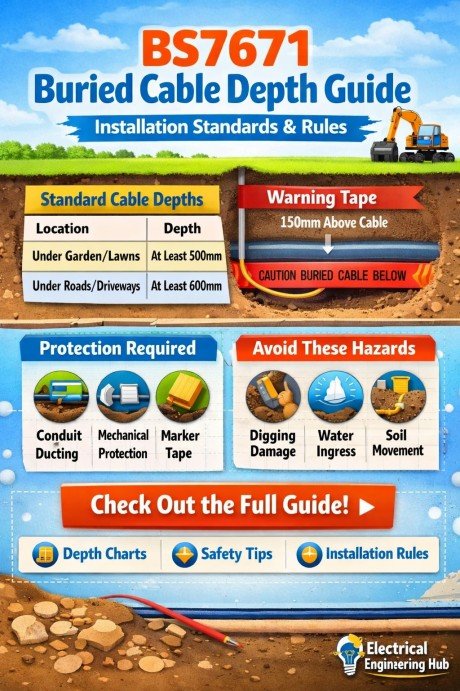
Table of Contents
Underground cable installations are commonly used in residential developments, commercial facilities, industrial sites, renewable energy projects, and utility networks. When cables are buried too shallow, they become vulnerable to accidental damage from digging, landscaping, and construction work. Excessive depth, on the other hand, can increase installation costs and make maintenance more difficult.
Learn more about earthing cable size as per iec
For this reason, understanding BS7671 Buried Cable Depth recommendations alongside industry best practices is essential for achieving a safe and compliant installation. Proper trench preparation, warning tapes, cable protection systems, and suitable backfilling materials all contribute to a successful underground cable project.
Key Takeaways
Check Key Takeaways
| Requirement | Typical Recommendation |
|---|---|
| Domestic garden areas | 450 mm minimum depth |
| Roads and vehicle areas | 600 mm to 1000 mm depth |
| Warning tape placement | Approximately 150 mm above cable |
| Mechanical protection | Required where risk of damage exists |
| Cable bedding | Sand or suitable fine material |
| Compliance | Follow BS 7671 and local regulations |
What Does BS7671 Say About Buried Cable Depth?
The BS7671 Buried Cable Depth guidance is based on protecting cables from foreseeable damage rather than specifying one universal depth for every installation. Regulation requirements focus on selecting and erecting wiring systems so that they are protected against external influences.
In practice, electrical engineers often follow industry-accepted installation depths that have become standard across many projects. These depths are also influenced by utility company requirements, local authority standards, and engineering specifications.
The key objective is to ensure the cable remains protected throughout its operational life while allowing safe maintenance and future excavation activities.
Discover everything about cable bending radius iec standard
Recommended Buried Cable Depths
The following table summarizes commonly accepted installation depths used alongside BS 7671 guidance.
| Installation Area | Typical Burial Depth |
|---|---|
| Residential gardens | 450 mm |
| Footpaths and walkways | 450 mm to 600 mm |
| Agricultural land | 600 mm |
| Commercial areas | 600 mm to 750 mm |
| Roads and driveways | 750 mm to 1000 mm |
| Industrial sites | As determined by engineering assessment |
These values may vary depending on local regulations, cable type, and site-specific conditions.
Factors Affecting Cable Burial Depth
Several factors influence the final burial depth selected during installation.
Ground Usage
Areas exposed to frequent digging, cultivation, or vehicle movement generally require deeper cable placement. Residential gardens may allow shallower installations than industrial facilities.
Mechanical Protection
The use of ducts, conduits, cable tiles, or protective covers can improve cable protection. Additional protection may reduce the risk of damage even when standard burial depths are used.
Cable Type
Different cable constructions offer varying levels of mechanical strength. Armoured cables provide greater protection than standard insulated cables and are commonly used for underground installations.
Find out more about iec 61439 busbar clearance
Future Excavation Risk
Locations where future construction or landscaping work is anticipated may require additional depth and protection measures to reduce accidental cable strikes.
Trench Construction Requirements
Achieving compliance involves more than simply meeting BS7671 Buried Cable Depth recommendations. The trench itself must be prepared correctly.
A typical underground cable trench should include:
- Adequate trench width
- Smooth trench bottom
- Sand or fine soil bedding
- Proper cable spacing
- Suitable backfill material
- Warning tape above the cable
- Mechanical protection where required
These measures help prevent damage from sharp stones, ground settlement, and excavation activities.
Explore details on iec standard for underground cable laying
Example Underground Cable Trench Layout
| Layer | Purpose |
|---|---|
| Backfill material | Restores ground surface |
| Warning tape | Alerts future excavators |
| Selected fill | Protects cable |
| Cable | Power transmission |
| Sand bedding | Prevents abrasion |
| Compacted trench bottom | Stable foundation |
For a complete overview of trenching practices, cable protection methods, and installation procedures, refer to our detailed guide on underground cable installation standards.
Warning Tape and Cable Markers
Warning tape is an important safety feature in underground cable systems. It is usually installed approximately 150 mm above the cable route. During excavation, workers encounter the tape before reaching the cable, reducing the likelihood of accidental damage.
Cable marker posts may also be used where cable routes cross roads, agricultural fields, or large open areas. These markers improve route identification and simplify future maintenance.
Common Mistakes During Underground Cable Installation
Many underground cable failures result from poor installation practices rather than cable defects.
Common mistakes include:
- Insufficient burial depth
- Lack of warning tape
- Using unsuitable backfill material
- Poor trench compaction
- Inadequate mechanical protection
- Failure to identify existing underground services
- Incorrect cable selection
Get complete information about iec standard for busbar sizing
Avoiding these issues significantly improves long-term reliability and safety.
BS7671 Buried Cable Depth for Armoured Cables
Steel Wire Armoured (SWA) cables are among the most widely used underground power cables. Although SWA provides excellent mechanical protection, installers should not rely solely on the armour for protection against excavation damage.
The recommended BS7671 Buried Cable Depth for SWA cables typically remains similar to other underground power cables. Proper trench construction, warning tapes, and route marking should still be implemented.
SWA cables are frequently used for:
- Garden power supplies
- Outbuildings
- Solar installations
- Industrial facilities
- Agricultural applications
- Street lighting systems
Understand better about nec 430.32
Inspection and Testing Requirements
After installation, underground cables should undergo inspection and testing to verify compliance with BS 7671 requirements.
Typical tests include:
- Continuity testing
- Insulation resistance testing
- Earth fault loop impedance testing
- Polarity verification
- Functional testing
Accurate documentation of cable routes and depths should also be maintained for future reference. Use this tool if you are trying to calculate cable size for underground cables. Try here Underground Cable Size Calculator – Find Correct Wire Size for Long Distance Runs
Best Practices for Long-Term Cable Protection
A successful underground cable installation combines proper depth with additional protective measures.
Recommended best practices include:
- Use suitable armoured or protected cables.
- Install cables at appropriate depths.
- Provide sand bedding above and below cables.
- Place warning tape above cable routes.
- Maintain accurate route drawings.
- Use cable ducts in high-risk locations.
- Conduct thorough testing before energization.
These measures help minimize maintenance costs and improve operational reliability.
Dive deeper into instrument earthing iec standard
Conclusion
Understanding BS7671 Buried Cable Depth requirements is essential for safe and compliant underground electrical installations. While BS 7671 focuses on protecting cables from external influences rather than specifying one fixed depth, industry practice generally recommends around 450 mm in domestic areas and deeper installations in locations exposed to vehicle traffic or heavy ground disturbance.
Proper trench construction, mechanical protection, warning tapes, and accurate route identification are equally important components of a successful installation. By following established engineering practices and BS 7671 principles, installers can significantly reduce the risk of cable damage, electrical faults, and costly repairs.
Read in detail about iec 61439 busbar calculation
Frequently Asked Questions
What is the minimum BS7671 Buried Cable Depth for residential gardens?
A depth of approximately 450 mm is commonly used for domestic garden installations, provided adequate protection measures are in place.
Does BS 7671 specify an exact burial depth?
No. BS 7671 focuses on protecting cables from external influences and mechanical damage. Actual depth requirements depend on installation conditions and industry practices.
How deep should cables be buried under driveways?
Cables installed beneath driveways are commonly buried between 750 mm and 1000 mm to provide additional protection from vehicle loads.
Is warning tape required above underground cables?
Warning tape is strongly recommended and is typically placed about 150 mm above the cable to alert anyone excavating nearby.
Can armoured cable be buried directly in the ground?
Yes. SWA cable can be buried directly in the ground when installed correctly with suitable bedding, protection measures, and compliance with relevant regulations.
Follow Us on Social:
Subscribe our Newsletter on Electrical Insights for latest updates from Electrical Engineering Hub
#bs7671buriedcabledepth,#buriedcabledepth,#bs7671wiringregulations,#cableinstallation,#electricalstandards,#undergroundcable,#electricalengineering,#cablesafety,#wiringregulations,#electricaldesign