IEC 60364 5 52 | Best Guide on Cable Sizing & Current Carrying Capacity
Electrical installations must be designed with safety, efficiency, and reliability in mind. One of the most important standards used worldwide for cable selection is IEC 60364 5 52. This standard provides detailed guidance on cable sizing, current carrying capacity, voltage drop, and installation methods to ensure electrical systems operate safely under different conditions.
Understanding IEC 60364 5 52 is essential for electrical engineers, designers, contractors, and maintenance professionals. Proper cable sizing not only prevents overheating and insulation damage but also improves system performance and energy efficiency. Whether you are designing a residential, commercial, or industrial installation, following this standard helps ensure compliance with international best practices.
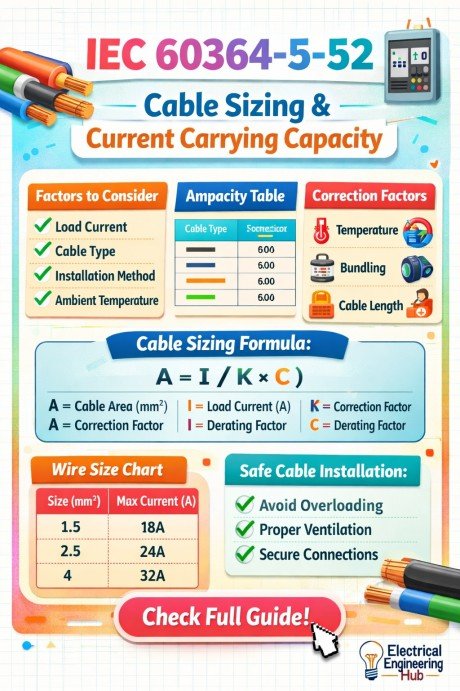
Table of Contents
The selection of electrical cables involves much more than matching the conductor size to the load current. Environmental conditions, installation methods, grouping factors, ambient temperature, and voltage drop requirements must all be considered. IEC 60364 5 52 provides a structured approach to evaluating these factors and choosing the correct cable size.
Dive deeper into instrument earthing iec standard
Key Takeaways
- IEC 60364 5 52 provides requirements for cable sizing and current carrying capacity.
- Cable selection depends on load current, installation method, ambient temperature, and grouping factors.
- Voltage drop limits must be considered during cable design.
- Proper cable sizing reduces overheating risks and improves system reliability.
- The standard is widely used in residential, commercial, and industrial electrical installations.
What is IEC 60364 5 52?
IEC 60364 5 52 is a section of the IEC 60364 series that focuses on the selection and erection of electrical equipment related to wiring systems. It provides guidelines for determining conductor sizes based on electrical loading and installation conditions.
The standard helps engineers ensure that conductors can carry the expected current without exceeding temperature limits. It also addresses mechanical protection, environmental influences, and voltage drop requirements.
Know more about IEC Standard for Earthing System
By following IEC 60364 5 52, designers can create electrical installations that are safe, efficient, and compliant with international standards.
Importance of Cable Sizing
Cable sizing is one of the most critical aspects of electrical design. An undersized cable can overheat, leading to insulation failure, fire hazards, and equipment damage. On the other hand, an oversized cable increases installation costs unnecessarily.
Proper cable sizing offers several benefits:
- Improved safety
- Reduced power losses
- Better voltage regulation
- Longer cable lifespan
- Compliance with electrical standards
The requirements outlined in IEC 60364 5 52 help engineers achieve the right balance between safety and cost-effectiveness.
Know more about Earth Fault Relay Sensitivity Setting
Current Carrying Capacity Explained
Current carrying capacity, also known as ampacity, refers to the maximum current a cable can carry continuously without exceeding its permissible operating temperature.
Several factors influence current carrying capacity:
| Factor | Impact on Cable Capacity |
|---|---|
| Conductor Material | Copper carries more current than aluminum of the same size |
| Insulation Type | Different insulation materials have different temperature ratings |
| Installation Method | Buried, conduit, tray, or free-air installation affects heat dissipation |
| Ambient Temperature | Higher temperatures reduce current capacity |
| Grouping of Cables | Multiple cables together reduce heat dissipation |
| Soil Thermal Resistivity | Important for underground installations |
IEC 60364 5 52 provides correction factors for these conditions, ensuring accurate cable selection.
Know more about Earth Cable Size for Lightning Protection
Cable Installation Methods According to IEC 60364 5 52
One of the most important aspects of the standard is the classification of installation methods. The way a cable is installed directly affects its ability to dissipate heat.
Common installation methods include:
| Installation Method | Description |
|---|---|
| Method A | Cable enclosed in thermal insulation |
| Method B | Cable in conduit on a wall |
| Method C | Cable clipped directly to a surface |
| Method D | Cable buried underground |
| Method E | Cable installed in free air |
| Method F | Cable on cable trays or ladders |
Each installation method has its own current rating tables within IEC 60364 5 52.
Know more about How Does Earth Fault Relay Protect Electrical Circuits? Complete Guide to Ground Fault Protection
Factors Affecting Cable Sizing
When selecting a cable, engineers must consider multiple design parameters.
Load Current
The design current is the starting point for cable selection. The chosen cable must have a current rating higher than the expected load current.
Ambient Temperature
Higher ambient temperatures reduce the cable’s ability to dissipate heat. Correction factors are applied when temperatures differ from standard reference conditions.
Voltage Drop
Excessive voltage drop can affect equipment performance and efficiency. The standard recommends maintaining voltage drop within acceptable limits.
Grouping Factor
When multiple cables are installed together, heat accumulation reduces their current carrying capability. Grouping correction factors help compensate for this effect. Get instant results with our online tool earth cable size calculator
Conductor Material
Copper conductors generally offer better conductivity and smaller cable sizes compared to aluminum conductors.
Voltage Drop Requirements
Voltage drop is a key consideration during cable sizing. As current flows through a conductor, a voltage reduction occurs due to cable resistance.
Typical causes of excessive voltage drop include:
- Long cable runs
- High load currents
- Small conductor sizes
- Poor installation practices
The designer must verify that voltage drop remains within permissible limits throughout the electrical installation.
For engineers working on grounding and protection systems, understanding the relationship between cable sizing and earthing is equally important. You can also explore our detailed guide on IEC 60364 Earthing to gain a complete understanding of earthing requirements and protective measures.
Explore details on table 250.122 nec
Typical Cable Sizing Process
The cable sizing process under IEC 60364 5 52 generally follows these steps:
- Determine the design load current.
- Select the installation method.
- Identify ambient temperature conditions.
- Apply grouping correction factors.
- Check current carrying capacity.
- Verify voltage drop limits.
- Confirm short-circuit withstand capability.
- Select the final conductor size.
This systematic approach ensures safe and reliable cable selection.
Example of Cable Selection
The following simplified example illustrates the process:
| Parameter | Value |
|---|---|
| Load Current | 80 A |
| Cable Type | Copper XLPE |
| Installation Method | Cable Tray |
| Ambient Temperature | 40°C |
| Cable Length | 60 m |
The engineer would first select a cable from the current rating tables in IEC 60364 5 52, then apply temperature and grouping correction factors, and finally verify voltage drop and short-circuit performance.
Know all the basics about earth conductor size calculation
Benefits of Following IEC 60364 5 52
Organizations that implement the standard gain several advantages:
- Enhanced electrical safety
- Reduced risk of fire hazards
- Improved system reliability
- Better energy efficiency
- International compliance
- Lower maintenance costs
- Consistent engineering practices
These benefits make the standard a valuable reference for modern electrical installations.
Common Mistakes in Cable Sizing
Even experienced professionals can make errors during cable selection. Common mistakes include:
- Ignoring ambient temperature corrections
- Neglecting grouping factors
- Focusing only on load current
- Overlooking voltage drop calculations
- Using incorrect installation methods
- Not verifying short-circuit ratings
Avoiding these mistakes helps maintain compliance with IEC 60364 5 52 and ensures long-term system performance.
Find all about substation earthing design
FAQs
What is IEC 60364 5 52 used for?
IEC 60364 5 52 is used for selecting and installing electrical wiring systems, including cable sizing, current carrying capacity calculations, and voltage drop assessment.
How does ambient temperature affect cable current carrying capacity?
Higher ambient temperatures reduce a cable’s ability to dissipate heat, which lowers its current carrying capacity and requires correction factors. Find more about iec grounding standards
Why are installation methods important in cable sizing?
Different installation methods affect heat dissipation. Cables installed in free air can carry more current than cables enclosed in insulation or conduit.
Does IEC 60364 5 52 apply to industrial installations?
Yes. The standard is widely used in residential, commercial, and industrial electrical systems worldwide.
What factors should be considered when selecting cable size?
Key factors include load current, installation method, ambient temperature, grouping factors, voltage drop, conductor material, and short-circuit withstand capability.
Know more about European Earthing System TN-S TN-C-S TT Explained: Key Differences, Safety, and Standards
Conclusion
IEC 60364 5 52 serves as a fundamental reference for cable sizing and current carrying capacity calculations in electrical installations. By considering installation methods, temperature conditions, grouping factors, and voltage drop limits, engineers can select cables that operate safely and efficiently throughout their service life. Following the requirements of IEC 60364 5 52 not only improves system reliability but also helps ensure compliance with internationally recognized electrical design practices.
Follow Us on Social:
Subscribe our Newsletter on Electrical Insights for latest updates from Electrical Engineering Hub
#IEC60364552,#IEC60364,#ElectricalStandards,#CableSizing,#ElectricalInstallation,#VoltageDrop,#WiringRegulations,#ElectricalEngineering,#PowerDistribution,#IECCompliance