Testing Zener Diode: Professional Step-by-Step Guide for Accurate Circuit Testing Using Multimeter
Testing Zener Diode is an essential skill for anyone working with electronic circuits, power supplies, and voltage regulation systems. A properly functioning Zener diode ensures stable voltage reference and protects sensitive components from overvoltage conditions. When Testing Zener Diode, accuracy and correct multimeter settings play a major role in obtaining reliable results during diagnostics.
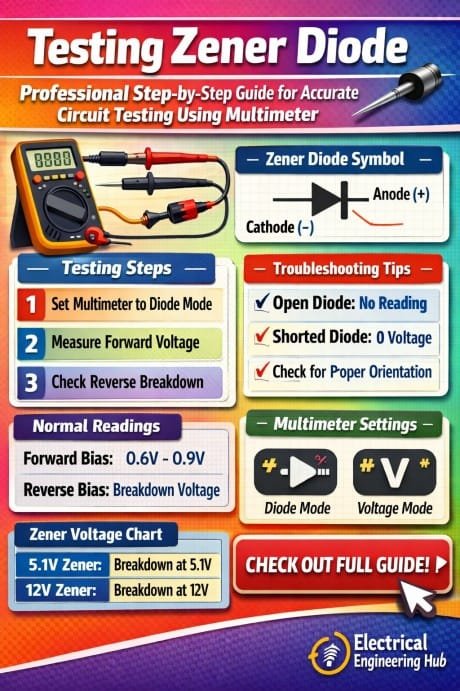
Table of Contents
In practical electronics, Testing Zener Diode helps identify whether the diode is operating in its breakdown region as expected. Since Zener diodes are widely used for voltage regulation, clamping circuits, and protection circuits, understanding the correct testing procedure ensures better circuit performance and fault detection.
Understanding Zener Diode Functionality
A Zener diode is designed to allow current flow not only in forward bias but also in reverse breakdown region at a specific voltage known as Zener voltage. This unique property makes it suitable for voltage stabilization applications. While Testing Zener Diode, it is important to understand that normal diodes behave differently in reverse bias, but Zener diodes are intentionally engineered for controlled breakdown.
In electronic repair and maintenance work, Testing Zener Diode becomes necessary when power regulation issues occur in power supplies or reference circuits. A faulty Zener diode can lead to unstable output voltage, overheating, or complete circuit failure.
Know more about How to Check Transistor With Multimeter
Tools Required for Accurate Testing
Before starting the process of Testing Zener Diode, having the correct tools ensures precision and safety. A digital multimeter with diode and voltage measurement functions is the most important tool. In addition, a variable DC power supply or battery setup is often used for reverse breakdown testing.
Below is a simple overview of required tools:
| Tool | Purpose | Recommended Range |
|---|---|---|
| Digital Multimeter | Measure forward and reverse voltage | Auto or manual range |
| DC Power Supply | Apply reverse bias voltage | 0–30V adjustable |
| Resistor (1kΩ–10kΩ) | Current limiting | 0.5W or higher |
| Connecting Probes | Circuit connection | Standard test leads |
Having these tools ready makes Testing Zener Diode more controlled and reduces the risk of incorrect readings or component damage.
Step-by-Step Procedure for Testing Zener Diode
The correct method of Testing Zener Diode involves both forward bias and reverse bias checks. Each step must be performed carefully to ensure accurate results.
Step 1: Forward Bias Test
Start by setting the multimeter to diode mode. Connect the red probe to the anode and black probe to the cathode. A healthy Zener diode will show a forward voltage drop similar to a standard silicon diode, typically between 0.6V to 0.7V. This confirms basic conduction capability during Testing Zener Diode.
Know more about Types of Field Effect Transistor
Step 2: Reverse Bias Observation
Reverse the probes. In this condition, the multimeter should show no conduction or “OL” (open loop) reading. This step is critical during Testing Zener Diode because it confirms that the diode is blocking current in normal reverse condition.
Step 3: Breakdown Voltage Test
Apply a controlled DC voltage using a power supply along with a series resistor. Gradually increase voltage until the diode reaches its breakdown region. The voltage at which current stabilizes is the Zener voltage. This is the most important part of Testing Zener Diode in real circuit conditions.
Choosing the right meter can improve troubleshooting efficiency. Explore our recommendations for the Best Multimeter Under $50 before making a purchase.
Step 4: Voltage Verification
Measure the voltage across the diode while in breakdown mode. If the reading matches the rated Zener voltage printed on the component, the diode is functioning correctly. Any significant deviation indicates damage or aging.
Multimeter Settings and Expected Results
The following table helps in understanding correct readings during Testing Zener Diode under different conditions:
| Test Condition | Multimeter Setting | Expected Result |
|---|---|---|
| Forward Bias | Diode Mode | 0.6V – 0.7V drop |
| Reverse Bias | Diode Mode | OL / No conduction |
| Breakdown Test | DC Voltage Mode | Rated Zener voltage |
| Faulty Diode | Any Mode | Irregular or zero readings |
These readings are commonly used in electronics troubleshooting labs and repair environments where Testing Zener Diode is part of routine diagnostics.
Find all about Types of Transistor
Common Errors During Testing
Many beginners face incorrect results due to improper connections or wrong settings. One common mistake during Testing Zener Diode is applying direct high voltage without a current-limiting resistor, which can permanently damage the diode. Another error is misidentifying anode and cathode terminals, leading to false readings.
Loose probe connections can also affect measurement stability. Ensuring firm contact and stable power supply improves accuracy during Testing Zener Diode in practical circuits.
Practical Applications in Electronics
Zener diodes are widely used in regulated power supplies, voltage reference circuits, and surge protection systems. When engineers perform Testing Zener Diode, they ensure that voltage regulation circuits in devices such as adapters, chargers, and industrial controllers remain stable.
In repair work, Testing Zener Diode helps diagnose faults in SMPS circuits where voltage fluctuation is a common issue. It also plays an important role in protecting microcontrollers and sensitive ICs from voltage spikes.
Safety Guidelines During Testing
Safety is a key aspect of Testing Zener Diode, especially when working with higher voltage setups. Always use a resistor in series to limit current and avoid overheating. Do not exceed the rated power dissipation of the diode during testing.
Know more about How N-Channel MOSFET Works? Important Facts We Must Know
It is also recommended to discharge capacitors in the circuit before performing Testing Zener Diode to avoid electric shock or damage to the multimeter. Using insulated probes further improves safety during measurement.
Conclusion
Understanding Testing Zener Diode is fundamental for electronics technicians, students, and engineers who work with voltage regulation circuits. A structured approach using a multimeter and controlled power supply ensures accurate results and reliable diagnostics.
By following proper steps, from forward bias testing to breakdown voltage measurement, Testing Zener Diode becomes a precise and dependable method for identifying component health. Regular practice of these techniques improves troubleshooting speed and enhances overall circuit design quality.
Know more about N-channel Enhancement Type MOSFET
Follow Us on Social:
Subscribe our Newsletter on Electrical Insights for latest updates from Electrical Engineering Hub
#TestingZenerDiode,#ZenerDiodeTest,#DiodeTesting,#ElectronicsBasics,#CircuitTesting,#ElectricalTesting,#SemiconductorDiode,#MultimeterTest,#ElectronicsRepair,#TechTutorials