
Automotive Cable Size Calculator – Avoid Voltage Drop & Choose the Perfect Car Wiring Size
Introduction
The automotive cable size calculator is a practical tool used to determine the correct cable cross-sectional area for vehicle electrical systems. It helps users select wiring that can safely carry current without excessive voltage drop or overheating. This is critical in cars, trucks, RVs, boats, and off-grid vehicle setups where electrical loads such as inverters, winches, lighting systems, and battery chargers are common.
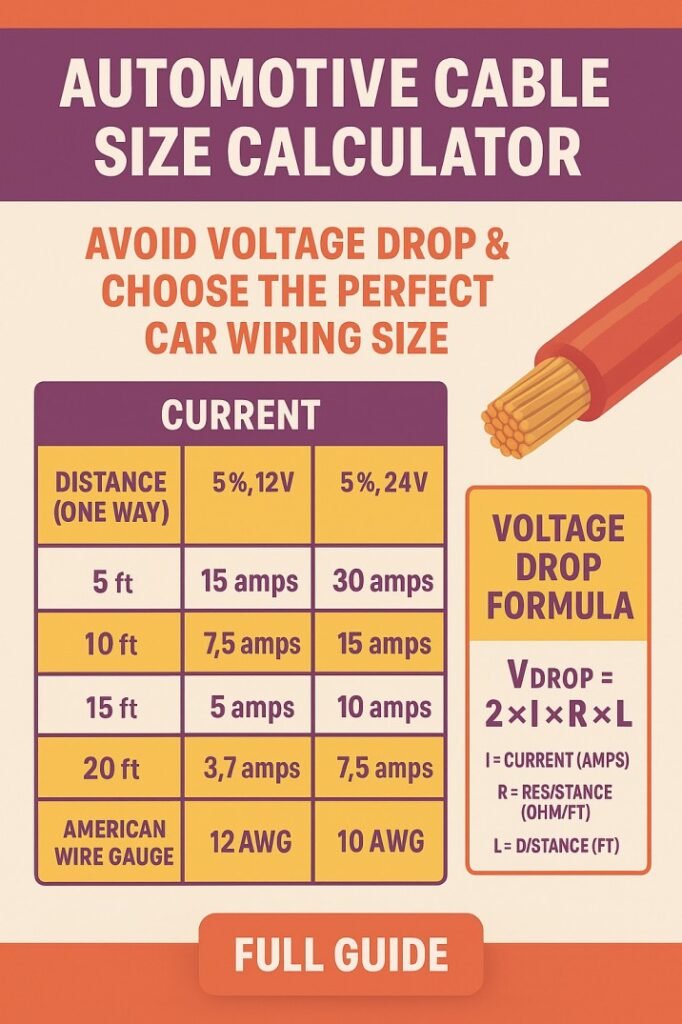
Table of Contents
In automotive environments, electrical systems operate at low voltages but often carry high currents. Even small resistance in undersized cables can lead to significant voltage loss, poor equipment performance, and potential fire risk. Using an automotive cable size calculator ensures the wiring is matched to the load, distance, and system voltage, improving reliability and safety.
Professionals rely on accurate cable sizing to prevent nuisance faults, protect expensive equipment, and comply with accepted automotive and electrical wiring practices.
Automotive Cable Size Calculator
Enter the system voltage, current, and cable length into the automotive cable size calculator to find the recommended cable size.
Use accurate load values for the most reliable result.
Automotive Cable Size Calculator
IEC & NEC Based Interactive Tool
Input Parameters
How to Use
1. Enter the system voltage, load current, and cable length.
2. Select the environment where the cable will be installed (engine bay, interior, or exterior).
3. Choose the applicable standard (IEC or NEC).
4. Select conductor material (Copper or Aluminium).
5. Click “Calculate Size” to get the recommended automotive cable size.
This tool provides indicative sizing based on international standards. Always confirm with detailed engineering design and local regulations before implementation.
Discover our Electrical Cable Sizing Tools, a great resource for all types of cable calculations. It includes cable calculators for generators, transformers, earthing, and more.
How to Use Automotive Cable Size Calculator (Step-by-Step)
- Identify the system voltage
Check whether the system is 12V, 24V, or another DC voltage used in the vehicle. - Determine the load current
Find the current drawn by the device or circuit. This is usually listed on the equipment label or in the technical manual. - Measure the cable length
Measure the total round-trip length of the cable run, from the power source to the load and back to ground. - Select allowable voltage drop
Choose a voltage drop limit based on the application. Sensitive electronics require a lower voltage drop than general accessories. - Enter values into the automotive cable size calculator
Input voltage, current, length, and voltage drop allowance. - Review the recommended cable size
The calculator provides a cable cross-section that can safely carry the current while keeping voltage drop within limits.
Designing electrical system? Use this clearance and creepage calculator for accurate distances
How the Calculation Works
The automotive cable size calculator works by balancing three main electrical factors: current, resistance, and voltage drop. Every cable has electrical resistance, which increases with length and decreases with larger cross-sectional area.
When current flows through a cable, some voltage is lost due to this resistance. In low-voltage automotive systems, even a small drop can affect performance. The calculator estimates how much voltage would be lost over the selected cable length at the given current.
If the predicted voltage drop exceeds the acceptable limit, a larger cable size is recommended. The tool also considers safe current-carrying capacity so the conductor does not overheat under continuous load. By combining voltage drop control and thermal limits, the automotive cable size calculator provides a balanced and practical cable recommendation.
Practical Electrical Example
Consider a 12V auxiliary battery system in a utility vehicle powering a 600W inverter.
Given values:
- System voltage: 12V DC
- Load power: 600W
- Estimated current: approximately 50A
- Cable length (battery to inverter and back): 6 meters
- Target voltage drop: 3%
Using the automotive cable size calculator, these values are entered to evaluate the required cable size. The tool determines that a small cable would cause excessive voltage drop, reducing inverter performance and possibly triggering low-voltage shutdown.
Use this tool if you are trying to calculate cable size for underground cables. Try here Underground Cable Size Calculator – Find Correct Wire Size for Long Distance Runs
The recommended cable size supports the 50A load while keeping voltage drop within the 3% target. This ensures the inverter receives sufficient voltage, operates efficiently, and avoids unnecessary stress on the battery and wiring.
Key Factors That Affect the Result
Several electrical and environmental factors influence the output of the automotive cable size calculator:
- Voltage level
Lower voltage systems require larger cables for the same power because current is higher. - Load type
Continuous loads like inverters or compressors place more thermal stress on cables than short-duration loads. - Power factor and efficiency
For systems involving inverters or chargers, inefficiencies increase input current, affecting cable size. - Cable length
Longer runs increase resistance and voltage drop, often requiring a larger conductor. - Installation conditions
Cables bundled together, run through hot engine compartments, or enclosed in conduits may have reduced current-carrying capacity. - Ambient temperature
Higher temperatures reduce the cable’s ability to dissipate heat, which may require upsizing.
Discover how this tool works and why it’s worth using NEC Wire Size Calculator – Voltage Drop Compliant Sizing for 120V & 240V Circuits
Common Mistakes to Avoid
Incorrect inputs in the automotive cable size calculator can lead to undersized or oversized cable selection.
A frequent error is using one-way cable length instead of total round-trip length. Since current flows out and back, the full circuit length must be considered. Ignoring this doubles the effective resistance and leads to underestimating voltage drop.
Another mistake is underestimating current. Devices such as inverters and motors can draw higher current during startup or peak operation. Using only nominal values can result in cables that overheat under real conditions.
Some users also select an unrealistically high allowable voltage drop. While a higher drop may seem acceptable, it can cause dim lights, slow motors, or malfunctioning electronics. Following conservative voltage drop limits improves performance and system longevity.
Why Use Automotive Cable Size Calculator
The automotive cable size calculator provides a quick and technically sound method to size cables without manual trial and error.
It improves accuracy by considering both voltage drop and current-carrying capacity. This reduces the risk of overheated conductors and unstable equipment operation.
It saves time during design, installation, and troubleshooting. Instead of repeatedly replacing cables, users can select a suitable size from the start.
This tool is perfect for achieving better results in solar system design. Try here Wire Size Calculator for Solar Panels – Avoid Power Loss in Off-Grid and Hybrid Systems
It also supports better engineering decisions, especially in complex vehicle electrical systems with multiple loads, auxiliary batteries, and charging sources.
Electrical Standards & Practical Considerations
Automotive wiring practices are influenced by general electrical safety principles and industry guidelines for low-voltage DC systems. These practices define safe current densities, insulation temperature ratings, and recommended voltage drop limits.
Following accepted standards improves safety by reducing the chance of insulation failure, short circuits, and fire hazards. Proper cable sizing also enhances system performance, ensuring equipment receives stable voltage under load.
In vehicles, vibration, heat, and exposure to oils or moisture add additional stress to cables. Selecting the correct size using an automotive cable size calculator, along with proper insulation type and mechanical protection, ensures long-term durability in harsh operating conditions. We recommend this tool for anyone struggling with the sizing of subpanels. Try here Wire Size Calculator for Subpanels and Feeders – NEC Guidelines Included
Frequently Asked Questions (FAQs)
What happens if I use a cable that is too small in a vehicle electrical system?
An undersized cable can overheat, cause excessive voltage drop, and potentially damage connected equipment or create a fire hazard.
Does cable length really matter at 12V or 24V?
Yes. At low voltages, even small resistance over long cable runs can cause significant voltage drop, making cable length a critical factor.
Can I use the same cable size for all automotive accessories?
No. Different devices draw different currents and may be located at different distances from the power source. Each circuit should be checked individually.
Is voltage drop more important than current rating?
Both are important. A cable must safely carry the current without overheating and keep voltage drop within acceptable limits for proper equipment operation. This tool can help you get the job done more efficiently Solar Wire Size Calculator (DC): Best Solar Cable Sizing Tool
Should I oversize cables for future upgrades?
In many cases, slightly upsizing can be beneficial if future higher loads are expected, provided the cable is properly protected by suitable fusing or circuit breakers.
Explore our professional online tool for quick calculations kw to cable size calculator
Follow Us on Social:
Subscribe our Newsletter on Electrical Insights for latest updates from Electrical Engineering Hub
#AutomotiveCable, #CableSizeCalculator, #AutoElectrical, #VoltageDrop, #CarWiring, #12VSystems, #EVWiring, #AutomotiveEngineering, #WireSizing, #VehicleElectrics