Street Light Cable Size Chart: Complete Guide (NEC & IEC)
Choosing the correct cable size for street lighting is one of the most important parts of any outdoor electrical installation. A proper Street Light Cable Size Chart helps electricians, contractors, and engineers avoid voltage drop issues, overheating, and power losses.
Street lighting systems often run over long distances, which makes cable selection more critical than indoor wiring. If the cable size is too small, the light output may reduce, and energy efficiency will drop. This guide explains how to use a Street Light Cable Size Chart based on NEC and IEC standards, along with practical tables and examples.
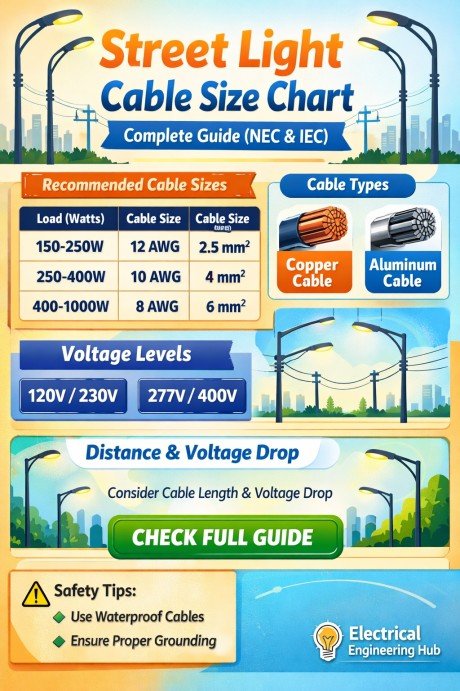
Table of Contents
Table of Contents
Why Street Light Cable Size Matters
Street lights are usually installed in rows with considerable spacing between poles. This creates long cable runs, increasing resistance and voltage drop.
Correct cable sizing helps with:
- Maintaining proper voltage at each pole
- Reducing power loss
- Improving cable lifespan
- Preventing overheating
- Meeting NEC and IEC compliance
- Ensuring public safety
A cable that is undersized may cause dim lighting, while oversized cables can increase project cost unnecessarily.
Know more about Smart Solar Street Light System with IoT Integration
Main Factors for Selecting Street Light Cable Size
Before using a Street Light Cable Size Chart, understand the factors affecting cable selection.
Load Current
The total wattage of all connected street lights determines the current.
Formula:
Current (A) = Power (W) ÷ Voltage (V)
Example:
10 LED lights × 150W = 1500W
At 230V:
Current = 1500 ÷ 230 = 6.52A
Cable Length
Longer cable lengths create higher voltage drops. Distance plays a major role in outdoor lighting circuits.
Voltage Drop Limit
According to IEC, the recommended voltage drop for lighting circuits is 3%.
NEC generally recommends keeping it under 5%, but for lighting systems, lower is better.
Installation Method
Cable buried underground has different ampacity than cable installed in conduit.
Ambient Temperature
High temperatures reduce cable carrying capacity.
Download Free Street Lighting Voltage Drop Calculator in Excel
Street Light Cable Size Chart (IEC Standard)
The following Street Light Cable Size Chart gives general recommendations for copper cables.
| Load Current (A) | Cable Length (Meters) | Recommended Cable Size |
|---|---|---|
| 5A | Up to 50m | 1.5 mm² |
| 5A | 50m to 100m | 2.5 mm² |
| 10A | Up to 50m | 2.5 mm² |
| 10A | 50m to 120m | 4 mm² |
| 16A | Up to 80m | 4 mm² |
| 16A | 80m to 150m | 6 mm² |
| 20A | Up to 100m | 6 mm² |
| 25A | Up to 120m | 10 mm² |
This chart is suitable for 230V single-phase street lighting circuits.
Street Light Cable Size Chart (NEC Standard)
For NEC-based systems using AWG:
| Load Current (A) | Distance (Feet) | Recommended Wire Size |
|---|---|---|
| 5A | Up to 150 ft | 14 AWG |
| 10A | Up to 200 ft | 12 AWG |
| 15A | Up to 250 ft | 10 AWG |
| 20A | Up to 300 ft | 8 AWG |
| 25A | Up to 350 ft | 6 AWG |
NEC Article 310 provides ampacity tables, while Article 210 covers branch circuits.
Use our free street light cable size calculator
Key Takeaways
- Cable size must be selected based on current and distance
- Voltage drop is the biggest factor in street light installations
- IEC recommends a maximum 3% voltage drop for lighting
- NEC wire sizing uses AWG, while IEC uses mm²
- Underground cable conditions affect ampacity
- Copper cables offer better conductivity than aluminum
Using a proper Street Light Cable Size Chart saves energy and increases system reliability.
Voltage Drop Example for Street Lighting
Suppose you have:
- Total Load = 2400W
- Supply Voltage = 230V
- Distance = 120 meters
- Cable = Copper
Current:
2400 ÷ 230 = 10.43A
At this load and distance, the chart suggests 4 mm² cable.
But to improve efficiency and future expansion, 6 mm² may be a better choice.
For accurate calculations, use our detailed street light cable size calculation tool to quickly find the correct conductor size based on load, distance, and voltage drop.
Copper vs Aluminum for Street Lights
Both materials are used in outdoor lighting.
| Factor | Copper | Aluminum |
|---|---|---|
| Conductivity | Higher | Lower |
| Cost | Higher | Lower |
| Flexibility | Better | Moderate |
| Corrosion Resistance | Better | Good |
| Size Requirement | Smaller | Larger |
Copper is often preferred for urban street lighting due to its better conductivity.
Use this tool if you are trying to calculate cable size for underground cables. Try here Underground Cable Size Calculator – Find Correct Wire Size for Long Distance Runs
Common Cable Types for Street Lighting
Different cable types are used depending on environment.
XLPE Cable
Good for underground installations due to heat resistance and durability.
PVC Cable
Cost-effective for short-distance installations.
Armored Cable
Used where mechanical protection is required.
Solar Cable
Used in solar-powered street lights.
If you want a more detailed breakdown of conductor recommendations, check our complete guide on street light wire size for practical examples and advanced sizing methods.
Take a look at this tool for a smarter way to handle feeder wire sizing Feeder Wire Size Calculator – Accurate Guide for Electricians and Homeowners
Practical Tips for Cable Selection
Follow these tips for better installation:
- Always calculate full load current
- Add future load margin of 20%
- Check local code requirements
- Use voltage drop calculators
- Select weather-resistant insulation
- Use armored cables for buried routes
- Consider fault current capacity
These practices improve lighting performance and reduce maintenance costs.
NEC vs IEC Cable Sizing Comparison
| Parameter | NEC | IEC |
|---|---|---|
| Unit | AWG | mm² |
| Voltage Drop Limit | Up to 5% | 3% preferred |
| Main Standard | NFPA 70 | IEC 60364 |
| Ampacity Basis | Article 310 | Installation method tables |
Both standards are widely used, but local regulations decide which one applies.
Use our online tool for free Wire Size Calculator for Motors – Accurate Motor Cable Sizing Tool for Electric Loads
Mistakes to Avoid
Many installers make these common mistakes:
Ignoring Voltage Drop
This is the most frequent issue in long street lighting lines.
Using Minimum Size Only
Always consider future expansion.
Wrong Soil Correction Factor
Underground temperature affects cable performance.
Poor Jointing
Bad joints increase resistance and heat.
A reliable Street Light Cable Size Chart helps reduce these mistakes.
Make your task simple with our online tool electrical cable size calculator
Conclusion
A well-planned street lighting system depends heavily on selecting the right cable size. Using a proper Street Light Cable Size Chart ensures your installation meets NEC and IEC requirements while delivering efficient performance.
Always calculate load current, consider cable length, and check voltage drop before finalizing cable size. Whether you are installing LED street lights, solar poles, or highway lighting systems, correct cable sizing improves safety, saves power, and extends equipment life.
For better accuracy, use calculation tools and refer to code standards regularly.
FAQs
What is the standard cable size for street lights?
For small LED street lights, 2.5 mm² or 4 mm² copper cable is commonly used, depending on distance and load.
How much voltage drop is allowed in street lighting?
IEC recommends 3%, while NEC allows up to 5%, though lower is better for lighting quality.
Which cable is better for street lights, copper or aluminum?
Copper is better due to lower resistance and smaller required size, but aluminum is more economical. Explore our professional online tool for quick calculations kw to cable size calculator
How do I calculate street light cable size?
You need load current, distance, voltage, and voltage drop limit. A cable calculator can simplify this process.
Follow Us on Social:
Subscribe our Newsletter on Electrical Insights for latest updates from Electrical Engineering Hub
StreetLightCableSizeChart, #CableSizingGuide, #NECStandards, #IECStandards, #VoltageDropCalculation, #ElectricalEngineering, #StreetLightingDesign, #CableSelection, #PowerDistribution, #ElectricalSafety