
IEC 61326 Standard Series
The IEC 61326 Standard Series is one of the most important international frameworks for electromagnetic compatibility in electrical equipment used for measurement, control, and laboratory applications. It defines the EMC requirements needed to ensure that equipment works safely and accurately in environments where electromagnetic interference is present.
Manufacturers, engineers, and testing laboratories rely on IEC 61326 Standard to design products that meet compliance requirements for global markets. Without proper EMC compliance, instruments may fail, give inaccurate readings, or interfere with nearby equipment.
This guide explains the IEC 61326 Standard Series, its parts, applications, testing requirements, and why it matters for industrial and laboratory environments.
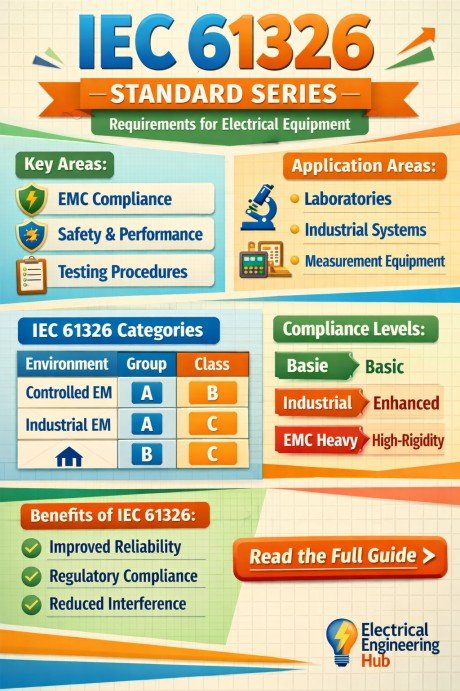
Table of Contents
Table of Contents
What is IEC 61326 Standard?
IEC 61326 Standard is an international standard developed by the International Electrotechnical Commission (IEC). It focuses on electromagnetic compatibility for electrical equipment used in measurement, control, and laboratory use.
The standard ensures that devices:
- Do not generate excessive electromagnetic emissions
- Can withstand electromagnetic disturbances
- Operate reliably in industrial, commercial, and laboratory environments
Explore in detail IEC 61000 Standards
It is widely used in:
- Test and measurement instruments
- Laboratory analyzers
- Industrial automation systems
- Process control equipment
- Monitoring devices
The IEC 61326 Standard helps manufacturers achieve CE marking and other international certifications.
Overview of IEC61326 Standard Series
The IEC 61326 Standard Series consists of multiple parts. Each part addresses specific equipment categories and EMC conditions.
| Standard Part | Description |
|---|---|
| IEC 61326-1 | General EMC requirements |
| IEC 61326-2-1 | Equipment for test and measurement applications |
| IEC 61326-2-2 | Portable test, measuring, and monitoring devices |
| IEC 61326-2-3 | Transducers with integrated conditioning |
| IEC 61326-2-4 | Insulation monitoring devices |
| IEC 61326-2-5 | Field devices in industrial applications |
| IEC 61326-2-6 | In-vitro diagnostic medical equipment |
Each section provides specialized requirements based on operational environments.
Explore more about Electrostatic Discharge (ESD) immunity test standard IEC 61000-4-2
Why IEC 61326 Standard Matters
Modern industrial systems have many electronic devices working together. These devices generate electromagnetic noise. If equipment is not properly protected, performance may suffer.
IEC 61326 Standard provides a clear path for EMC compliance by improving:
- Measurement accuracy
- Equipment safety
- Operational reliability
- Regulatory compliance
- Product quality
For example, in laboratories, even small electromagnetic disturbances can affect sensitive instruments.
Key EMC Requirements in IEC61326 Standard
The standard covers two major EMC areas.
Emission Requirements
Emission tests verify that equipment does not create harmful interference.
Common tests include:
- Conducted emissions
- Radiated emissions
- Harmonic current emissions
- Voltage fluctuations
Explore all about IEC 61000-4 Series
Immunity Requirements
Immunity tests confirm that equipment can resist external disturbances.
Common immunity tests include:
| Test Type | IEC Reference |
|---|---|
| Electrostatic discharge | IEC 61000-4-2 |
| Radiated immunity | IEC 61000-4-3 |
| Electrical fast transient | IEC 61000-4-4 |
| Surge immunity | IEC 61000-4-5 |
| Conducted immunity | IEC 61000-4-6 |
| Voltage dips | IEC 61000-4-11 |
If you want to understand these immunity standards better, you should also explore our detailed guide on IEC 61000 standards for a deeper understanding of EMC test methods.
Find all about IEC 61000-4-3 to know about immunity requirements and testing for equipment
Environmental Classification in IEC61326 Standard Series
The IEC 61326 Standard Series classifies operating environments because EMC risks vary by location.
Basic Electromagnetic Environment
Used for:
- Laboratories
- Research centers
- Controlled industrial spaces
This environment has low interference.
Industrial Electromagnetic Environment
Used for:
- Heavy industries
- Manufacturing plants
- Process control facilities
This environment has high electrical noise.
Find out more about iec 61439 busbar clearance
Portable and Battery-Powered Environment
Portable equipment often needs special requirements due to unpredictable operating conditions.
Key Takeaways
Before selecting or designing equipment under IEC 61326 Standard, remember these important points:
- It focuses on EMC compliance for measuring and control devices
- It includes both emission and immunity testing
- Different series parts apply to different equipment types
- Industrial environments require stricter immunity levels
- Compliance improves product reliability and market acceptance
Understanding these basics can save time during product development.
IEC 61326 Standard Testing Process
Testing under IEC 61326 Standard follows a structured process.
1. Product Classification
The first step is identifying the exact equipment type.
2. Environment Selection
Determine whether the equipment will operate in industrial, laboratory, or portable environments.
3. Applicable Test Selection
Based on classification, select required emission and immunity tests.
4. Laboratory Testing
Certified EMC laboratories perform tests using standardized methods.
5. Compliance Documentation
Successful testing results in compliance reports and declarations.
| Step | Purpose |
|---|---|
| Product review | Identify risks |
| EMC test plan | Define procedures |
| Testing | Validate performance |
| Documentation | Maintain compliance |
Find all about Standard Depth of Underground Cables
Industries Using IEC 61326 Standard
Many industries depend on this standard.
Industrial Automation
PLC systems, process controllers, and sensors need EMC protection.
Laboratories
Analytical equipment like spectrometers and analyzers must avoid signal distortion.
Power Systems
Electrical monitoring systems require reliable performance under fluctuating conditions.
Environmental Monitoring
Portable analyzers used outdoors need immunity against environmental noise.
Medical Diagnostics
Diagnostic instruments often follow IEC 61326-2-6.
Dive deeper into instrument earthing iec standard
Common Compliance Challenges
Meeting IEC 61326 Standard is not always simple.
Manufacturers often face:
- Poor PCB grounding
- Inadequate shielding
- Cable routing issues
- Weak surge protection
- Design changes after testing failures
These issues increase cost and delay product launches.
Early EMC planning can reduce these risks.
Best Practices for IEC 61326 Compliance
To improve success rates:
- Use proper grounding techniques
- Separate noisy and sensitive circuits
- Add EMI filters
- Use shielded cables
- Perform pre-compliance testing
- Follow good enclosure design
These steps help meet EMC limits more easily.
Dive deeper into complete guide to iec 61508
Future Importance of IEC 61326 Standard Series
As industrial automation grows, EMC compliance is becoming more critical. Smart factories, IoT sensors, and connected lab equipment increase electromagnetic complexity.
The IEC 61326 Standard Series will continue evolving to address:
- Wireless communication interference
- Smart instrumentation
- AI-based industrial systems
- High-frequency switching equipment
Manufacturers must stay updated with revisions to remain compliant.
Conclusion
The IEC 61326 Standard Series is essential for ensuring electromagnetic compatibility in measurement, control, and laboratory equipment. It provides clear rules for emission and immunity testing, helping manufacturers build reliable and compliant products.
Whether you design industrial instruments, laboratory analyzers, or portable monitoring systems, understanding IEC 61326 Standard can improve product performance and reduce compliance risks.
Explore details on Electrical Compliance Testing
With growing dependence on electronic systems, EMC compliance is no longer optional. It is a critical part of product quality and market success.
Frequently Asked Questions
1. What is the main purpose of IEC 61326 Standard?
Its main purpose is to define EMC requirements for electrical measurement, control, and laboratory equipment.
2. Is IEC 61326 mandatory?
It is not always legally mandatory, but it is often required for product certifications like CE marking.
3. What is the difference between IEC 61326 and IEC 61000?
IEC 61326 applies EMC requirements to specific equipment, while IEC 61000 standards define general EMC test methods.
4. Who needs IEC 61326 compliance?
Manufacturers of measuring instruments, laboratory equipment, and industrial control devices.
5. How often is IEC 61326 updated?
IEC updates standards periodically to address new technologies and changing EMC environments.
Follow Us on Social:
Subscribe our Newsletter on Electrical Insights for latest updates from Electrical Engineering Hub
IEC61326, #EMCCompliance, #IndustrialAutomation, #ElectricalStandards, #InstrumentationSafety, #EMCTesting, #IECStandards, #ControlSystems, #ComplianceEngineering, #ElectricalEngineering