High Voltage Cable Trench Depth Standards | Best Guide
Proper planning of underground power systems depends heavily on correct installation practices, and one of the most important aspects is High Voltage Cable Trench Depth. This factor directly affects safety, long-term cable performance, and compliance with electrical standards such as IEC and local utility regulations. Incorrect depth can lead to insulation failure, thermal issues, and accidental damage during excavation work. Engineers and contractors must therefore treat trench depth as a critical design parameter rather than a general guideline.
In modern electrical distribution systems, High Voltage Cable Trench Depth is determined by voltage level, soil conditions, mechanical protection, and expected load conditions. Higher voltage circuits typically require deeper burial to reduce risk and improve heat dissipation. Proper depth also ensures adequate separation from other underground utilities like water pipelines and communication ducts, reducing interference and safety hazards.
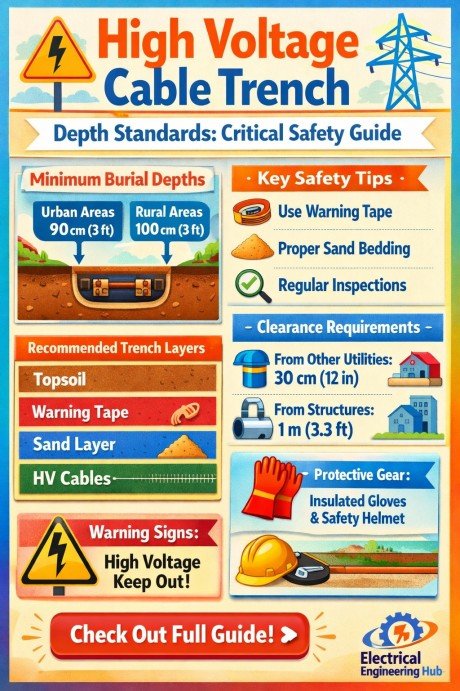
Table of Contents
Another important factor influencing High Voltage Cable Trench Depth is the type of cable construction. Armoured underground power cables, duct bank systems, and direct-buried installations all have different requirements. In urban environments, space constraints often require the use of protective conduits and reinforced concrete covers, while rural installations may allow more standard trenching methods.
Learn more about earthing cable size as per iec
Compliance with regulatory frameworks is essential when determining High Voltage Cable Trench Depth. Standards such as IEC 60364 and local electricity authority codes define minimum burial depths and protective measures. These guidelines are designed to ensure both operational safety and ease of maintenance while minimizing the risk of third-party damage during excavation activities.
Key Takeaways
Check Key Takeaways
- Trench depth directly impacts electrical safety and system reliability
- Voltage level and soil type are major design factors
- Proper backfilling and thermal management improve cable life
- Compliance with IEC and local standards is mandatory
- Mechanical protection reduces risk of external damage
For a deeper understanding of compliance requirements, you can explore our detailed guide on underground cable installation standards, which explains regulatory practices and installation procedures in practical scenarios.
Design Considerations for Safe Cable Burial
When planning High Voltage Cable Trench Depth, engineers must evaluate soil resistivity, moisture content, and ambient temperature. These parameters influence heat dissipation from underground power cables. Poor thermal conditions can increase conductor temperature, reducing efficiency and lifespan.
Load demand also plays a role. Heavily loaded circuits generate more heat, requiring better spacing and deeper trenches. In some cases, thermal backfill materials are used to improve heat transfer and stabilize operating conditions.
Regulatory and Industry Standards
Most electrical authorities define minimum values for High Voltage Cable Trench Depth based on voltage rating. For example, distribution-level cables may require shallower depths than transmission-level systems. However, additional protection such as concrete slabs or warning tapes is often mandatory.
Discover everything about cable bending radius iec standard
Table: Typical Trench Depth Guidelines
| Voltage Level | Typical Trench Depth | Protection Method |
|---|---|---|
| Low Voltage (LV) | 0.6 – 0.9 m | Direct burial or PVC conduit |
| Medium Voltage (MV) | 0.9 – 1.2 m | Duct bank or concrete cover |
| High Voltage (HV) | 1.2 – 1.8 m | Reinforced concrete + warning tape |
| Extra High Voltage | 1.5 – 2.0 m+ | Specialized duct systems |
Following correct High Voltage Cable Trench Depth standards ensures compliance with safety regulations and reduces operational risks.
Installation Process and Execution Steps
The installation process begins with route surveying and marking existing underground utilities. Once the trench alignment is confirmed, excavation is carried out to achieve the required High Voltage Cable Trench Depth.
Cable bedding is then prepared using sand or fine soil to prevent mechanical stress. Cables are laid carefully to avoid bending beyond permissible limits. After placement, protective covers or bricks are installed depending on design specifications.
Backfilling is done in layers to maintain stability. Warning tapes are placed above the cable zone to alert future excavation teams. Proper compaction is essential to avoid soil settlement that could alter the designed High Voltage Cable Trench Depth over time.
Find out more about iec 61439 busbar clearance
Safety Requirements and Risk Prevention
Ensuring correct High Voltage Cable Trench Depth is essential for minimizing electrical hazards. One of the biggest risks is accidental digging by construction equipment, which can cause severe outages or safety incidents. Adequate depth combined with protective markers significantly reduces this risk.
Earthing and bonding systems also play a role in safety. In case of fault conditions, proper grounding ensures fault currents are safely discharged into the earth, protecting equipment and personnel.
Standard Depth Variations Based on Conditions
Different environmental conditions require adjustments in High Voltage Cable Trench Depth. Rocky terrain may require blasting or alternative routing, while sandy soil may need reinforced duct systems to maintain stability.
The table below summarizes adjustments:
| Condition | Adjustment Approach |
|---|---|
| Rocky soil | Reduced depth with protective ducting |
| High water table | Waterproof ducts and insulation |
| Urban area | Shallow trench with concrete slab protection |
| Agricultural land | Standard depth with warning tape |
These variations ensure that High Voltage Cable Trench Depth remains effective under all environmental constraints.
Explore details on iec standard for underground cable laying
Soil and Environmental Influences
Soil composition significantly affects thermal conductivity. Clay soils retain moisture and provide better cooling, while dry sandy soils may require thermal backfill materials to maintain safe operating temperatures.
Seasonal changes also impact performance. In regions with extreme temperature variations, engineers often design flexible systems to accommodate expansion and contraction while maintaining correct High Voltage Cable Trench Depth.
Installation Best Practices for Longevity
Long-term performance depends on strict adherence to installation standards. Proper compaction, correct bedding material, and careful handling of cables are essential.
Maintaining uniform High Voltage Cable Trench Depth along the entire route prevents localized stress points. Engineers also ensure separation from other utilities to avoid electromagnetic interference and mechanical conflict.
Common Mistakes to Avoid
One of the most common errors is inconsistent trench depth due to uneven excavation. This can lead to hot spots and mechanical stress. Another mistake is using improper backfill material, which affects heat dissipation and cable performance.
Ignoring soil testing before installation is also a major issue. Without proper analysis, High Voltage Cable Trench Depth may not meet thermal or mechanical requirements, leading to premature failures.
Get complete information about iec standard for busbar sizing
Frequently Asked Questions
1. What is the standard High Voltage Cable Trench Depth for transmission lines?
It typically ranges between 1.2 to 2.0 meters depending on voltage level and soil conditions.
2. Why is trench depth important for underground cables?
It ensures safety, thermal stability, and protection from mechanical damage during excavation.
3. Can trench depth be reduced in urban areas?
Yes, but only with proper protective systems like duct banks and reinforced concrete covers.
4. How does soil type affect cable installation?
Soil determines heat dissipation and stability, influencing the required depth and backfill method.
5. What standards regulate cable trench depth?
IEC standards and local utility codes define minimum requirements for safe installation.
Follow Us on Social:
Subscribe our Newsletter on Electrical Insights for latest updates from Electrical Engineering Hub
#highvoltagecabletrenchdepthstandards,#highvoltagecabletrenchdepth,#cabletrenchdepthstandards,#highvoltagecable,#cabletrenching,#electricalstandards,#powercableinstallation,#undergroundcables,#cabledepthrequirements,#hvcablesafety