IEEE Standard for Power Transformer Testing: Best Guide for Compliance, Diagnostics and Performance Validation
Power transformers are critical assets in any electrical network, and their reliability directly affects system stability and operational costs. The IEEE standard for power transformer testing provides a structured framework to ensure that transformers meet performance, safety, and durability requirements throughout their lifecycle. From factory acceptance tests to field diagnostics, these standards help engineers maintain consistency and reduce the risk of unexpected failures.
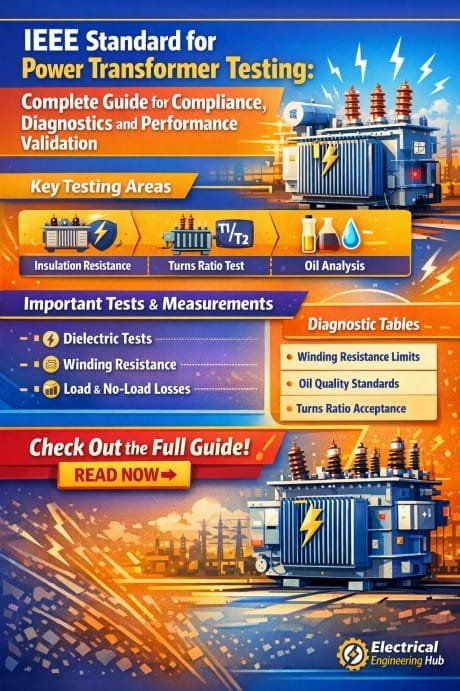
Table of Contents
Understanding how these testing procedures work is essential for utilities, industrial users, and service providers who aim to achieve compliance and optimize transformer performance.
Importance of Transformer Testing in Modern Power Systems
Testing is not just a regulatory requirement; it is a practical necessity. Transformers operate under varying loads, temperatures, and environmental conditions. Without proper evaluation, minor defects can grow into major failures.
Know more about Transformer Oil Testing: 9 Important Tests for Healthiness
The IEEE standard for power transformer testing ensures that every unit undergoes rigorous checks before commissioning and during operation. These tests confirm insulation strength, thermal performance, and electrical characteristics.
Key benefits include:
- Early detection of manufacturing defects
- Improved operational reliability
- Reduced maintenance costs
- Extended service life
- Compliance with international engineering practices
Overview of IEEE Transformer Testing Standards
IEEE has developed several standards that define testing procedures and acceptance criteria. Among them, IEEE C57 series is widely used across the industry.
Below is a quick reference table for commonly used standards:
| Standard | Description | Application |
|---|---|---|
| IEEE C57.12.90 | Standard test code for liquid-immersed transformers | Routine and type testing |
| IEEE C57.12.91 | Dry-type transformer testing | Indoor installations |
| IEEE C57.152 | Diagnostic field testing | Condition monitoring |
| IEEE C57.104 | Dissolved gas analysis interpretation | Fault detection |
These standards collectively form the backbone of the IEEE standard for power transformer testing and guide both manufacturers and field engineers.
Know more about IEEE Standard for Instrument Transformers
Classification of Transformer Tests
Transformer testing is generally divided into three main categories based on purpose and timing.
Routine Tests
Routine tests are performed on every transformer before delivery. They ensure that the unit meets basic operational requirements.
Common routine tests include:
- Winding resistance measurement
- Turns ratio test
- Insulation resistance test
- No-load loss and excitation current
- Load loss and impedance
Type Tests
Type tests are conducted on representative units to validate design performance. These are more extensive and often performed only once for a particular design.
Examples include:
- Temperature rise test
- Lightning impulse test
- Short-circuit withstand test
Special Tests
Special tests are optional and performed based on customer requirements or specific applications.
Learn more about uk transformer manufacturers
Typical special tests include:
- Partial discharge measurement
- Frequency response analysis (FRA)
- Zero-sequence impedance
- Acoustic sound level measurement
Each of these categories is defined under the IEEE standard for power transformer testing to ensure uniform evaluation criteria.
Key Diagnostic Tests and Their Purpose
Diagnostic testing plays a vital role in assessing transformer health during operation. These tests help identify internal faults without dismantling the equipment.
Dissolved Gas Analysis (DGA)
DGA is one of the most widely used techniques. It detects gases formed due to insulation breakdown or overheating.
| Gas Type | Possible Fault |
|---|---|
| Hydrogen | Partial discharge |
| Methane | Low-energy faults |
| Acetylene | Arcing |
| Ethylene | Thermal faults |
Explore details on largest transformer manufacturer in usa
Insulation Power Factor Test
This test measures dielectric losses and indicates insulation deterioration. A rising trend suggests contamination or aging.
Sweep Frequency Response Analysis (SFRA)
SFRA detects mechanical displacement in windings caused by short circuits or transportation damage.
Thermal Imaging
Infrared scanning identifies hot spots in transformer components such as bushings, connections, and cooling systems.
These methods complement the IEEE standard for power transformer testing by providing real-time insights into transformer condition.
Performance Validation Parameters
Performance validation ensures that the transformer operates within design limits under actual service conditions.
Important parameters include:
- Voltage regulation
- Efficiency
- Load handling capability
- Temperature limits
- Insulation integrity
The IEEE standard for power transformer testing defines acceptable limits for each parameter, ensuring consistency across different manufacturers and installations.
Dive deeper into transformer manufacturers in france
Testing Equipment and Tools
Accurate testing requires specialized equipment. The quality of results depends heavily on the precision of instruments used.
| Equipment | Function |
|---|---|
| Transformer turns ratio tester | Measures winding ratio |
| Megger | Insulation resistance testing |
| Power factor test set | Dielectric loss measurement |
| DGA analyzer | Gas analysis |
| SFRA kit | Mechanical integrity check |
Using calibrated and certified equipment is essential to comply with the IEEE standard for power transformer testing.
Field Testing vs Factory Testing
Both factory and field testing serve different purposes but are equally important.
Factory Testing
- Conducted before shipment
- Ensures manufacturing quality
- Performed under controlled conditions
Know all about Transformer Sizing for EV Charger
Field Testing
- Conducted after installation
- Verifies installation integrity
- Detects transport-related damage
The IEEE standard for power transformer testing integrates both approaches to provide a complete validation framework.
Common Testing Challenges and Solutions
Despite well-defined procedures, testing can present challenges in real-world scenarios.
Environmental Conditions
Humidity and temperature can affect insulation measurements. Testing should be performed under stable conditions.
Data Interpretation
Incorrect analysis of test results can lead to wrong decisions. Using historical data and trending helps improve accuracy.
Equipment Calibration
Uncalibrated instruments can produce misleading results. Regular calibration is essential.
Addressing these challenges ensures effective implementation of the IEEE standard for power transformer testing.
Know more about Transformers Earthspark Size Chart
Compliance and Documentation Requirements
Proper documentation is a key part of compliance. Every test must be recorded with detailed observations and results.
Typical documentation includes:
- Test reports
- Calibration certificates
- Inspection records
- Maintenance logs
Maintaining organized records helps in audits and future diagnostics.
Best Practices for Reliable Transformer Testing
Following best practices improves testing accuracy and transformer reliability.
- Schedule regular testing intervals
- Compare results with baseline data
- Use certified testing equipment
- Train personnel on standard procedures
- Follow safety protocols strictly
These practices align with the IEEE standard for power transformer testing and ensure long-term performance.
Find all about Transformer Disconnect Sizing
Future Trends in Transformer Testing
The industry is moving toward advanced monitoring and predictive maintenance.
Emerging trends include:
- Online condition monitoring systems
- AI-based fault prediction
- Digital twins for transformers
- Remote diagnostics using IoT
These technologies enhance traditional methods defined in the IEEE standard for power transformer testing and provide deeper insights into asset health.
Conclusion
The IEEE standard for power transformer testing serves as a comprehensive guide for ensuring transformer reliability, safety, and efficiency. By covering routine checks, advanced diagnostics, and performance validation, it provides a complete framework for both manufacturers and operators.
Explore all about Transformer Bond Sizing
Adopting these standards not only ensures compliance but also reduces operational risks and maintenance costs. With evolving technologies and increasing demand for reliable power systems, following a structured testing approach is more important than ever.
Organizations that implement the IEEE standard for power transformer testing effectively can achieve better asset management, improved system stability, and long-term operational success. Know more about Transformer Cooling Methods: ONAN, ONAF, OFAF & More
Follow Us on Social:
Subscribe our Newsletter on Electrical Insights for latest updates from Electrical Engineering Hub
#IEEEStandards, #PowerTransformerTesting, #TransformerDiagnostics, #ElectricalEngineering, #HighVoltageTesting, #TransformerMaintenance, #IEEECompliance, #EnergySystems, #SubstationTesting, #ElectricalTesting