
Synchrophasor Measurements for Power Systems: Advanced PMU Technology for Real-Time Grid Monitoring & Stability Enhancement
Modern power systems are becoming more complex due to renewable integration, distributed generation, and dynamic load behavior. In this evolving landscape, synchrophasor measurements for power systems have emerged as a critical technology for ensuring grid reliability, visibility, and stability. Utilities and grid operators now rely on advanced Phasor Measurement Units (PMUs) to monitor system conditions in real time and respond proactively to disturbances.
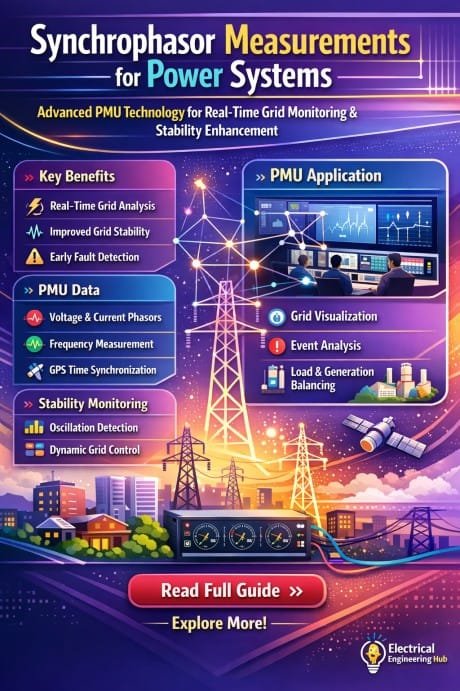
Table of Contents
Understanding Synchrophasor Measurements for Power Systems
At its core, synchrophasor measurements for power systems refer to time-synchronized measurements of electrical quantities such as voltage and current phasors. These measurements are aligned using a precise time source, typically GPS, which allows data from multiple locations to be compared instantaneously.
Unlike conventional SCADA systems that provide data every few seconds, synchrophasor technology delivers high-speed data streams, often 30 to 120 samples per second. This level of detail gives operators a dynamic and accurate view of grid behavior.
Know more about What Provides Short Circuit Protection for the Motor
Key Components of Synchrophasor Systems
| Component | Description |
|---|---|
| PMU (Phasor Measurement Unit) | Measures voltage, current, frequency, and phase angle |
| GPS Receiver | Provides precise time synchronization |
| Phasor Data Concentrator (PDC) | Aggregates data from multiple PMUs |
| Communication Network | Transfers real-time data to control centers |
| Control Center Applications | Analyze and visualize grid conditions |
Know more about Electric Motor Troubleshooting Chart – Complete Fault Diagnosis & Repair Guide for Engineers
How PMU Technology Works
PMUs measure electrical waveforms and convert them into phasors using synchronized timestamps. This synchronization allows operators to detect phase angle differences across geographically dispersed substations. These differences are crucial for identifying power flow issues, oscillations, and potential instability.
The process involves sampling the waveform, applying signal processing algorithms, and tagging each measurement with a universal timestamp. This ensures that synchrophasor measurements for power systems remain consistent and reliable across the network.
Know more about Fault Current and Short Circuit Current: A Quick Guide
Importance in Modern Grid Monitoring
The increasing penetration of renewable energy sources like solar and wind introduces variability and uncertainty into the grid. Traditional monitoring tools struggle to capture these rapid changes. This is where synchrophasor measurements for power systems provide a significant advantage.
They enable operators to:
- Monitor grid conditions in real time
- Detect faults and disturbances instantly
- Analyze system oscillations
- Improve situational awareness
With real-time visibility, utilities can make faster and more informed decisions, reducing the risk of blackouts.
Applications of Synchrophasor Technology
The practical applications of synchrophasor measurements for power systems extend across multiple domains of grid operation and planning.
Wide Area Monitoring Systems (WAMS)
WAMS uses PMU data to monitor large interconnected grids. It helps identify abnormal conditions and ensures system stability.
Know more about Demand Factor for Transformer Sizing – Accurate Load Calculation & Optimal kVA Selection Guide
Fault Detection and Location
PMUs can detect faults within milliseconds and pinpoint their exact location. This reduces downtime and improves restoration speed.
Voltage Stability Monitoring
Voltage collapse is a major concern in heavily loaded systems. Synchrophasor data helps in predicting voltage instability before it occurs.
Know more about Short Circuit Calculation Methods: IEC vs ANSI
Oscillation Detection
Low-frequency oscillations can damage equipment and destabilize the grid. PMUs identify these oscillations early, allowing corrective actions.
Renewable Integration
With fluctuating generation from renewables, synchrophasor measurements for power systems help maintain balance between supply and demand.
Benefits of Synchrophasor Measurements
The adoption of synchrophasor technology brings several operational and economic benefits.
Key Advantages
| Benefit | Impact on Power System |
|---|---|
| Real-Time Monitoring | Immediate visibility of grid conditions |
| Enhanced Reliability | Reduced risk of cascading failures |
| Faster Fault Response | Quick isolation and restoration |
| Improved Stability | Better control of voltage and frequency |
| Data-Driven Decisions | Accurate system analysis and planning |
These advantages make synchrophasor measurements for power systems an essential tool for modern grid management.
Know more about What is the Maximum Value for Short Circuit Protection for Multi-Motor Branch Circuits
Comparison with Traditional SCADA Systems
While SCADA systems have been the backbone of grid monitoring for decades, they have limitations in speed and accuracy. Synchrophasor technology complements and enhances SCADA capabilities.
| Feature | SCADA | Synchrophasor Systems |
|---|---|---|
| Data Rate | 2–4 seconds | 30–120 samples/sec |
| Time Synchronization | Limited | GPS-based precise timing |
| Dynamic Monitoring | Low | High |
| Disturbance Detection | Slow | Instant |
| Grid Visibility | Partial | Wide-area, real-time |
This comparison highlights why synchrophasor measurements for power systems are becoming the preferred solution for advanced monitoring.
Role in Grid Stability Enhancement
Maintaining grid stability is one of the biggest challenges for utilities. Instabilities can lead to cascading failures and large-scale blackouts. Synchrophasor measurements for power systems play a vital role in preventing such scenarios.
Use our online tool Short Circuit Current Calculator: Best Tool
They provide early warning signals for:
- Frequency deviations
- Voltage instability
- Line overloads
- Inter-area oscillations
With these insights, operators can take preventive actions such as load shedding, generator adjustment, or network reconfiguration.
Challenges in Implementation
Despite its advantages, implementing synchrophasor technology comes with certain challenges.
Common Issues
- High initial investment cost
- Communication infrastructure requirements
- Data management and storage complexity
- Cybersecurity concerns
- Need for skilled personnel
However, with ongoing advancements and cost reductions, the adoption of synchrophasor measurements for power systems is steadily increasing worldwide. Know more about NEC NFPA 70 2026 — Complete Guide to Code Updates, Compliance Requirements, and Electrical Safety Standards
Future Trends in PMU Technology
The future of power systems lies in smarter, more resilient grids. Synchrophasor technology is evolving to meet these demands.
Know more about Best Surge Protector Made in USA – Top-Rated Reliable Power Safety for Your Devices
Emerging Developments
- Integration with smart grids and IoT
- Advanced analytics using artificial intelligence
- Cloud-based data processing
- Enhanced cybersecurity frameworks
- Deployment in distribution networks
These innovations will further strengthen the role of synchrophasor measurements for power systems in ensuring grid stability and efficiency.
Practical Considerations for Deployment
For utilities planning to implement synchrophasor systems, careful planning is essential.
Deployment Checklist
- Identify critical substations for PMU placement
- Ensure reliable communication networks
- Integrate with existing SCADA systems
- Train personnel for data analysis
- Establish cybersecurity protocols
A well-planned deployment maximizes the benefits of synchrophasor measurements for power systems and ensures long-term success.
Explore all about Best Surge Protector with USB-C Ports – Fast Charging & Total Device Protection in One Power Strip
Conclusion
As power systems continue to evolve, the need for accurate, real-time monitoring becomes more critical. Synchrophasor measurements for power systems provide a powerful solution for enhancing grid visibility, improving stability, and enabling faster decision-making.
With advanced PMU technology, utilities can detect disturbances early, respond effectively, and maintain a reliable power supply. Despite some implementation challenges, the long-term benefits far outweigh the costs. As the energy sector moves toward smarter grids, synchrophasor technology will remain at the forefront of innovation and stability enhancement.
Know more about HVDC Transformer Working Principle Explained – How Converter Transformers Handle Extreme DC Power
Get new guides in your feed. Follow Electrical Insights on LinkedIn for new electrical standards guides, calculators and design tips from Azad Circuit Hub.
#SynchrophasorMeasurements, #PowerSystemMonitoring, #PMUtechnology, #SmartGridSolutions, #WideAreaMonitoring, #PowerSystemStability, #GridModernization, #ElectricalEngineering, #RealTimeData, #PhasorMeasurementUnits
