IEC Standard for Tan Delta Test: Complete Guide for Accurate Insulation & High Voltage Testing
The IEC standard for tan delta test is a critical guideline for evaluating the health of electrical insulation in high voltage equipment. Tan delta testing, also known as dissipation factor testing, helps in detecting insulation deterioration, moisture ingress, or contamination in transformers, cables, and switchgears.
Following the IEC standard ensures accurate measurements, reliability, and safety in high voltage testing. This article provides a complete guide for engineers and technicians to understand and implement tan delta testing according to international norms.
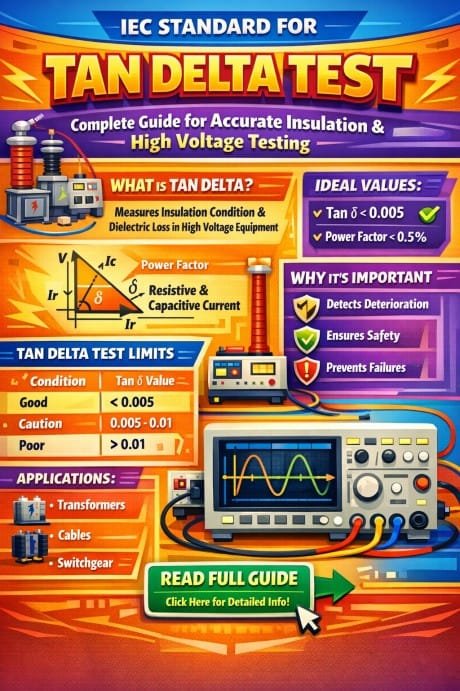
Table of Contents
What is Tan Delta Testing?
Tan delta testing measures the dissipation factor (DF) or loss tangent of insulation material. It quantifies the energy loss in an insulating material under alternating voltage. A low tan delta value indicates healthy insulation, while higher values suggest aging, moisture, or contamination. Tan delta tests are essential for preventive maintenance, ensuring the reliability of electrical systems.
Find all about VLF Tan Delta Testing of MV Cables: Ensure Reliable High-Voltage Cable Performance
The principle of the test is based on applying a high voltage AC to the insulation and measuring the phase difference between the applied voltage and resulting current. The ratio of the resistive current to the capacitive current gives the dissipation factor, expressed as tan δ.
Importance of IEC Standard for Tan Delta Test
The IEC standard for tan delta test provides uniform procedures and limits for testing high voltage equipment. It ensures consistency, repeatability, and comparability of results across different systems and equipment manufacturers. Without following these standards, measurements can be inaccurate, leading to misdiagnosis of insulation condition or unexpected failures.
Some key benefits include:
- Accurate detection of insulation deterioration
- Standardized procedures for global compliance
- Reliable preventive maintenance planning
- Enhanced safety for testing personnel and equipment
Applications of Tan Delta Testing
Tan delta testing is widely applied in the electrical industry. Some common applications are:
- Power Transformers: Detects insulation degradation in transformer windings.
- High Voltage Cables: Identifies moisture penetration or insulation faults.
- Switchgears & Circuit Breakers: Ensures insulation integrity under operational stress.
- Rotating Machines: Evaluates insulation of stator and rotor windings in motors and generators.
IEC Guidelines for Conducting Tan Delta Test
The IEC provides detailed guidance for conducting tan delta tests safely and accurately. According to the IEC standard for tan delta test, the following procedures are recommended:
- Preparation of Equipment:
Ensure the test instrument is calibrated and capable of generating high voltage up to the rated level of the equipment under test. - Safety Measures:
Follow high voltage safety protocols, including grounding, insulation mats, and warning signs. - Voltage Application:
Apply AC voltage gradually to avoid sudden stress on the insulation. The voltage is typically applied in steps to monitor tan delta changes at different stress levels. - Measurement and Recording:
Measure the tan delta and capacitance values at each voltage step. Record the readings systematically for analysis. - Evaluation Against IEC Limits:
Compare the measured tan delta values with IEC standard limits to determine insulation health.
Know more about HT Motor Tan Delta Testing – Best Guide for High Voltage Motor Insulation Diagnostic & Preventive Maintenance
The IEC emphasizes performing tests under controlled environmental conditions, as temperature and humidity can significantly affect readings.
Tan Delta Test Setup
A standard tan delta test setup includes:
| Component | Function |
|---|---|
| High Voltage Source | Provides controlled AC voltage to the insulation |
| Measurement Unit | Records current, voltage, and phase angle |
| Grounding System | Ensures safety and accurate measurement |
| Capacitive Divider | Measures voltage drop across the insulation |
| Test Cables & Probes | Connects equipment under test to the measurement system |
The setup must comply with IEC specifications for insulation test connections, cable lengths, and grounding to minimize errors.
Find all about Partial Discharge vs Tan Delta Cable Testing: Important Key Differences Every Engineer Must Know
Factors Affecting Tan Delta Test Accuracy
Several factors influence tan delta test accuracy. Understanding them is essential to comply with the IEC standard for tan delta test:
- Temperature: High temperatures can increase dissipation factor. Always record ambient temperature during the test.
- Moisture Content: Moisture in insulation increases tan delta readings significantly.
- Frequency: IEC recommends performing the test at the rated frequency of the equipment.
- Voltage Level: Testing at multiple voltage levels helps detect non-linear insulation deterioration.
- Test Equipment Calibration: Only calibrated instruments produce accurate results.
Interpreting Tan Delta Test Results
The analysis of tan delta results is critical for preventive maintenance:
| Tan Delta Value | Insulation Condition | Action Required |
|---|---|---|
| < 0.5% | Excellent | Routine monitoring |
| 0.5% – 1% | Good | Schedule periodic inspection |
| 1% – 2% | Moderate deterioration | Plan maintenance or further diagnostic tests |
| > 2% | Severe deterioration | Immediate action required, possible insulation replacement |
By comparing measurements with previous test results, engineers can track insulation aging and predict equipment failures.
Explore details on High Voltage Cable Testing Procedure: Step-by-Step Guide for Safe & Accurate HV Cable Testing
Advantages of Following IEC Standard
Strict adherence to the IEC standard for tan delta test ensures:
- Consistent testing methodology across different locations and equipment
- Reliable early detection of insulation faults
- Reduced risk of unplanned outages and equipment damage
- Standardized reporting for regulatory compliance
- Increased confidence in long-term equipment performance
Common Misconceptions
Some technicians mistakenly assume that tan delta testing is only necessary for aged equipment. In reality, IEC recommends routine testing for both new and operational equipment to detect latent insulation defects. Another misconception is that a single high voltage test is sufficient. Following IEC guidelines, multiple voltage levels and environmental conditions should be considered for accurate evaluation.
Know more about High Voltage Testing Procedures for Electrical Panels: Step by Step
Conclusion
The IEC standard for tan delta test is a cornerstone of high voltage maintenance, ensuring insulation reliability, safety, and operational efficiency. By adhering to IEC guidelines, engineers can accurately assess insulation condition, plan preventive maintenance, and extend the life of transformers, cables, and high voltage equipment.
Incorporating tan delta testing into regular maintenance schedules provides an effective approach to minimize downtime, reduce costs, and safeguard electrical assets. Understanding the test procedure, setup, and interpretation of results according to IEC standards is essential for any electrical professional working in high voltage environments. Know more about Insulation Resistance Testing: Step-by-Step Process
Following the IEC standard for tan delta test not only aligns with international best practices but also significantly enhances the reliability of power systems. Whether for new installations or ongoing maintenance, this test remains a vital tool in the electrical engineering toolkit.
Follow Us on Social:
Subscribe our Newsletter on Electrical Insights for latest updates from Electrical Engineering Hub
#IECStandard #TanDeltaTest #ElectricalTesting #InsulationTesting #PowerEquipment #HighVoltageTest #ElectricalSafety #IECCompliance #DielectricTest #PVModuleTesting