IEEE Standard for Overhead Conductors: Important Guide to Design, Selection and Compliance
Overhead transmission and distribution lines form the backbone of modern power systems. Their performance depends heavily on the quality, design, and selection of conductors. The IEEE standard for overhead conductors provides a structured framework to ensure safety, efficiency, and long-term reliability. Engineers, contractors, and utility planners rely on these standards to maintain consistency across projects while meeting operational and regulatory requirements.
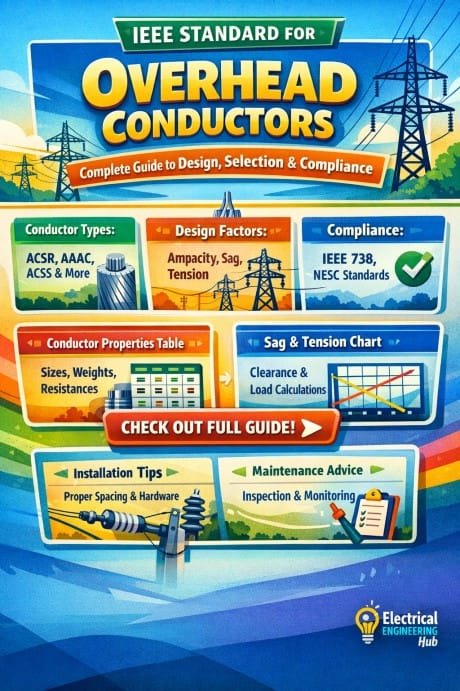
Table of Contents
This guide explains how these standards influence design practices, conductor selection, installation, and compliance. It also highlights practical considerations that matter in real-world applications.
Understanding IEEE Standards in Overhead Line Systems
IEEE standards are developed to establish uniform engineering practices. In the context of overhead conductors, these standards define material properties, electrical characteristics, and mechanical performance requirements.
Know more about Difference Between 11kV and 33kV Substation: Best Guide on Design, Cost, Capacity & Applications
The IEEE standard for overhead conductors focuses on ensuring that conductors can handle electrical load, environmental stress, and mechanical tension without failure. These guidelines are widely used alongside IEC and ASTM standards to achieve global compatibility.
Key objectives include:
- Ensuring electrical efficiency and minimal power losses
- Maintaining mechanical strength under varying loads
- Enhancing safety for both operators and the public
- Supporting long service life with minimal maintenance
Find all about IEEE Standard for Insulation Resistance Test
Types of Overhead Conductors Covered in Standards
Different conductor types are used depending on voltage level, environmental conditions, and cost considerations. The IEEE standard for overhead conductors provides recommendations for commonly used conductor types.
Common Conductor Types
| Conductor Type | Description | Typical Use |
|---|---|---|
| AAC (All Aluminum Conductor) | High conductivity, lightweight | Short span distribution lines |
| ACSR (Aluminum Conductor Steel Reinforced) | Steel core for strength | Long span transmission lines |
| AAAC (All Aluminum Alloy Conductor) | Better corrosion resistance | Coastal and industrial areas |
| ACAR (Aluminum Conductor Alloy Reinforced) | Balanced strength and conductivity | Medium to high voltage lines |
Each conductor type is evaluated based on mechanical strength, sag characteristics, and thermal performance.
Design Considerations for Overhead Conductors
Designing overhead lines is not just about selecting a conductor. It involves analyzing multiple parameters to ensure reliable performance. The IEEE standard for overhead conductors outlines key design factors that engineers must consider.
Explore details on table 250.122 nec
Electrical Parameters
Electrical performance determines how efficiently power is transmitted.
- Current carrying capacity
- Resistance and reactance
- Corona loss at high voltages
- Voltage regulation
Mechanical Parameters
Mechanical strength is critical for maintaining line integrity.
- Tensile strength
- Weight per unit length
- Wind and ice loading
- Sag and tension limits
Know more about types of faults in transmission lines
Environmental Factors
Environmental conditions play a major role in conductor performance.
- Temperature variations
- Pollution levels
- Humidity and corrosion
- Wind speed and direction
Know all the basics about earth conductor size calculation
Sag and Tension Calculations
Sag is the vertical distance between the conductor and the lowest point of the span. Proper sag ensures safety clearance and mechanical stability.
| Factor | Impact on Sag |
|---|---|
| Temperature increase | Increases sag |
| Higher tension | Reduces sag |
| Longer span | Increases sag |
| Heavier conductor | Increases sag |
Accurate sag calculations are essential to comply with safety regulations and avoid line faults.
Selection Criteria for Overhead Conductors
Choosing the right conductor requires balancing technical and economic factors. The IEEE standard for overhead conductors provides a structured approach for selection.
Key Selection Factors
- Load demand and future expansion
- Span length and terrain conditions
- Installation and maintenance costs
- Environmental exposure
- Regulatory requirements
Know more about bus differential protection
Comparison of Selection Parameters
| Parameter | AAC | ACSR | AAAC |
|---|---|---|---|
| Conductivity | High | Medium | Medium |
| Strength | Low | High | Medium |
| Corrosion Resistance | Low | Medium | High |
| Cost | Low | Moderate | Moderate |
Engineers often prefer ACSR for long-distance transmission due to its high tensile strength, while AAAC is suitable for corrosive environments.
Installation Guidelines and Best Practices
Proper installation is essential to achieve the performance expected from conductors. The IEEE standard for overhead conductors provides detailed guidelines to ensure correct installation.
Key Installation Practices
- Use proper stringing techniques to avoid conductor damage
- Maintain recommended tension levels during installation
- Ensure proper jointing and clamping
- Avoid sharp bends and surface abrasions
Know more about Types of Transmission Line Conductors Explained: Best Guide for Power Engineers
Safety Considerations
- Maintain safe clearance from ground and structures
- Use protective equipment during installation
- Follow grounding and bonding practices
Improper installation can lead to premature failure, increased losses, and safety hazards.
Compliance and Regulatory Requirements
Compliance ensures that overhead line systems meet national and international safety standards. The IEEE standard for overhead conductors plays a key role in regulatory approval processes.
Compliance Checklist
| Requirement | Description |
|---|---|
| Material Certification | Verify conductor material quality |
| Mechanical Testing | Ensure tensile strength compliance |
| Electrical Testing | Confirm conductivity and resistance |
| Installation Inspection | Check proper installation practices |
Utilities and contractors must document compliance at every stage, from procurement to commissioning.
Know more about Types of Transmission Lines Explained: Overhead vs Underground with Important Applications
Testing and Quality Assurance
Testing ensures that conductors meet performance expectations before and after installation. The IEEE standard for overhead conductors defines testing procedures to verify quality.
Common Tests
- Tensile strength test
- Conductivity test
- Heat resistance test
- Corrosion resistance test
Regular inspection and maintenance further enhance system reliability.
Advantages of Following IEEE Standards
Adhering to established standards provides several benefits for utilities and project developers.
- Improved system reliability
- Reduced maintenance costs
- Enhanced safety and compliance
- Better performance under extreme conditions
- Increased lifespan of conductors
The IEEE standard for overhead conductors helps minimize risks and ensures consistent performance across different projects.
Know more about Phase to Phase Clearance as per IEC 61439: Best Guide
Challenges in Practical Implementation
Despite clear guidelines, implementing standards in real projects can be challenging.
Common Issues
- Budget constraints leading to substandard material selection
- Lack of skilled workforce for proper installation
- Environmental challenges such as extreme weather
- Inadequate maintenance practices
Addressing these challenges requires proper planning, training, and quality control.
Future Trends in Overhead Conductor Technology
The power industry is evolving rapidly, and conductor technology is improving to meet growing demands.
Emerging Developments
- High-temperature low-sag conductors
- Composite core conductors
- Smart monitoring systems for real-time performance
- Improved corrosion-resistant materials
Dive deeper into instrument earthing iec standard
These advancements are gradually being incorporated into updated versions of the IEEE standard for overhead conductors, ensuring that modern requirements are met.
Conclusion
Overhead conductors are a critical component of power transmission and distribution systems. Their performance directly impacts efficiency, reliability, and safety. The IEEE standard for overhead conductors provides a comprehensive framework that guides engineers through design, selection, installation, and compliance.
By following these standards, utilities and contractors can ensure that their systems operate efficiently under varying conditions. Proper conductor selection, accurate design calculations, and strict compliance practices lead to long-term benefits, including reduced operational costs and improved system stability.
Explore details on iec standard for underground cable laying
Follow Us on Social:
Subscribe our Newsletter on Electrical Insights for latest updates from Electrical Engineering Hub
#IEEEStandardForOverheadConductors, #OverheadConductors, #IEEEStandards, #PowerTransmission, #ElectricalEngineering, #TransmissionLines, #GridInfrastructure, #ConductorDesign, #EnergyStandards, #UtilityEngineering