IEC Standard for Rectifier Transformer – Design Requirements, Compliance Guide & Industrial Applications
Rectifier transformers are critical components in many industrial power systems where alternating current must be converted into direct current. Because these transformers operate under heavy electrical stress, harmonics, and nonlinear loads, their design must follow strict international guidelines. The IEC standard for rectifier transformer provides a structured framework that ensures safety, efficiency, reliability, and compatibility with industrial power conversion systems.
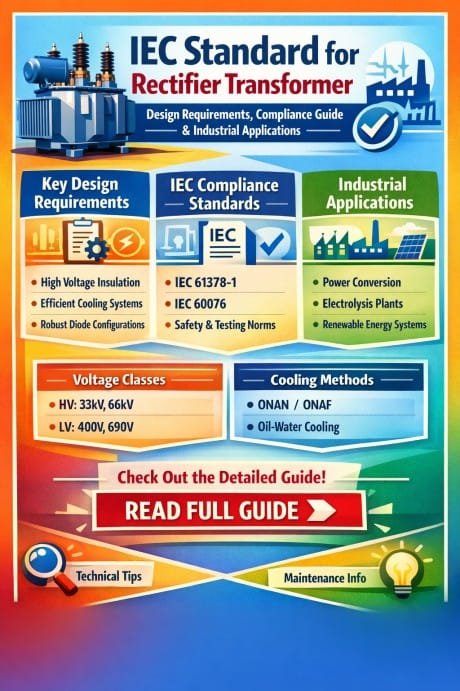
Table of Contents
Industries such as electrolysis plants, DC traction systems, HVDC transmission, metal processing facilities, and chemical manufacturing rely heavily on rectifier transformers. Compliance with the IEC standard for rectifier transformer ensures that these transformers perform reliably under challenging operating conditions while maintaining acceptable limits for temperature rise, insulation strength, and harmonic distortion.
Understanding these standards is essential for electrical engineers, procurement professionals, and industrial plant designers who are responsible for specifying or selecting rectifier transformer equipment.
Know more about IEC Standard for Neutral to Earth Voltage – Limits, Measurement & Safety Guidelines
Understanding Rectifier Transformers and Their Role
A rectifier transformer is a specially designed power transformer that supplies AC power to rectifier circuits, which then convert the AC into DC power. Unlike conventional distribution transformers, rectifier transformers must handle harmonic currents, voltage distortion, and higher thermal stresses.
The IEC standard for rectifier transformer defines the design requirements needed to withstand these demanding electrical conditions. These transformers often feature multiple secondary windings, phase shifting arrangements, and enhanced insulation systems to accommodate rectifier operation.
Common configurations include:
- Star–delta connections
- Delta–delta configurations
- Phase-shifting transformer arrangements
- Multi-winding rectifier transformer systems
These designs help minimize harmonic distortion and improve overall system performance in high-power rectification systems.
Key IEC Standards Applicable to Rectifier Transformers
Several IEC standards collectively form the regulatory framework for rectifier transformer design, manufacturing, and testing. The IEC standard for rectifier transformer typically references multiple documents that address insulation, performance, testing, and operational requirements.
| IEC Standard | Description | Application |
|---|---|---|
| IEC 61378 | Converter transformers for industrial applications | Core design guideline for rectifier transformers |
| IEC 60076 | Power transformer standard | General transformer design and testing |
| IEC 60076-3 | Insulation levels and dielectric tests | High voltage insulation performance |
| IEC 60076-5 | Short circuit withstand capability | Mechanical strength during faults |
| IEC 61000 | Electromagnetic compatibility | Harmonic and EMI performance |
Among these, IEC 61378 is considered the primary IEC standard for rectifier transformer used in industrial converter applications.
Find all about Capacitor Bank Sizing for Power Factor Correction – Step by Step
Design Requirements Defined by IEC Standards
The design of rectifier transformers must address several technical challenges that are not present in conventional power transformers. The IEC standard for rectifier transformer outlines several critical design factors.
Thermal Performance
Rectifier transformers operate with high harmonic currents that increase losses and temperature rise in the windings. Designers must consider:
- Increased eddy current losses
- Stray flux losses in tank walls
- Enhanced cooling systems
Typical cooling methods include ONAN, ONAF, OFAF, and OFWF depending on the transformer rating and industrial environment.
Know more about Transformer Cooling Methods: ONAN, ONAF, OFAF & More
Harmonic Current Handling
Rectifier loads produce harmonic currents that can significantly affect transformer operation. The IEC standard for rectifier transformer requires transformers to be designed for:
- Non-sinusoidal load currents
- Increased copper losses
- Additional heating in windings
To address these issues, manufacturers often use special conductor arrangements and magnetic shielding.
Insulation Coordination
Rectifier transformers are often connected to high voltage systems and must withstand voltage transients and switching surges. The IEC standard for rectifier transformer specifies insulation levels based on system voltage and operating conditions.
Important insulation considerations include:
- Basic insulation level (BIL)
- Lightning impulse withstand voltage
- Partial discharge limits
- Dielectric strength testing
Mechanical Strength
Short circuit forces can cause significant mechanical stress on transformer windings. IEC standards require that rectifier transformers maintain structural integrity during fault conditions.
This involves:
- Robust clamping structures
- Reinforced winding supports
- Adequate short circuit withstand capability
Find all about IEC Standard for Relay Testing: Best Guide
Typical Technical Specifications
When specifying a rectifier transformer, engineers typically define several electrical and mechanical parameters. These specifications ensure compliance with the IEC standard for rectifier transformer.
| Parameter | Typical Range |
|---|---|
| Power Rating | 500 kVA – 200 MVA |
| Primary Voltage | 6 kV – 400 kV |
| Secondary Voltage | Based on rectifier configuration |
| Cooling Method | ONAN / ONAF / OFAF |
| Frequency | 50 Hz or 60 Hz |
| Vector Group | Custom based on rectifier design |
| Impedance | Typically 8% – 15% |
Proper specification ensures the transformer can operate efficiently within the intended power conversion system.
Testing Requirements According to IEC Standards
Before a rectifier transformer is delivered to an industrial facility, it must undergo rigorous testing procedures. The IEC standard for rectifier transformer defines several routine, type, and special tests.
Explore all about Transformer Bond Sizing
Routine Tests
These tests are conducted on every transformer produced.
- Winding resistance measurement
- Ratio and polarity verification
- Insulation resistance test
- No-load loss measurement
- Load loss measurement
Type Tests
Type tests verify the transformer design and performance.
- Temperature rise test
- Lightning impulse test
- Short circuit withstand test
Special Tests
Some industrial applications require additional verification.
- Harmonic current capability test
- Partial discharge measurement
- Acoustic noise measurement
These tests confirm that the transformer meets international safety and reliability standards. Find more Transformer calculators here
Industrial Applications of Rectifier Transformers
Rectifier transformers are widely used in industries where high power DC supply is required. The IEC standard for rectifier transformer ensures that these transformers operate safely in these demanding applications.
Common industrial sectors include:
| Industry | Application |
|---|---|
| Aluminum Smelting | Electrolytic reduction process |
| Electrochemical Plants | Chlorine and hydrogen production |
| Railway Systems | DC traction power supply |
| HVDC Transmission | Converter stations |
| Steel Industry | Electric arc furnaces |
| Mining Industry | DC motor drives |
In these environments, rectifier transformers operate continuously under heavy electrical loading, making IEC compliance essential for long-term reliability.
Know all about Transformer Sizing for EV Charger
Advantages of Following IEC Standards
Adhering to the IEC standard for rectifier transformer offers several benefits for power system designers and industrial operators.
Key advantages include:
- Improved transformer reliability
- Enhanced thermal performance
- Better harmonic handling capability
- Increased safety and insulation protection
- Global standardization for procurement
Because IEC standards are internationally recognized, equipment designed according to these guidelines can be used in projects across different countries without compatibility concerns.
Selection Guidelines for Engineers
When selecting a rectifier transformer, engineers should evaluate several important parameters to ensure compliance with the IEC standard for rectifier transformer.
Know more about Transformers Earthspark Size Chart
Important selection factors include:
- Transformer power rating
- Rectifier configuration (6 pulse, 12 pulse, 24 pulse)
- Harmonic distortion limits
- Cooling system requirements
- Voltage regulation performance
- Installation environment
Proper coordination between transformer manufacturers, electrical engineers, and system designers ensures optimal performance in industrial rectification systems.
Conclusion
Rectifier transformers play a crucial role in converting AC power into DC for heavy industrial processes. Because these transformers operate under challenging electrical conditions, strict adherence to international standards is essential. The IEC standard for rectifier transformer provides a comprehensive framework that defines design requirements, testing procedures, insulation coordination, and operational performance. Find all about Transformer Disconnect Sizing
By following these standards, manufacturers can produce high-quality transformers capable of handling harmonic currents, thermal stresses, and high power loads. For engineers and industrial operators, understanding the IEC standard for rectifier transformer helps ensure reliable equipment selection, improved system efficiency, and long-term operational stability in demanding industrial environments.
Explore details on largest transformer manufacturer in usa
Follow Us on Social:
Subscribe our Newsletter on Electrical Insights for latest updates from Electrical Engineering Hub
#IECStandardForRectifierTransformer, #RectifierTransformer, #IECStandards, #PowerTransformerDesign, #ElectricalEngineering, #IndustrialPowerSystems, #TransformerTesting, #PowerQuality, #ElectricalStandards, #SubstationEngineering