IEC Standard for Thermal Overload Relay: Complete Guide for Selection, Testing & Compliance
The iec standard for thermal overload relay plays a critical role in ensuring the safe and reliable operation of electrical motors and industrial systems. Thermal overload relays are essential protection devices used to prevent motor damage caused by overheating, phase failure, or prolonged overcurrent conditions. Understanding the applicable IEC standards helps engineers, technicians, and business owners select the right relay, test it properly, and remain compliant with international safety requirements.
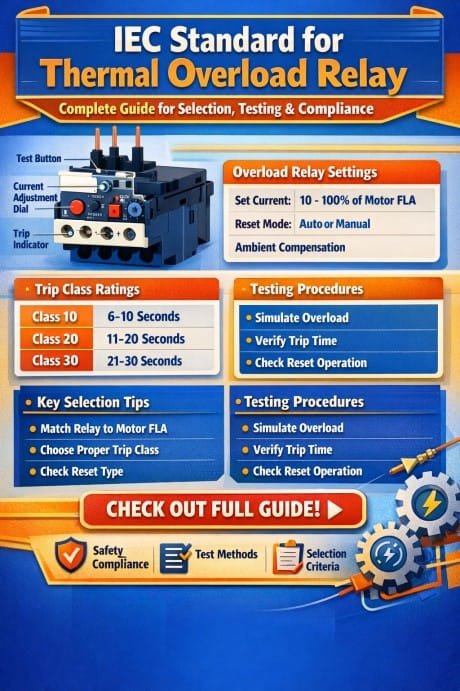
Table of Contents
In this complete guide, you will learn how the iec standard for thermal overload relay works, how to select the right device, and what testing and compliance measures are required in modern electrical installations.
What is a Thermal Overload Relay?
A thermal overload relay is a protective device designed to protect motors from overheating due to excessive current. It operates based on heat generated by current flow through a bimetallic strip or electronic sensing mechanism.
When the motor draws more current than its rated capacity for an extended time, the relay trips and disconnects the circuit. This prevents insulation damage, winding failure, and costly downtime.
Dive deeper into complete guide to iec 61508
The iec standard for thermal overload relay defines how these devices should perform under different operating conditions, ensuring consistency across manufacturers.
Relevant IEC Standards for Thermal Overload Relay
The main international standard governing thermal overload relays is IEC 60947, particularly IEC 60947-4-1, which covers contactors and motor starters.
Here is a quick overview of key IEC standards:
| Standard | Description |
|---|---|
| IEC 60947-4-1 | Covers electromechanical contactors and motor starters including overload relays |
| IEC 60947-1 | General rules for low-voltage switchgear and controlgear |
| IEC 60947-5-1 | Control circuit devices and switching elements |
| IEC 60255 | Electrical relays (for protective relays in general applications) |
The iec standard for thermal overload relay ensures that devices meet strict requirements related to tripping characteristics, temperature performance, and reliability.
Know more about What is Standard Voltage in USA? All You need to Know
Working Principle According to IEC Guidelines
Thermal overload relays operate based on inverse time characteristics. This means the higher the current, the faster the relay trips.
Two main types are commonly used:
- Bimetallic thermal overload relays
- Electronic thermal overload relays
According to the iec standard for thermal overload relay, the relay must:
- Trip within defined time-current curves
- Withstand normal starting currents
- Provide phase loss protection
- Maintain accuracy under varying ambient temperatures
These guidelines ensure that the relay does not trip unnecessarily while still providing reliable protection.
Tripping Classes Defined by IEC
One of the most important aspects of the iec standard for thermal overload relay is tripping class. It determines how quickly a relay responds to overload conditions.
| Tripping Class | Typical Trip Time | Application |
|---|---|---|
| Class 10A | 2–10 seconds | Standard motors |
| Class 10 | 4–10 seconds | General purpose |
| Class 20 | 6–20 seconds | Heavy-duty loads |
| Class 30 | 9–30 seconds | High inertia loads |
Choosing the correct tripping class is essential for motor protection and process stability.
Selection Guide for Thermal Overload Relay
Selecting the right relay is critical for system performance. The iec standard for thermal overload relay provides clear criteria to ensure proper selection.
Learn more in detail on NEMA 250 Enclosures – Electrical Enclosure Standards | Best Manufacturing Companies in USA
Key Selection Factors
- Motor Full Load Current (FLC)
Always match the relay setting range with the motor’s rated current. - Tripping Class
Select based on load type and starting characteristics. - Ambient Temperature
Ensure the relay compensates for temperature variations. - Mounting Compatibility
Confirm compatibility with contactors or motor starters. - Reset Mode
Choose between manual and automatic reset depending on safety needs.
Know more about Transformer Oil Testing: 9 Important Tests for Healthiness
Example Selection Table
| Motor Rating (kW) | Voltage (V) | FLC (A) | Recommended Relay Range |
|---|---|---|---|
| 5.5 kW | 400 V | 11 A | 9–13 A |
| 11 kW | 400 V | 22 A | 18–25 A |
| 22 kW | 400 V | 42 A | 37–50 A |
| 45 kW | 400 V | 85 A | 80–95 A |
Following the iec standard for thermal overload relay ensures optimal protection and long motor life.
Know more about Phase to Phase Clearance as per IEC 61439: Best Guide
Testing Procedures for Compliance
Testing is essential to verify that the relay operates within IEC-defined limits. The iec standard for thermal overload relay outlines several testing methods.
Common Tests
- Overload Trip Test
- Phase Failure Test
- Temperature Rise Test
- Repeatability Test
- Insulation Resistance Test
Testing Parameters
| Test Type | Purpose | Expected Outcome |
|---|---|---|
| Overload Test | Verify trip timing | Matches IEC curve |
| Phase Loss Test | Detect single phasing | Relay trips quickly |
| Thermal Stability | Heat endurance | No false tripping |
| Calibration Test | Accuracy check | Within tolerance |
Routine testing ensures compliance with the iec standard for thermal overload relay and reduces the risk of unexpected failures.
Use our online tool Creepage Distance Calculator – Calculate Safe Insulation & Clearance for PCB and High Voltage Design
Installation and Setting Best Practices
Proper installation is as important as correct selection. The iec standard for thermal overload relay emphasizes correct settings and wiring practices.
Best Practices
- Set the relay to 100–115% of motor FLC
- Ensure proper phase connection
- Avoid installing in high heat zones without compensation
- Use proper cable sizing
- Regularly inspect for loose connections
Incorrect installation can lead to nuisance tripping or failure to protect the motor.
Common Mistakes to Avoid
Even experienced professionals make mistakes when dealing with overload protection. The iec standard for thermal overload relay helps avoid these common errors:
- Selecting incorrect tripping class
- Ignoring ambient temperature effects
- Using undersized or oversized relay
- Skipping periodic testing
- Improper reset configuration
Avoiding these issues improves reliability and compliance.
Know more about IEC Standard for Neutral to Earth Voltage – Limits, Measurement & Safety Guidelines
Advantages of IEC-Compliant Thermal Overload Relays
Using devices aligned with the iec standard for thermal overload relay offers several benefits:
- Improved motor protection
- Standardized performance globally
- Better safety and compliance
- Reduced maintenance costs
- Enhanced system reliability
These advantages make IEC-compliant relays a preferred choice in industrial and commercial applications. Know all about ieee and iec standards
Applications in Industry
Thermal overload relays are widely used across various industries. The iec standard for thermal overload relay ensures they perform reliably in different environments.
Common Applications
- Industrial motor control panels
- HVAC systems
- Pumps and compressors
- Conveyor systems
- Manufacturing machinery
Their role is critical in preventing downtime and protecting expensive equipment.
Final Thoughts
The iec standard for thermal overload relay is a fundamental guideline for ensuring safe and efficient motor protection. From selection and installation to testing and compliance, following IEC standards guarantees consistent performance and long-term reliability.
Whether you are an electrical contractor, engineer, or business owner, understanding the iec standard for thermal overload relay helps you make informed decisions and maintain high safety standards. By applying the principles covered in this guide, you can optimize your system performance while ensuring compliance with international best practices.
Find all about IEC Standard for Relay Testing: Best Guide
Follow Us on Social:
Subscribe our Newsletter on Electrical Insights for latest updates from Electrical Engineering Hub
#IECStandard, #ThermalOverloadRelay, #MotorProtection, #ElectricalEngineering, #RelayTesting, #IndustrialSafety, #IECCompliance, #OverloadProtection, #ControlSystems, #ElectricalStandards