IEC 61000-3 – Power Quality Harmonics Standard Explained for Electrical Engineers
Power quality has become a major concern in modern electrical systems because of the increasing use of electronic loads such as variable frequency drives, switched-mode power supplies, LED lighting, and industrial automation equipment. These devices do not draw current in a purely sinusoidal form and therefore introduce harmonics into the electrical network. Harmonic distortion can lead to overheating of equipment, malfunction of protection devices, and excessive losses in transformers and cables.
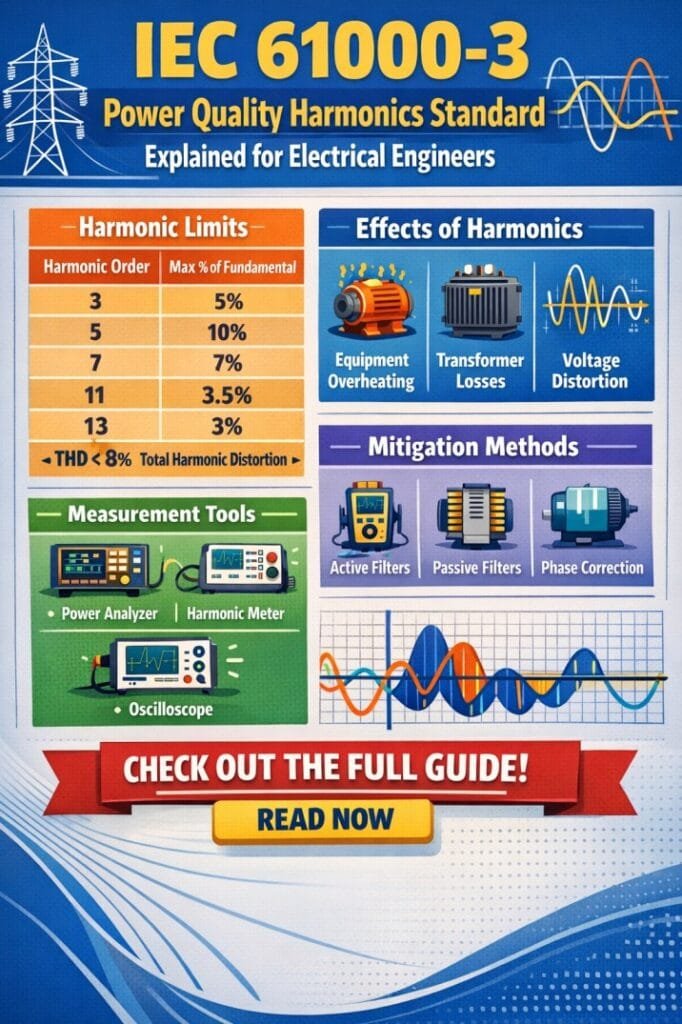
Table of Contents
To control this issue, international standards define acceptable limits for harmonic emissions. One of the most important standards used worldwide is IEC 61000 3, which provides limits and guidelines to control harmonic currents injected into public low-voltage power systems. Understanding IEC 61000-3 is essential for electrical engineers involved in power system design, equipment manufacturing, testing, and compliance verification.
Learn more about earthing cable size as per iec
This article explains the purpose, structure, and technical requirements of IEC 61000 3, along with its practical implications for engineers and power quality professionals.
Overview of IEC 61000-3
The IEC 61000-3 series is part of the broader IEC 61000 electromagnetic compatibility (EMC) standard family. While many EMC standards focus on immunity or electromagnetic emissions, IEC 61000-3 specifically addresses disturbances in public power supply networks caused by electrical equipment.
The standard focuses mainly on two types of disturbances:
• Harmonic current emissions
• Voltage fluctuations and flicker
Electrical equipment connected to public networks must comply with the limits defined in IEC 61000-3 to ensure that the overall power system remains stable and reliable.
The main objective of IEC 61000-3 is to limit the harmonic distortion generated by individual devices so that the combined effect of many devices does not degrade the power quality of the supply network.
Discover everything about cable bending radius iec standard
Structure of the IEC 61000 3 Standard
The IEC 61000-3 series consists of multiple parts, each covering a specific aspect of power quality disturbances. Electrical engineers commonly encounter the following sections during equipment design and testing.
| IEC 61000-3 Part | Description | Typical Application |
|---|---|---|
| IEC 61000-3-2 | Limits for harmonic current emissions | Equipment ≤16 A per phase |
| IEC 61000-3-3 | Voltage fluctuations and flicker limits | Equipment ≤16 A per phase |
| IEC 61000-3-11 | Voltage fluctuations for higher current equipment | Equipment up to 75 A |
| IEC 61000-3-12 | Harmonic limits for higher current equipment | Equipment 16 A – 75 A |
Among these, IEC 61000 3-2 is the most widely referenced part because it defines harmonic limits for most commercial and household electrical equipment.
Find out more about iec 61439 busbar clearance
Why Harmonics Occur in Electrical Systems
Modern electrical devices often use power electronics for efficient operation. These circuits draw current in short pulses instead of a smooth sinusoidal waveform. When such loads operate on the AC supply, they introduce harmonic currents at multiples of the fundamental frequency.
Common sources of harmonics include:
• Variable frequency drives (VFDs)
• Uninterruptible power supplies (UPS)
• LED drivers and electronic lighting systems
• Computer power supplies
• Battery chargers
• Industrial rectifiers
These harmonic currents distort the voltage waveform in the network and create several technical problems.
| Harmonic Problem | Impact on Electrical System |
|---|---|
| Transformer overheating | Increased losses and reduced lifespan |
| Neutral conductor overloading | Triplen harmonics accumulate in neutral |
| Capacitor bank failure | Resonance and excessive current |
| Protection malfunction | False tripping of breakers and relays |
| Increased system losses | Lower efficiency of distribution network |
To prevent these problems, IEC 61000-3 defines acceptable emission limits for electrical equipment connected to the grid.
Explore details on iec standard for underground cable laying
Equipment Classification in IEC 61000-3-2
The harmonic current limits defined in IEC 61000 3 depend on the type of equipment. To simplify compliance, the standard classifies equipment into different categories.
| Equipment Class | Typical Examples |
|---|---|
| Class A | Balanced three-phase equipment, household appliances |
| Class B | Portable tools |
| Class C | Lighting equipment |
| Class D | Personal computers, monitors, televisions |
Each class has its own harmonic current limits because the operating characteristics of these devices are different.
For example, lighting equipment produces distinct harmonic patterns compared to industrial machinery. By classifying equipment types, IEC 61000-3 ensures that harmonic limits remain realistic while maintaining power quality.
Get complete information about iec standard for busbar sizing
Harmonic Current Limits
One of the core features of IEC 61000 3 is the specification of harmonic current limits for different harmonic orders. These limits are defined as maximum permissible current levels relative to the fundamental current.
Below is an example of typical harmonic limits used in the standard.
| Harmonic Order | Maximum Permissible Current |
|---|---|
| 3rd harmonic | Limited to prevent neutral overload |
| 5th harmonic | Controlled due to high distortion impact |
| 7th harmonic | Reduced to maintain waveform stability |
| 9th and higher | Gradually decreasing limits |
These limits ensure that the harmonic distortion produced by individual equipment does not accumulate to dangerous levels in the distribution network. Understand better about nec 430.32
Electrical engineers performing compliance testing must measure harmonic currents using specialized power quality analyzers according to the test procedures specified in IEC 61000-3.
Voltage Fluctuations and Flicker Requirements
Another important aspect of IEC 61000 3 is the control of voltage fluctuations. Rapid changes in electrical load can cause visible flicker in lighting systems, which can be uncomfortable for occupants.
Typical sources of flicker include:
• Large motors starting frequently
• Welding equipment
• Arc furnaces
• Compressors and pumps
The standard defines acceptable flicker levels using parameters such as:
• Short term flicker severity (Pst)
• Long term flicker severity (Plt)
Electrical equipment must meet the limits defined in IEC 61000-3 before it can be connected to the public supply network. Know more about iec 61508
Compliance Testing for IEC 61000-3
Manufacturers must verify that their products comply with IEC 61000 3 before releasing them to the market. Testing is usually performed in accredited EMC laboratories using standardized measurement procedures.
The compliance process typically includes the following steps.
- Connecting the equipment to a controlled test power source
- Measuring harmonic current emissions
- Evaluating voltage fluctuations and flicker
- Comparing results with the limits defined in the standard
- Documenting the results for certification
Testing instruments used during compliance evaluation include power quality analyzers, harmonic analyzers, and flicker meters. Read in detail about iec 61439 busbar calculation
| Test Parameter | Measurement Instrument |
|---|---|
| Harmonic current | Harmonic analyzer |
| Voltage fluctuation | Flicker meter |
| Total harmonic distortion | Power quality analyzer |
| Current waveform | Digital oscilloscope |
These measurements help engineers confirm whether the equipment meets the requirements specified in IEC 61000-3. Use our online tool electricity load calculator in kw for home
Importance of IEC 61000-3 for Electrical Engineers
Electrical engineers working in power systems, manufacturing, and industrial automation frequently deal with harmonic distortion. Knowledge of IEC 61000 3 helps engineers design equipment that minimizes interference with the power grid.
Some key benefits of following IEC 61000-3 include:
• Improved power quality in distribution networks
• Reduced overheating of transformers and cables
• Better reliability of sensitive electronic equipment
• Compliance with international regulatory requirements
• Easier global market access for electrical products
By controlling harmonic emissions at the equipment level, the standard ensures that the cumulative effect of many devices does not degrade the power supply system. Uncover insights on iec standard for lighting lux level
Practical Design Considerations
Engineers designing electrical equipment often implement several techniques to comply with IEC 61000 3 harmonic limits.
Common mitigation methods include:
• Power factor correction circuits
• Passive harmonic filters
• Active harmonic filters
• Multi-pulse rectifier configurations
• Improved converter control techniques
These design strategies help reduce harmonic distortion and ensure compliance with the emission limits defined in IEC 61000-3.
For example, many modern power supplies use active power factor correction (PFC) circuits to shape the input current waveform into a near-sinusoidal form.
Explore details on iec 61508 functional safety
IEC 61000-3 and Modern Power Systems
As electrical networks continue to evolve with renewable energy systems, electric vehicles, and distributed generation, harmonic distortion is becoming an even greater concern. Solar inverters, EV chargers, and high-frequency power converters can all introduce harmonics into the network.
Because of these emerging technologies, the role of IEC 61000-3 is becoming increasingly important for maintaining grid stability and protecting infrastructure.
Utilities and regulatory authorities rely on standards like IEC 61000 3 to ensure that new technologies integrate smoothly into existing power systems without degrading power quality.
Know more about Phase to Phase Clearance as per IEC 61439: Best Guide
Conclusion
Harmonic distortion is one of the most significant power quality challenges in modern electrical systems. Nonlinear loads used in industrial equipment, consumer electronics, and lighting systems can introduce unwanted harmonic currents into the power network.
The IEC 61000-3 standard provides internationally recognized limits and guidelines to control these disturbances and maintain stable operation of public electricity networks. By defining harmonic current limits, equipment classifications, and flicker requirements, the standard helps engineers design devices that are compatible with modern power systems.
Use our online tool Creepage Distance Calculator – Calculate Safe Insulation & Clearance for PCB and High Voltage Design
For electrical engineers, understanding IEC 61000-3 is essential when designing equipment, performing compliance testing, or analyzing power quality issues. Proper implementation of the standard not only improves system reliability but also ensures that electrical products meet global regulatory requirements and operate safely within the power grid.
Follow Us on Social:
Subscribe our Newsletter on Electrical Insights for latest updates from Electrical Engineering Hub
#IEC610003, #PowerQualityStandards, #HarmonicDistortion, #ElectricalStandards, #EMCCompliance, #PowerSystemEngineering, #ElectricalEngineering, #HarmonicsControl, #GridCompliance, #EMCStandards