Development Board vs Microcontroller: Important Comparison Guide for Embedded Systems Projects
Embedded systems are the backbone of modern electronics, from smart home devices to industrial automation. When starting a project, one of the most common confusions for beginners and even intermediate developers is understanding Development Board vs Microcontroller. Both are closely related, yet they serve different purposes in hardware design and embedded programming. Choosing the right option can significantly impact cost, development speed, and scalability of your project.
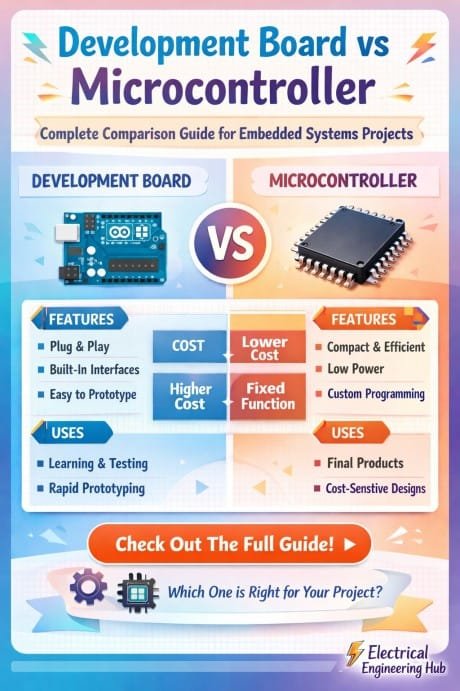
Table of Contents
In simple terms, Development Board vs Microcontroller is not just a technical comparison but also a decision between convenience and customization. A development board provides an easy-to-use environment with built-in components, while a microcontroller offers raw processing capability that requires external circuits for full functionality. Understanding their strengths helps in building efficient embedded systems.
Understanding the Basics
The discussion around Development Board vs Microcontroller starts with their fundamental structure. A microcontroller is a compact integrated circuit that contains a processor, memory, and input/output peripherals on a single chip. It is designed for dedicated tasks and runs firmware directly.
Know more about Best FPGA Development Board For Beginners
On the other hand, a development board is a ready-made platform that includes a microcontroller along with additional components such as USB interfaces, voltage regulators, oscillators, and sometimes sensors. In the context of Development Board vs Microcontroller, the development board acts as a learning and prototyping tool that simplifies hardware setup.
What is a Development Board?
A development board is designed to help engineers and students quickly prototype embedded systems without dealing with complex circuitry. Boards like Arduino, ESP32 DevKit, and Raspberry Pi Pico are widely used in education and rapid development.
Key features include:
- Built-in power regulation
- USB connectivity for easy programming
- Pre-soldered components
- Support for multiple programming environments
These features make it ideal for beginners who want to focus on coding rather than hardware design. In Development Board vs Microcontroller discussions, this ease of use is a major advantage.
What is a Microcontroller?
A microcontroller is the core processing unit used in embedded systems. Popular examples include ATmega328P, PIC microcontrollers, and STM32 series. Unlike development boards, it requires external circuits for power supply, programming interface, and communication modules.
Find all about Wemos D1 Mini Pinout for Arduino
Microcontrollers are preferred in commercial products because they allow full control over hardware design, power consumption, and cost optimization. They are commonly used in automotive systems, medical devices, and industrial controllers.
Key Differences Between Development Board vs Microcontroller
| Feature | Development Board | Microcontroller |
|---|---|---|
| Hardware Setup | Pre-built and ready to use | Requires external circuitry |
| Ease of Use | Beginner-friendly | Requires technical expertise |
| Cost Efficiency | Higher per unit | Lower in mass production |
| Flexibility | Limited hardware customization | Fully customizable design |
| Application Stage | Prototyping and learning | Final product integration |
This comparison clearly shows how Development Board vs Microcontroller differs in terms of usage and application stages in embedded system design.
Why Beginners Prefer Development Board vs Microcontroller
For beginners entering the world of embedded systems, Development Board vs Microcontroller becomes an important learning decision. Development boards provide a plug-and-play environment where users can write code, upload it instantly, and see results without worrying about circuit design.
Microcontrollers, however, require deeper understanding of electronics such as resistors, capacitors, clock systems, and power regulation. This learning curve makes development boards a more practical starting point for most learners.
Hardware Design Perspective in Development Board vs Microcontroller
From a hardware engineering perspective, Development Board vs Microcontroller highlights a trade-off between integration and control. Development boards come with integrated USB-to-serial converters, voltage regulators, and sometimes debugging tools, which simplify the design process.
Find all about 10 Electronics Project Ideas Without Arduino
Microcontrollers, in contrast, allow engineers to design custom PCBs tailored to specific needs. This reduces unnecessary components and improves efficiency in mass production systems. However, it also increases initial development time and complexity.
Programming and Ecosystem
Software development is another key area in Development Board vs Microcontroller. Development boards usually support high-level programming environments like Arduino IDE or MicroPython, which reduce coding complexity.
Microcontrollers often require low-level programming using C or assembly language, along with external programmers for firmware flashing. This gives developers more control over performance but increases development effort.
| Aspect | Development Board | Microcontroller |
|---|---|---|
| Programming Level | High-level APIs | Low-level firmware |
| Debugging | Easy via USB | Requires external tools |
| Libraries | Rich ecosystem | Limited or custom |
Cost and Scalability
In Development Board vs Microcontroller, cost plays a crucial role in product development. Development boards are more expensive per unit because they include additional components that are not needed in final production.
Microcontrollers are cost-effective when used in large-scale manufacturing. Engineers often prototype using development boards and later migrate to standalone microcontroller circuits for production to reduce overall cost. Find all about Raspberry Pi Projects For Beginners
Choosing the Right Option for Your Project
When deciding between Development Board vs Microcontroller, the choice depends on the project stage and requirements. For learning, experimentation, and quick prototyping, development boards are ideal. They reduce setup time and allow rapid testing of ideas.
Know more about 10 Arduino Project Ideas Tinkercad
For commercial products, industrial automation, or battery-powered devices, microcontrollers are more suitable due to their efficiency and compact design.
Common Use Cases
Development boards are commonly used in:
- Robotics prototypes
- IoT experiments
- Educational labs
- Smart home demos
Microcontrollers are used in:
- Automotive control systems
- Medical monitoring devices
- Industrial machines
- Consumer electronics
This real-world usage further clarifies the practical difference in Development Board vs Microcontroller selection.
Know more about Arduino Project Ideas For Electrical Engineering
Final Thoughts
Understanding Development Board vs Microcontroller is essential for anyone working in embedded systems. Both have unique strengths and limitations, and neither can replace the other completely. Development boards simplify learning and prototyping, while microcontrollers offer efficiency and flexibility for final products. A balanced approach—starting with development boards and transitioning to microcontrollers—often leads to the best engineering outcomes in embedded design.
Follow Us on Social:
Subscribe our Newsletter on Electrical Insights for latest updates from Electrical Engineering Hub
#developmentboardvsmicrocontroller,#microcontroller,#embeddedsystems,#arduino,#raspberrypi,#electronicsengineering,#iotprojects,#circuitdesign,#robotics,#learnembedded