IEEE Standard for Transformer Protection: Complete Guide for Reliable Power System Safety & Compliance
The ieee standard for transformer protection plays a critical role in ensuring safe, stable, and efficient operation of power systems worldwide. As transformers form the backbone of electrical transmission and distribution networks, their protection against faults, overloads, and insulation failures is essential for uninterrupted power supply.
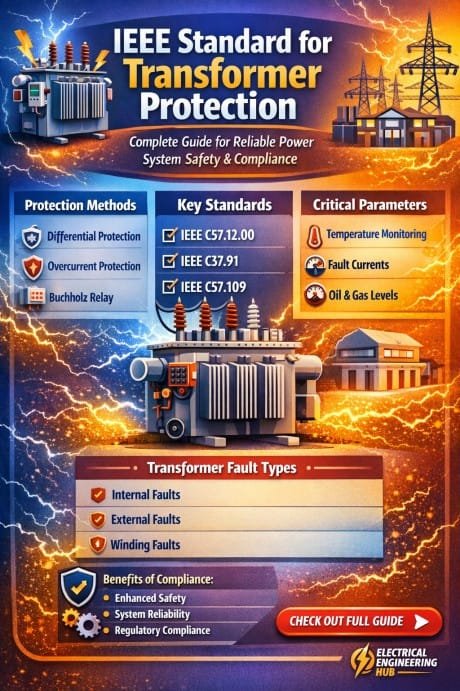
Table of Contents
Modern utilities and industrial systems rely on structured guidelines and engineering practices defined under this standard to minimize risks and enhance system reliability. Understanding the ieee standard for transformer protection helps engineers, technicians, and project designers implement consistent protection strategies that align with global best practices.
Learn more about earthing cable size as per iec
Introduction to Transformer Protection Standards
Transformer protection is a key aspect of power system engineering that focuses on detecting internal and external faults before they cause severe damage. The ieee standard for transformer protection provides a structured framework that defines how transformers should be monitored, protected, and maintained in different operating conditions.
In power networks, transformers are exposed to electrical stress, thermal overload, short circuits, and insulation breakdowns. These conditions can significantly reduce equipment life if not managed properly. The ieee standard for transformer protection outlines essential requirements for protection relays, fault detection systems, and coordination with upstream and downstream devices.
Engineers use these guidelines to ensure that protection schemes are both selective and sensitive, reducing unnecessary tripping while maintaining system safety.
Importance of Transformer Protection in Power Systems
The importance of transformer protection cannot be overstated in modern electrical infrastructure. A failure in a single transformer can lead to cascading outages and significant financial losses. The ieee standard for transformer protection ensures that such risks are minimized through proper design and implementation.
Key reasons for its importance include:
- Prevention of catastrophic transformer failures
- Reduction in downtime and maintenance costs
- Enhanced safety for personnel and equipment
- Improved system reliability and fault isolation
- Compliance with international electrical safety practices
Discover everything about cable bending radius iec standard
In industrial environments, following the ieee standard for transformer protection helps maintain operational continuity and protects critical loads from unexpected disruptions.
Key IEEE Standards and Technical Framework
The ieee standard for transformer protection is closely associated with several IEEE C57 series standards that govern transformer design, testing, and safety requirements. These standards define how protection systems should be integrated with transformer construction and operational parameters.
Common IEEE standards related to transformer protection
| Standard | Description | Application |
|---|---|---|
| IEEE C57.12.00 | General requirements for liquid-immersed transformers | Design and manufacturing |
| IEEE C57.12.90 | Test code for transformers | Performance testing |
| IEEE C57.91 | Loading guide for oil-immersed transformers | Thermal and overload analysis |
| IEEE C37 series | Relay and protection standards | Protective relays coordination |
The ieee standard for transformer protection ensures that these documents work together to provide a unified approach to transformer safety, testing, and operational reliability.
Explore details on iec standard for underground cable laying
Common Transformer Protection Schemes
Protection schemes are the core of transformer safety systems. The ieee standard for transformer protection recommends multiple layers of protection to detect both internal and external faults effectively.
Key protection methods include:
- Differential Protection: Detects internal winding faults by comparing input and output currents
- Overcurrent Protection: Protects against external short circuits and overload conditions
- Buchholz Relay Protection: Identifies gas accumulation in oil-filled transformers
- Restricted Earth Fault Protection: Detects ground faults within transformer windings
- Thermal Protection: Monitors temperature rise in windings and oil
Each of these methods is designed to act independently or in coordination depending on fault severity. The ieee standard for transformer protection emphasizes selectivity to ensure only the affected section is isolated.
Protection Functions Overview
The following table summarizes major transformer protection functions used in accordance with industry practices defined under the ieee standard for transformer protection.
| Protection Type | Function | Response Time | Application Area |
|---|---|---|---|
| Differential | Internal fault detection | Very fast | Core and windings |
| Overcurrent | External fault protection | Fast | Incoming feeders |
| Buchholz Relay | Gas-based fault detection | Medium | Oil-immersed transformers |
| Thermal Relay | Overheating protection | Slow | Load monitoring |
| Earth Fault | Ground fault detection | Fast | Neutral grounding systems |
This structured approach ensures that protection systems operate efficiently under various fault conditions while maintaining system stability.
Get complete information about iec standard for busbar sizing
Compliance and System Reliability
Compliance with the ieee standard for transformer protection is essential for utilities, industrial plants, and renewable energy systems. It ensures that transformer protection systems meet global safety and performance benchmarks.
Compliance involves:
- Proper relay calibration and testing
- Accurate fault current calculation
- Coordination studies with network protection systems
- Adherence to insulation and thermal limits
- Periodic inspection and maintenance schedules
By following the ieee standard for transformer protection, engineers can ensure consistent reliability across different voltage levels and load conditions.
Testing and Commissioning Practices
Testing is a crucial phase in transformer protection implementation. The ieee standard for transformer protection provides guidelines for verifying relay accuracy, response time, and system coordination before energizing the transformer.
Dive deeper into instrument earthing iec standard
Common testing procedures include:
- Primary injection testing for current transformers
- Secondary injection testing for protection relays
- Insulation resistance testing
- Turn ratio and polarity checks
- Functional testing of trip circuits
These tests help ensure that the protection system performs as intended during real fault conditions. Proper commissioning reduces the risk of unexpected failures and enhances long-term system stability.
Design Considerations for Protection Systems
Designing a transformer protection system requires careful planning and coordination. The ieee standard for transformer protection guides engineers in selecting appropriate devices and setting protection parameters based on transformer size, voltage class, and application.
Learn more in detail on NEMA 250 Enclosures – Electrical Enclosure Standards | Best Manufacturing Companies in USA
Important design factors include:
- Transformer rating and impedance
- Fault level calculations
- Relay coordination with upstream systems
- Cooling method and thermal limits
- Sensitivity and selectivity balance
A well-designed system ensures that minor disturbances do not lead to major outages. The ieee standard for transformer protection helps maintain this balance through structured engineering practices.
Common Transformer Faults and Detection Methods
Understanding transformer faults is essential for effective protection system design. The ieee standard for transformer protection addresses various fault conditions and their detection techniques.
Typical faults include:
- Phase-to-phase short circuits
- Winding insulation failure
- Core overheating
- Oil leakage and gas formation
- External line faults
Detection methods rely on electrical, thermal, and mechanical indicators. The ieee standard for transformer protection ensures that these faults are identified early to prevent catastrophic damage.
Know more about Phase to Phase Clearance as per IEC 61439: Best Guide
Best Practices for Reliable Transformer Protection
Implementing best practices enhances system reliability and extends transformer life. The ieee standard for transformer protection encourages a proactive approach to maintenance and system monitoring.
Best practices include:
- Regular relay calibration and testing
- Continuous temperature monitoring
- Proper grounding and earthing systems
- Coordination studies for system upgrades
- Use of modern digital protection relays
These practices help maintain operational efficiency and reduce unexpected failures in power systems.
Know more about IEC Standard for Earthing System
Conclusion
The ieee standard for transformer protection serves as a comprehensive guideline for designing, implementing, and maintaining reliable transformer protection systems. It ensures that electrical networks operate safely under normal and fault conditions while minimizing downtime and equipment damage. By following structured protection schemes, testing methods, and compliance requirements, engineers can achieve high levels of system stability and operational efficiency.
In modern power systems, the ieee standard for transformer protection remains a foundational reference that supports safe energy distribution and long-term infrastructure reliability. Find all about IEEE Standard for Short Circuit Calculation
Follow Us on Social:
Subscribe our Newsletter on Electrical Insights for latest updates from Electrical Engineering Hub
#IEEEStandard, #TransformerProtection, #PowerSystemProtection, #ElectricalEngineering, #SubstationDesign, #RelayProtection, #GridSafety, #PowerEngineering, #ElectricalStandards, #EnergySystems