
NEMA Standard for Transformer Impedance: Complete Guide to Specifications, Limits & Design Practices
Understanding the nema standard for transformer impedance is essential for engineers, consultants, and business owners dealing with electrical systems. Transformer impedance directly affects voltage regulation, fault current levels, and overall system stability. If you are designing, selecting, or installing transformers, a clear understanding of these standards will help you make better technical and financial decisions.
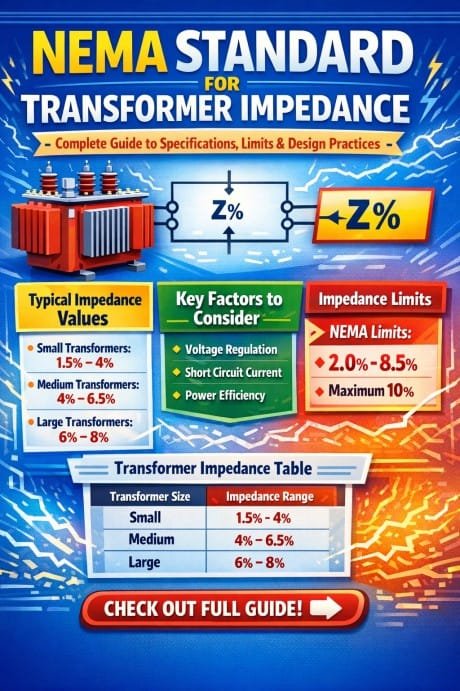
Table of Contents
This guide explains specifications, limits, and practical design considerations in a simple and professional way.
What is Transformer Impedance?
Transformer impedance is the opposition a transformer offers to the flow of current. It is expressed as a percentage and represents the voltage required to circulate rated current under short-circuit conditions.
In practical terms, impedance determines:
- Fault current levels during short circuits
- Voltage drop under load conditions
- Load sharing between parallel transformers
The nema standard for transformer impedance provides guidance on acceptable impedance ranges to ensure safe and efficient operation.
Know more about IEC Standard for Neutral to Earth Voltage – Limits, Measurement & Safety Guidelines
Why NEMA Standards Matter
The National Electrical Manufacturers Association (NEMA) sets industry guidelines to maintain consistency, safety, and performance across electrical equipment.
Following the nema standard for transformer impedance ensures:
- Compatibility between equipment
- Predictable system performance
- Reduced risk of equipment failure
- Compliance with engineering best practices
Unlike some rigid standards, NEMA allows flexibility, which is useful in customized industrial applications.
Typical Impedance Values as per NEMA Guidelines
The nema standard for transformer impedance does not fix a single value but provides recommended ranges based on transformer size and application.
Here is a general reference table:
| Transformer Rating (kVA) | Typical Impedance (%) |
|---|---|
| Up to 50 kVA | 2.0 – 4.0% |
| 51 – 500 kVA | 4.0 – 6.0% |
| 501 – 2500 kVA | 5.5 – 7.5% |
| Above 2500 kVA | 6.0 – 10.0% |
These values align with the nema standard for transformer impedance and may vary slightly depending on manufacturer design and application needs.
Know all about ieee and iec standards
Factors Affecting Transformer Impedance
Transformer impedance is not random. It is influenced by several design and operational factors.
Core and Winding Design
The spacing between windings and the geometry of the core significantly affect impedance. Larger spacing increases impedance, which helps limit fault currents.
Voltage Class
Higher voltage transformers usually have higher impedance to handle insulation and safety requirements. This is consistent with the nema standard for transformer impedance.
Cooling Method
Oil-filled transformers and dry-type transformers may have different impedance ranges due to thermal and mechanical design differences.
Application Requirements
Industrial applications may require higher impedance to limit short-circuit currents, while commercial buildings may prefer lower impedance for better voltage regulation.
Know more about IEC Standard for Earthing System
Impedance Tolerance Limits
NEMA allows certain tolerances in impedance values. These tolerances are important when comparing transformer performance.
| Parameter | Typical Tolerance |
|---|---|
| Impedance Variation | ±7.5% |
| Manufacturing Variation | ±5% |
The nema standard for transformer impedance ensures that even with these variations, the transformer performs within acceptable limits.
Impact of Impedance on System Performance
Transformer impedance plays a major role in electrical system behavior.
Use our online tool Creepage Distance Calculator – Calculate Safe Insulation & Clearance for PCB and High Voltage Design
Fault Current Limitation
Higher impedance reduces fault current. This helps protect:
- Circuit breakers
- Switchgear
- Cables
This is one of the key reasons the nema standard for transformer impedance is followed in industrial systems.
Voltage Regulation
Lower impedance results in better voltage regulation. However, it increases fault current levels. Engineers must balance both factors.
Parallel Operation
When operating transformers in parallel, matching impedance is critical. Even small differences can cause uneven load sharing.
Design Practices Based on NEMA Standards
Good design practices ensure that transformers meet both performance and safety requirements.
Selecting the Right Impedance
Use the nema standard for transformer impedance as a baseline, then adjust based on:
- Load type
- Fault level requirements
- System voltage
Coordination with Protection Systems
Transformer impedance must align with protection devices such as relays and breakers. Incorrect impedance can lead to nuisance tripping or failure to trip.
Future Expansion Planning
Choose impedance values that allow for future load expansion without major system changes.
Know more about Phase to Phase Clearance as per IEC 61439: Best Guide
Thermal and Mechanical Strength
Higher impedance often improves mechanical strength during short circuits. This is a hidden advantage considered in the nema standard for transformer impedance.
Comparison with IEEE Standards
While NEMA provides flexible guidelines, IEEE standards are more detailed and calculation-based.
| Feature | NEMA | IEEE |
|---|---|---|
| Approach | General guidelines | Detailed calculations |
| Flexibility | High | Moderate |
| Application Focus | Commercial & industrial | Utility & large systems |
| Impedance Specification | Range-based | Exact design-based |
Many engineers use both standards together for optimal design.
Common Mistakes to Avoid
Ignoring the nema standard for transformer impedance can lead to serious system issues. Here are some common mistakes:
- Selecting low impedance to improve voltage without considering fault current
- Mismatching impedance in parallel transformers
- Ignoring tolerance limits
- Not coordinating with protection systems
Avoiding these mistakes improves reliability and reduces operational risks.
Learn more about Arc Flash Risk Assessment According to NFPA 70E
Practical Example
Consider a 1000 kVA transformer in an industrial setup.
- Recommended impedance: 5.5% to 7.5%
- Selected impedance: 6.5%
Benefits:
- Controlled fault current
- Acceptable voltage regulation
- Compatibility with protection devices
This selection aligns well with the nema standard for transformer impedance and ensures balanced system performance.
Key Takeaways
Understanding the nema standard for transformer impedance helps you:
- Design safer electrical systems
- Control short-circuit currents
- Maintain voltage stability
- Ensure compatibility across equipment
It is not just a specification but a practical guideline for real-world engineering decisions.
Dive deeper into instrument earthing iec standard
Final Thoughts
The nema standard for transformer impedance serves as a reliable framework for transformer selection and system design. It balances flexibility with performance, allowing engineers to adapt based on specific project needs.
Whether you are working on a small commercial installation or a large industrial facility, applying these principles will improve system efficiency and long-term reliability. By carefully selecting impedance values and following best design practices, you can avoid costly mistakes and ensure smooth electrical operation. Discover everything about cable bending radius iec standard
Follow Us on Social:
Subscribe our Newsletter on Electrical Insights for latest updates from Electrical Engineering Hub
#NEMAStandard, #TransformerImpedance, #ElectricalEngineering, #PowerTransformers, #NEMAStandards, #ImpedanceCalculation, #ElectricalDesign, #TransformerDesign, #EngineeringStandards, #PowerSystems
