IEC Standard for GIS – Design Requirements, Testing Procedures & Compliance Guide
Gas Insulated Switchgear (GIS) has become a critical component in modern power systems where space limitations, reliability, and safety are major design considerations. Electrical utilities, transmission companies, and industrial facilities increasingly rely on GIS technology for medium and high voltage installations. To ensure performance, safety, and interoperability across manufacturers, international guidelines are defined under the IEC standard for GIS.
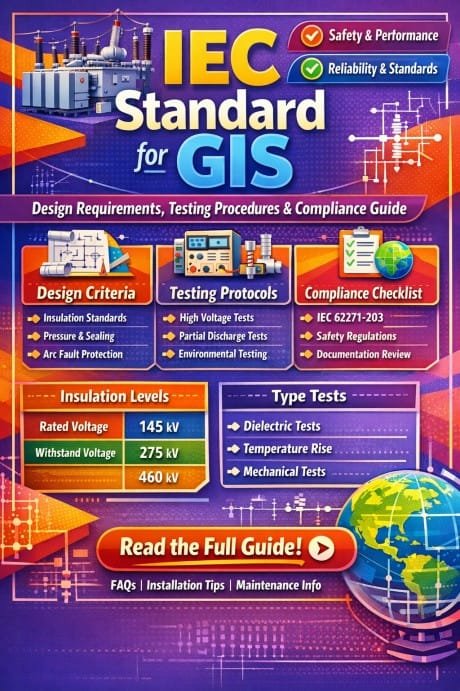
Table of Contents
The IEC standard for GIS provides a structured framework that covers design specifications, insulation requirements, mechanical strength, testing procedures, and compliance practices. These standards ensure that gas insulated switchgear operates safely under various electrical and environmental conditions while maintaining long service life.
Understanding these standards is essential for electrical engineers, consultants, equipment manufacturers, and power system operators who work with high voltage substations and compact switchgear installations.
Learn more about earthing cable size as per iec
Overview of IEC Standard for GIS
The International Electrotechnical Commission (IEC) develops global standards for electrical and electronic technologies. In the case of gas insulated switchgear, the most relevant guideline is IEC 62271, particularly IEC 62271-203, which specifically addresses high-voltage gas insulated metal-enclosed switchgear.
The IEC standard for GIS defines the construction, testing, and performance requirements for switchgear systems that use sulfur hexafluoride (SF6) or other insulating gases.
These standards cover systems typically rated above 52 kV and are widely adopted by utilities and manufacturers worldwide.
Key IEC Standards Related to GIS
| IEC Standard | Description |
|---|---|
| IEC 62271-1 | Common specifications for high-voltage switchgear and controlgear |
| IEC 62271-203 | Specific standard for gas insulated metal-enclosed switchgear |
| IEC 62271-100 | High-voltage circuit breakers |
| IEC 62271-102 | High-voltage disconnectors and earthing switches |
| IEC 62271-4 | Handling procedures for SF6 gas |
These documents collectively form the foundation of the IEC standard for GIS, ensuring consistency in design and operation across different installations.
Discover everything about cable bending radius iec standard
Design Requirements Under IEC Standard for GIS
The IEC standard for GIS defines several technical design requirements that manufacturers must meet to ensure safe and reliable operation. These requirements address electrical insulation, mechanical integrity, environmental protection, and operational reliability.
Electrical Insulation Requirements
Gas insulated switchgear relies primarily on SF6 gas insulation. The standard specifies insulation coordination to withstand system voltages and transient overvoltages.
Important parameters include:
- Rated lightning impulse withstand voltage
- Rated switching impulse withstand voltage
- Power frequency withstand voltage
- Partial discharge limits
Proper insulation design ensures that the GIS equipment can handle voltage surges caused by lightning strikes or switching operations without failure.
Explore details on iec standard for underground cable laying
Mechanical Design Requirements
Mechanical strength is another key element covered in the IEC standard for GIS. Since GIS equipment is sealed and pressurized, it must withstand both internal gas pressure and external environmental forces.
Important design aspects include:
- Pressure-resistant enclosure design
- Sealing integrity to prevent gas leakage
- Mechanical endurance of switching components
- Structural support for busbars and disconnectors
The enclosures are typically made of aluminum or stainless steel to provide corrosion resistance and long-term durability.
Find out more about iec 61439 busbar clearance
Environmental and Operational Conditions
The IEC standard for GIS also defines environmental conditions under which the equipment must operate safely.
Typical conditions specified include:
- Ambient temperature range
- Maximum altitude for installation
- Seismic withstand capability
- Humidity and pollution levels
GIS installations in coastal areas, deserts, or seismic zones require additional design considerations to comply with these environmental requirements.
Testing Procedures According to IEC Standard for GIS
Testing plays a crucial role in verifying the safety and performance of gas insulated switchgear. The IEC standard for GIS defines different categories of tests that must be conducted during manufacturing and installation.
These tests ensure that the equipment meets the required performance specifications before it is placed into service.
Get complete information about iec standard for busbar sizing
Type Tests
Type tests are conducted on prototype equipment to confirm that the design meets the requirements defined by the IEC standard for GIS.
Common type tests include:
- Lightning impulse withstand test
- Power frequency voltage test
- Temperature rise test
- Short-circuit current test
- Mechanical endurance test
These tests simulate extreme operating conditions to verify the durability and electrical integrity of the switchgear.
Routine Tests
Routine tests are performed on every GIS unit during manufacturing to ensure quality consistency.
Typical routine tests include:
| Test Type | Purpose |
|---|---|
| Power frequency withstand test | Verify insulation integrity |
| Partial discharge measurement | Detect insulation defects |
| Gas leakage test | Ensure enclosure sealing |
| Mechanical operation test | Confirm switching functionality |
Routine testing ensures that each manufactured unit complies with the IEC standard for GIS before delivery.
Dive deeper into instrument earthing iec standard
Site Acceptance Tests
After installation at the substation, additional tests are conducted to confirm correct assembly and operation.
Site tests usually include:
- Insulation resistance measurement
- Functional operation tests
- Gas pressure verification
- High voltage commissioning tests
These procedures ensure that the installed GIS system performs reliably under actual operating conditions.
Compliance Requirements for Utilities and Manufacturers
Compliance with the IEC standard for GIS is essential for equipment manufacturers and power utilities. Regulatory bodies and project consultants typically require certification that equipment meets these international standards.
Manufacturer Compliance
Manufacturers must demonstrate compliance through:
- Certified type test reports
- Quality management systems (ISO 9001)
- Factory acceptance testing documentation
- Material traceability records
This documentation ensures that all components meet the required technical specifications.
Know more about Phase to Phase Clearance as per IEC 61439: Best Guide
Utility Compliance
Power utilities must ensure proper installation and maintenance to maintain compliance with the IEC standard for GIS.
Key practices include:
- Periodic gas density monitoring
- Partial discharge monitoring
- Thermal inspection of connections
- Scheduled maintenance of switching mechanisms
These measures help extend the service life of GIS installations and maintain operational safety. Use our online tool Creepage Distance Calculator – Calculate Safe Insulation & Clearance for PCB and High Voltage Design
Advantages of Following IEC Standard for GIS
Adhering to the IEC standard for GIS provides several operational and technical benefits for electrical utilities and industrial users.
| Benefit | Explanation |
|---|---|
| Global compatibility | Equipment from different manufacturers can operate together |
| Improved safety | Strict insulation and testing requirements reduce failure risk |
| Higher reliability | Standardized testing ensures long-term performance |
| Simplified maintenance | Uniform design guidelines make maintenance easier |
| Regulatory acceptance | Many countries require IEC-compliant equipment |
These advantages make IEC standards the preferred benchmark for high-voltage switchgear systems worldwide. Know more about IEC Standard for Earthing System
Future Trends in GIS Standards
With the growing focus on environmental sustainability, the IEC standard for GIS is evolving to address the environmental impact of SF6 gas. Researchers and manufacturers are developing alternative insulating gases with lower global warming potential.
Modern GIS systems are also incorporating:
- Digital monitoring systems
- Online partial discharge diagnostics
- Smart grid integration
- Compact modular designs
Future revisions of the IEC standard for GIS will likely include updated guidelines for eco-friendly insulation technologies and digital monitoring systems.
Know more about IEC Standard for Insulation Resistance Test – Procedures, Limits & Best Practices Explained
Conclusion
Gas insulated switchgear plays a vital role in modern power transmission and distribution networks. Ensuring the reliability and safety of these systems requires strict adherence to internationally recognized standards. The IEC standard for GIS provides comprehensive guidelines covering design requirements, insulation coordination, mechanical strength, and rigorous testing procedures.
By following the IEC standard for GIS, manufacturers can produce reliable equipment while utilities can maintain safe and efficient substation operations. As power systems continue to evolve with higher reliability expectations and environmental considerations, these standards will remain essential in guiding the design and operation of gas insulated switchgear installations worldwide.
Know more about IEC Standard for Neutral to Earth Voltage – Limits, Measurement & Safety Guidelines
Follow Us on Social:
Subscribe our Newsletter on Electrical Insights for latest updates from Electrical Engineering Hub
#IECStandardForGIS, #GasInsulatedSwitchgear, #HighVoltageEngineering, #ElectricalStandards, #PowerSystemProtection, #SubstationEngineering, #GISSubstation, #ElectricalEngineering, #PowerTransmission, #IECStandards