Solar Tax Credit 2026 USA: Complete Guide to Federal Solar Incentives, Savings & Eligibility
Homeowners across the United States are increasingly investing in clean energy as electricity prices continue to rise. One of the biggest reasons behind this trend is the Solar Tax Credit 2025 program, which allows eligible taxpayers to recover a significant portion of their solar installation costs through federal tax incentives. Whether you are planning to install rooftop solar panels, battery storage, or a complete residential solar system, understanding the latest federal incentives can help you maximize savings and reduce long-term energy expenses.
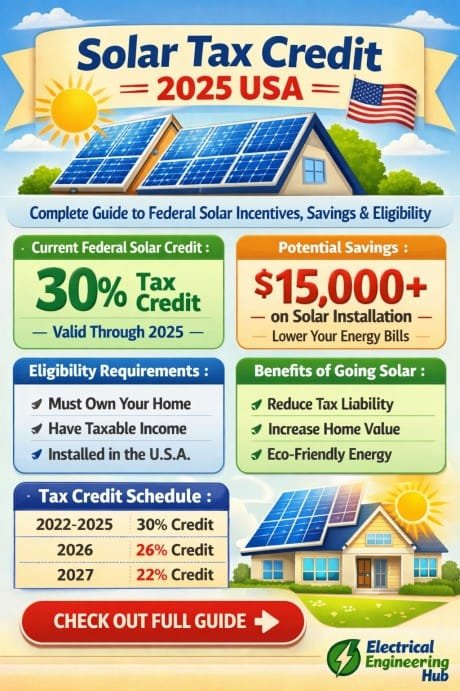
Table of Contents
The federal government continues to support renewable energy adoption through generous tax benefits. In 2025, homeowners and businesses can still take advantage of the Investment Tax Credit (ITC), making solar energy more affordable than ever. This guide explains eligibility, savings calculations, claim procedures, qualifying equipment, and the future of solar incentives in the United States.
What Is the Solar Tax Credit 2025?
The Solar Tax Credit 2025 refers to the federal solar Investment Tax Credit available for eligible solar energy systems installed in the United States. This tax credit allows homeowners to deduct a percentage of their solar installation costs from their federal income taxes.
This tool can help you get the job done more efficiently Solar Wire Size Calculator (DC): Best Solar Cable Sizing Tool
Under the Inflation Reduction Act, the federal government extended and expanded clean energy incentives, providing long-term certainty for homeowners and solar companies. The current residential clean energy credit offers a 30% tax credit for qualified solar installations.
This means if your solar system costs $20,000, you may qualify for a federal tax credit worth $6,000.
The incentive applies to several renewable energy technologies, including:
| Eligible Technology | Covered Under Tax Credit |
|---|---|
| Solar panels | Yes |
| Solar battery storage | Yes |
| Solar inverters | Yes |
| Mounting equipment | Yes |
| Wiring and installation labor | Yes |
| Energy monitoring systems | Yes |
The credit directly reduces the amount of federal taxes owed, making it one of the most valuable renewable energy incentives available in the USA.
How Does the Federal Solar Tax Credit Work?
The federal solar tax credit works by reducing your tax liability dollar for dollar. Unlike deductions, which lower taxable income, tax credits directly reduce the taxes you owe.
Here is a simple example:
| Solar Installation Cost | Tax Credit Percentage | Estimated Tax Credit |
|---|---|---|
| $10,000 | 30% | $3,000 |
| $18,000 | 30% | $5,400 |
| $25,000 | 30% | $7,500 |
If your tax liability is lower than the total credit amount, the remaining balance may usually be rolled over to future tax years, depending on current IRS regulations.
This tool is perfect for achieving better results in solar system design. Try here Wire Size Calculator for Solar Panels – Avoid Power Loss in Off-Grid and Hybrid Systems
This incentive applies to both primary residences and secondary homes located in the United States.
Eligibility Requirements for Solar Tax Credit 2025
Not every installation automatically qualifies. Homeowners must meet certain eligibility requirements to claim the credit successfully.
Basic Eligibility Criteria
To qualify for the Solar Tax Credit 2025, you must:
- Own the solar energy system
- Install the system at a U.S. residence
- Have sufficient federal tax liability
- Use new and qualifying equipment
- Complete installation during the eligible tax year
Leased systems generally do not qualify because the leasing company owns the equipment and claims the incentive instead.
Eligible Property Types
The tax credit can apply to:
| Property Type | Eligible |
|---|---|
| Primary residence | Yes |
| Secondary home | Yes |
| Rental property | Limited |
| Commercial property | Yes |
| Apartment tenant systems | Usually No |
Businesses may also qualify for separate commercial solar incentives and accelerated depreciation benefits.
What Expenses Are Covered?
Many homeowners assume only solar panels are covered, but the federal credit includes several related expenses.
Covered Costs Include
- Solar photovoltaic panels
- Solar batteries with qualifying capacity
- Installation labor
- Electrical upgrades directly related to solar
- Mounting hardware
- Permit fees
- Inspection costs
- Solar inverters
These combined costs can significantly increase the total tax credit amount.
Dive deeper into off grid solar system design
Example of Covered Expenses
| Expense Category | Cost |
|---|---|
| Solar panels | $11,000 |
| Inverter | $2,000 |
| Battery storage | $5,000 |
| Labor and permits | $2,000 |
| Total System Cost | $20,000 |
With a 30% federal tax credit, the estimated savings would be $6,000.
Solar Battery Storage and Tax Credits
Battery storage systems have become increasingly popular because they provide backup power during outages and improve energy independence.
The Inflation Reduction Act expanded eligibility rules so standalone battery systems can now qualify under certain conditions.
Popular solar battery systems include:
- Tesla Powerwall
- Enphase IQ Battery
- FranklinWH Battery
- LG Energy Solution batteries
Adding battery storage may increase the overall installation cost, but it can also increase long-term savings and improve energy reliability.
Know more about How to Test Solar Panel With Multimeter
State Solar Incentives in Addition to Federal Credits
Many states offer additional incentives on top of the federal solar tax credit. These programs vary widely depending on location.
Some common state-level incentives include:
| Incentive Type | Description |
|---|---|
| Net metering | Earn credits for excess electricity |
| Solar rebates | Upfront cash incentives |
| Property tax exemptions | Prevent higher taxes due to home value increase |
| Sales tax exemptions | Remove sales tax on solar equipment |
| Performance incentives | Payments based on energy production |
States such as California, New York, Texas, New Jersey, Arizona, and Massachusetts often provide strong solar incentive programs.
Combining federal and state incentives can dramatically reduce the total installation cost.
How Much Can Homeowners Save?
The amount homeowners save depends on several factors:
- System size
- Local electricity rates
- Sunlight exposure
- State incentives
- Energy consumption
- Net metering policies
Estimated Long-Term Savings
| System Size | Average Cost | Estimated Federal Tax Credit | Estimated 25-Year Savings |
|---|---|---|---|
| 5 kW | $15,000 | $4,500 | $30,000+ |
| 8 kW | $24,000 | $7,200 | $50,000+ |
| 10 kW | $30,000 | $9,000 | $65,000+ |
Solar systems can also increase property value while lowering monthly electricity bills.
Use our online tool for free Solar Performance Ratio Calculator – Measure Solar System Efficiency Accurately
How to Claim the Solar Tax Credit
Claiming the federal solar tax credit is usually straightforward if you keep proper records and documentation.
Documents You Should Keep
- Solar installation contract
- Paid invoices
- Manufacturer certifications
- Permit approvals
- Inspection records
- Proof of payment
IRS Form Required
Homeowners generally use IRS Form 5695 to claim the residential clean energy credit.
The process typically involves:
- Calculating eligible solar expenses
- Completing IRS Form 5695
- Reporting the credit on your federal tax return
- Carrying over unused credits if applicable
Many homeowners work with tax professionals to ensure proper filing.
Know more about Hybrid Solar Inverter Working Principle with Circuit Diagram
Common Mistakes to Avoid
Several mistakes can reduce or delay your solar tax credit claim.
Frequent Errors Include
- Leasing instead of purchasing
- Claiming non-eligible expenses
- Missing required documentation
- Filing incorrect IRS forms
- Assuming state incentives replace federal credits
Before installation, homeowners should confirm eligibility with both their installer and tax advisor.
Is Solar Worth It in 2025?
For many American homeowners, solar energy remains one of the best long-term investments available. Electricity costs continue to rise nationwide, while solar equipment prices have become more competitive.
The Solar Tax Credit 2025 helps reduce upfront costs substantially, making clean energy more accessible to average households.
Benefits of switching to solar include:
- Lower monthly utility bills
- Protection against rising energy prices
- Increased home value
- Reduced carbon footprint
- Energy independence
- Backup power options with batteries
Many systems can pay for themselves within several years, depending on local utility rates and available incentives.
Use our online tool Solar Inverter Sizing Calculator
Future of Federal Solar Incentives
Current federal incentives are expected to remain available at strong levels for several years under existing legislation. However, future policy changes may affect credit percentages or eligibility requirements later in the decade.
Homeowners considering solar installation may benefit from acting sooner rather than waiting for future uncertainty.
The U.S. solar industry is expected to continue growing rapidly as demand for renewable energy increases across residential and commercial sectors.
Final Thoughts
The Solar Tax Credit 2025 continues to provide major financial advantages for homeowners and businesses investing in renewable energy. With a 30% federal tax credit, additional state incentives, and long-term utility savings, solar energy remains one of the smartest energy upgrades available in the United States.
Understanding eligibility requirements, covered expenses, and filing procedures can help homeowners maximize available incentives while reducing installation costs. Whether you are considering rooftop solar panels or adding battery backup systems, federal solar incentives in 2025 offer a strong opportunity to lower energy bills and build long-term energy security.
Find more about Best Medium Voltage Transformers for Solar Plants
As electricity demand grows and utility prices increase, solar adoption is expected to accelerate across the country. Homeowners who take advantage of available incentives today may benefit from decades of energy savings and improved home efficiency.
Get new guides in your feed. Follow Electrical Insights on LinkedIn for new electrical standards guides, calculators and design tips from Azad Circuit Hub.
#solartaxcredit2025,#solarenergytaxcredit,#federalsolartaxcredit,#solarsavings2025,#solarrebates,#cleanenergyincentives,#residentialsolar,#solarinstallation,#renewableenergy,#energytaxcredits