IEC Standard for Surge Arresters: Complete Guide to Selection, Testing & Compliance
The IEC standard for surge arresters plays a critical role in ensuring the safe operation of electrical power systems. Surge arresters are designed to protect equipment from overvoltage caused by lightning strikes, switching surges, and transient disturbances. Without proper standardization, these devices may fail under stress, leading to costly outages and equipment damage.
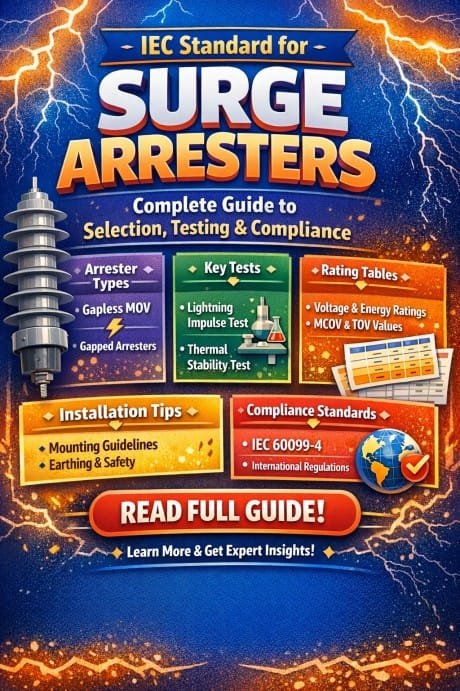
Table of Contents
Understanding the IEC standard for surge arresters helps engineers, technicians, and procurement professionals select the right device, ensure compliance, and maintain system reliability. This guide explains the key standards, selection criteria, testing methods, and compliance requirements in a practical and easy-to-follow manner. Discover everything about cable bending radius iec standard
Overview of IEC Standards for Surge Arresters
The International Electrotechnical Commission (IEC) provides globally accepted standards that define performance, testing, and application guidelines for surge arresters. The most relevant standards include:
| IEC Standard | Description |
|---|---|
| IEC 60099-4 | Metal-oxide surge arresters without gaps for AC systems |
| IEC 60099-5 | Selection and application recommendations |
| IEC 60099-8 | Surge arresters for transmission lines |
| IEC 61643 series | Low-voltage surge protective devices |
The IEC standard for surge arresters ensures that products meet safety, durability, and performance benchmarks across different voltage levels.
Learn more about earthing cable size as per iec
Types of Surge Arresters Covered by IEC Standards
Different applications require different types of surge arresters. The IEC standard for surge arresters classifies them based on construction and usage.
Metal Oxide Surge Arresters (MOA)
These are the most widely used arresters today. They offer:
- Gapless design
- Fast response time
- High energy absorption capability
Station Class Arresters
Used in substations and high-voltage systems. They provide:
- High discharge capability
- Enhanced protection for transformers and switchgear
Distribution Class Arresters
Installed on distribution lines and transformers:
- Lower energy rating than station class
- Cost-effective protection
Find out more about iec 61439 busbar clearance
Intermediate Class Arresters
Used between station and distribution class applications:
- Moderate discharge capacity
- Suitable for industrial networks
Key Parameters in IEC Standard for Surge Arresters Selection
Selecting the right arrester is essential for system protection. The IEC standard for surge arresters provides clear guidelines for choosing appropriate ratings.
Important Selection Factors
| Parameter | Description |
|---|---|
| Rated Voltage (Ur) | Maximum continuous operating voltage |
| Nominal Discharge Current (In) | Peak current during standard impulse |
| Residual Voltage | Voltage across arrester during discharge |
| Energy Handling Capability | Ability to absorb surge energy |
| Temporary Overvoltage (TOV) | Withstand capability during system faults |
Explore details on iec standard for underground cable laying
Practical Selection Tips
- Always match arrester voltage with system voltage
- Consider environmental conditions such as pollution and humidity
- Check energy rating for lightning-prone areas
- Ensure compatibility with insulation coordination
Following the IEC standard for surge arresters during selection minimizes failure risks and improves equipment lifespan.
Testing Requirements as per IEC Standards
Testing is a vital part of ensuring arrester reliability. The IEC standard for surge arresters defines several routine, type, and special tests.
Type Tests
These tests verify design performance:
- Lightning impulse residual voltage test
- Switching impulse test
- Long-duration current impulse test
- Pressure relief test
Get complete information about iec standard for busbar sizing
Routine Tests
Performed on every manufactured unit:
- Reference voltage test
- Partial discharge test
- Sealing test
Special Tests
Conducted when required:
- Pollution performance test
- Mechanical strength test
- Thermal stability test
| Test Type | Purpose |
|---|---|
| Type Test | Design validation |
| Routine Test | Quality assurance |
| Special Test | Application-specific verification |
Adhering to the IEC standard for surge arresters ensures that every unit performs reliably under real-world conditions. Dive deeper into instrument earthing iec standard
Installation Guidelines Based on IEC Standards
Correct installation is as important as proper selection. The IEC standard for surge arresters provides recommendations for installation to ensure maximum protection.
Installation Best Practices
- Install arresters as close as possible to the equipment
- Ensure proper grounding with low resistance
- Avoid sharp bends in connecting leads
- Maintain adequate clearance distances
Common Installation Mistakes
- Poor earthing system
- Incorrect voltage rating selection
- Long connection leads increasing inductive effects
Following the IEC standard for surge arresters during installation reduces the chances of insulation failure and improves system safety.
Uncover insights on iec standard for lighting lux level
Compliance and Certification Requirements
Compliance with IEC standards is essential for global acceptance. Manufacturers and utilities rely on the IEC standard for surge arresters to ensure product quality.
Certification Process
- Type testing by accredited laboratories
- Factory production control
- Routine testing documentation
- Third-party inspection (if required)
Markings and Documentation
Each arrester must include:
- Rated voltage and current
- Manufacturer details
- Standard reference (IEC 60099-4)
- Serial number for traceability
| Compliance Aspect | Requirement |
|---|---|
| Certification | IEC-approved testing |
| Documentation | Test reports and datasheets |
| Marking | Clear identification labels |
Using products that comply with the IEC standard for surge arresters ensures reliability and regulatory acceptance.
Know more about Phase to Phase Clearance as per IEC 61439: Best Guide
Advantages of Following IEC Standards
There are several benefits of adhering to the IEC standard for surge arresters:
- Improved system reliability
- Reduced equipment failure
- Standardized testing and performance
- Global compatibility
- Enhanced safety for personnel and equipment
These advantages make IEC standards the preferred choice for utilities and industries worldwide.
Common Applications of Surge Arresters
Surge arresters are used across various sectors. The IEC standard for surge arresters ensures consistent performance in all applications. Use our online tool Creepage Distance Calculator – Calculate Safe Insulation & Clearance for PCB and High Voltage Design
Major Application Areas
- Power transmission systems
- Distribution networks
- Renewable energy systems
- Industrial plants
- Communication infrastructure
Each application requires careful selection based on system voltage and exposure to surges.
Conclusion
The IEC standard for surge arresters serves as a comprehensive framework for the design, selection, testing, and installation of surge protection devices. By following these standards, engineers can ensure reliable system performance and long-term protection against overvoltage events. Know more about IEC Standard for Busbar Clearance
From understanding different arrester types to selecting the right ratings and ensuring compliance, every step is guided by the IEC standard for surge arresters. Whether you are working in power utilities, industrial systems, or renewable energy projects, applying these standards will help you achieve safe, efficient, and durable electrical installations.
Follow Us on Social:
Subscribe our Newsletter on Electrical Insights for latest updates from Electrical Engineering Hub
#IECStandardForSurgeArresters, #SurgeArresterIEC, #ElectricalStandards, #HighVoltageProtection, #PowerSystemSafety, #LightningProtection, #IEC60099, #SubstationDesign, #ElectricalEngineering, #SurgeProtection