IEC Standard for Ground Fault Protection Explained: Compliance, Requirements & Best Practices
The IEC standard for ground fault protection plays a critical role in modern electrical systems by reducing the risk of electric shock, fire, and equipment damage. In industrial plants, commercial buildings, and utility networks, ground faults remain one of the most common and dangerous electrical issues.
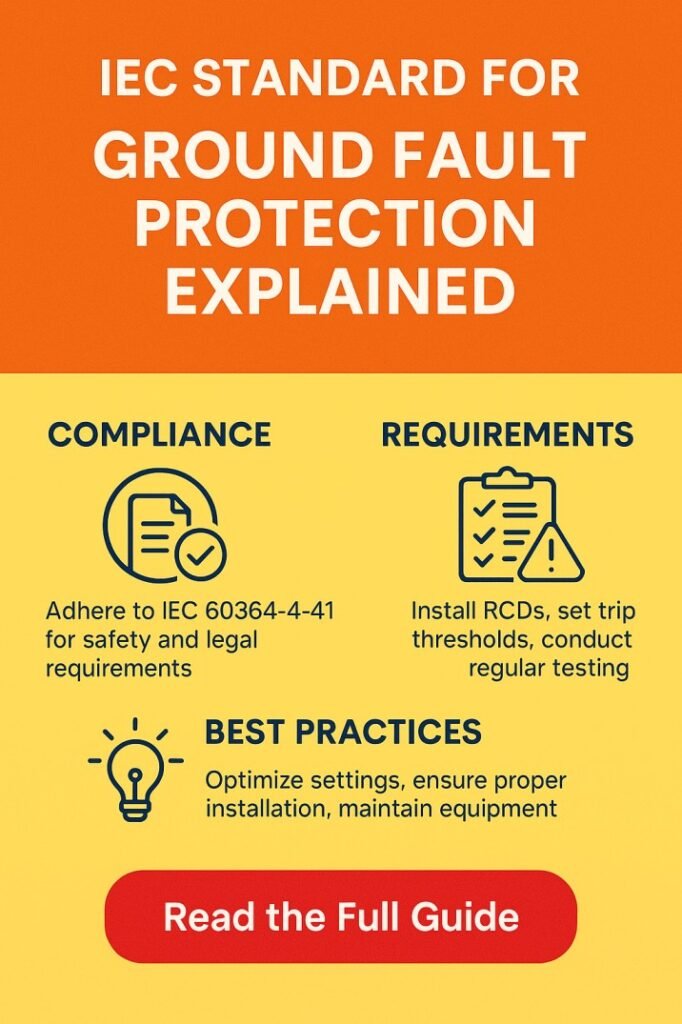
Table of Contents
International Electrotechnical Commission standards provide a globally accepted framework to detect, limit, and clear these faults in a safe and predictable way. This article explains the concept in detail, focusing on compliance needs, technical requirements, and practical best practices that engineers and facility managers can apply in real installations.
Know more about IEC Standard for Earthing System
Understanding Ground Fault Protection
A ground fault occurs when current unintentionally flows from an energized conductor to earth or to exposed conductive parts. This condition can arise due to insulation failure, moisture ingress, damaged cables, or improper installation. Without effective protection, ground faults may cause overheating, arc flash events, or lethal touch voltages.
The IEC standard for ground fault protection defines how these fault currents should be detected and interrupted within a specified time. The goal is not only to protect equipment but also to safeguard human life. Unlike overcurrent protection, which responds mainly to high fault currents, ground fault protection is sensitive to relatively small leakage currents that can still be hazardous.
Role of IEC in Electrical Safety
The International Electrotechnical Commission develops standards that harmonize electrical safety practices across countries. These standards are widely adopted or referenced by national regulations. When discussing ground fault protection, IEC documents ensure that protection methods remain consistent regardless of manufacturer or region.
Compliance with the IEC standard for ground fault protection helps organizations meet regulatory requirements, reduce liability, and improve overall system reliability. It also simplifies design decisions for engineers working on international projects where local codes may differ.
Know more about 7 Common Mistakes in Electrical Outlet Height
Key IEC Standards Related to Ground Fault Protection
Several IEC standards address ground fault protection directly or indirectly. Each focuses on a specific application area.
| IEC Standard | Scope | Application Area |
|---|---|---|
| IEC 60364 | Low-voltage electrical installations | Residential, commercial, industrial buildings |
| IEC 60255 | Measuring relays and protection equipment | Power system protection relays |
| IEC 60947-2 | Circuit breakers | Industrial switchgear |
| IEC 61008 | Residual current devices without overcurrent protection | Domestic and similar uses |
| IEC 61009 | RCBOs with overcurrent protection | Mixed load installations |
These standards together form the technical backbone of the IEC standard for ground fault protection, covering devices, installation rules, and performance requirements. Know more about IEC Standard for Busbar Clearance
Compliance Requirements Explained Simply
Compliance is not limited to selecting the right device. It also involves correct system design, installation, testing, and documentation. IEC requirements typically focus on three core areas.
First, sensitivity levels must match the application. For example, residential circuits often require 30 mA residual current devices to protect people, while industrial systems may use higher thresholds to avoid nuisance tripping.
Second, disconnection times must fall within safe limits. The IEC standard for ground fault protection specifies maximum allowable clearing times based on system voltage and earthing arrangement.
Third, coordination between protective devices is essential. Ground fault protection must work alongside overcurrent protection, surge protection, and insulation monitoring without conflict.
Use our online tool Creepage Distance Calculator – Calculate Safe Insulation & Clearance for PCB and High Voltage Design
Types of Ground Fault Protection Under IEC
IEC standards recognize several protection methods, each suited to different system types.
Residual current protection detects imbalance between phase and neutral currents. It is commonly used in low-voltage systems where human safety is the primary concern.
Ground fault relays monitor current flowing through a grounding conductor or a core balance transformer. These are typical in industrial and utility networks.
Insulation monitoring devices continuously check insulation resistance in IT systems, where immediate disconnection is not always required.
The IEC standard for ground fault protection defines performance criteria for each method, ensuring predictable behavior under fault conditions.
Know more about Phase to Phase Clearance as per IEC 61439: Best Guide
Earthing Systems and Their Impact
Earthing arrangement strongly influences ground fault protection design. IEC classifies earthing systems into TN, TT, and IT types.
| Earthing System | Description | Protection Approach |
|---|---|---|
| TN | Neutral directly earthed, exposed parts connected to neutral | Overcurrent and residual current devices |
| TT | Neutral earthed, exposed parts earthed separately | Residual current devices mandatory |
| IT | Neutral isolated or earthed through impedance | Insulation monitoring and alarms |
Understanding the earthing system is essential to apply the IEC standard for ground fault protection correctly, as protection requirements differ significantly.
Device Selection Best Practices
Selecting the right device goes beyond rated current and voltage. Environmental conditions, load type, and continuity requirements must also be considered.
When choosing residual current devices, consider immunity to harmonics and DC components, especially in systems with variable frequency drives or solar inverters.
For ground fault relays, adjustable pickup settings and time delays help achieve selective coordination. This prevents unnecessary shutdown of healthy sections.
Following the IEC standard for ground fault protection during device selection improves system availability and reduces maintenance issues.
Know more about How to Comply with OSHA Electrical Standards in detail
Installation and Wiring Considerations
Correct installation is just as important as correct design. Poor wiring practices can defeat even the best protection devices.
All live conductors must pass through the sensing element of residual current devices. Shared neutrals between circuits should be avoided unless specifically designed for it.
Grounding conductors must be sized according to fault current levels and mechanical strength requirements. Loose or corroded connections can cause false trips or failure to operate.
IEC installation rules ensure that the IEC standard for ground fault protection performs as intended throughout the system life cycle.
Testing, Inspection, and Maintenance
Regular testing verifies that protection devices remain functional. IEC standards require both initial verification and periodic inspection.
Manual test buttons on residual current devices should be operated at defined intervals. For industrial relays, secondary injection testing is recommended.
Documentation of test results supports compliance audits and insurance requirements. Maintaining records aligned with the IEC standard for ground fault protection also simplifies troubleshooting after a fault event.
Know more about Electrical Standards USA – National Electrical Code | Electrical Safety Foundation
Common Compliance Mistakes to Avoid
Many installations fail to achieve full compliance due to avoidable errors.
- Using incorrect sensitivity levels can lead to nuisance tripping or insufficient protection.
- Ignoring coordination between upstream and downstream devices may cause widespread outages.
- Assuming factory settings are always suitable is another common issue. Each system requires site-specific adjustment.
- Avoiding these mistakes helps ensure practical compliance with the IEC standard for ground fault protection rather than just theoretical adherence.
Benefits of IEC-Compliant Ground Fault Protection
- Adhering to IEC standards delivers both safety and economic benefits.
- Reduced risk of electric shock improves workplace safety and lowers accident-related costs.
- Early fault detection minimizes fire risk and prevents catastrophic equipment failure.
- Standardized protection simplifies system expansion and integration of new technologies.
- These advantages make compliance with the IEC standard for ground fault protection a sound long-term investment.
Know more about What is Standard Voltage in USA? All You need to Know
Future Trends and Practical Recommendations
As electrical systems evolve, ground fault protection continues to adapt. Increased use of power electronics, renewable energy, and electric vehicle infrastructure introduces new fault characteristics.
IEC standards are gradually addressing DC ground faults, high-frequency leakage currents, and smart monitoring integration.
For best results, engineers should stay updated with the latest revisions, select certified devices, and train maintenance staff regularly. Applying these practices ensures that the IEC standard for ground fault protection remains effective in both current and future installations.
Understand better about nec 430.32
Final Thoughts
Ground fault protection is not a single device or setting but a coordinated safety strategy. The IEC standard for ground fault protection provides a comprehensive framework that balances human safety, system reliability, and operational continuity. By understanding its requirements, applying best practices, and maintaining compliance over time, organizations can significantly reduce electrical risks while meeting international expectations. Explore details on iec standard for underground cable laying
Follow Us on Social:
Subscribe our Newsletter on Electrical Insights for latest updates from Electrical Engineering Hub
#IECStandard, #GroundFaultProtection, #ElectricalSafety, #IECCompliance, #PowerSystemProtection, #EarthFault, #ElectricalEngineering, #ProtectionRelays, #ElectricalStandards, #FaultProtection