
Dielectric Constant And Permittivity: Complete Guide for Engineers, Formulas, Applications & Practical Insights
Dielectric Constant And Permittivity are fundamental electrical properties that every engineer must understand when working with materials, insulation systems, and high-voltage equipment. These concepts play a critical role in determining how electric fields behave in different media, directly influencing the design of capacitors, transmission systems, and electronic devices. A clear understanding of Dielectric Constant And Permittivity helps engineers make accurate decisions in both theoretical analysis and practical applications.
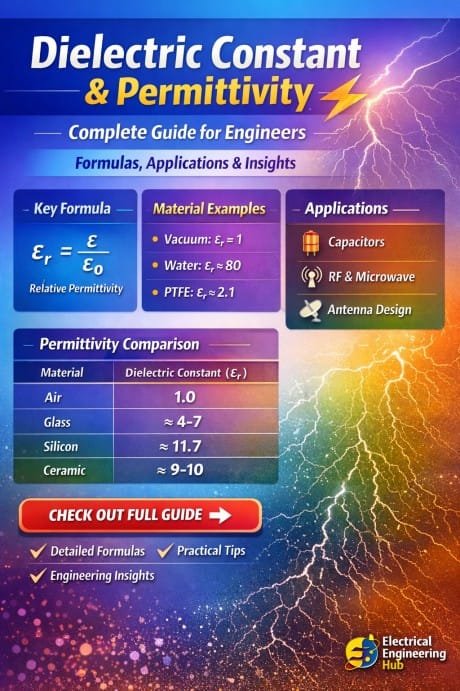
Table of Contents
Understanding Dielectric Constant And Permittivity
Dielectric Constant And Permittivity describe how a material responds to an electric field. Permittivity is an absolute property that measures how much electric flux a material can support, while dielectric constant is the relative measure comparing a material to vacuum.
Permittivity is represented by the symbol ε and is expressed in farads per meter. It indicates how easily electric field lines can pass through a material. The dielectric constant, often denoted as εr, is the ratio of the material’s permittivity to the permittivity of free space.
Find all about Work Function of Metals: A Detailed Explanation
The relationship is given by:
ε = εr × ε₀
Where ε₀ is the permittivity of free space, approximately equal to 8.854 × 10⁻¹² F/m.
These properties are essential in understanding electric insulation, capacitance, and energy storage in materials.
Key Differences Between Permittivity and Dielectric Constant
Although closely related, these two terms are not identical. The table below highlights the main differences:
| Property | Permittivity (ε) | Dielectric Constant (εr) |
|---|---|---|
| Definition | Absolute property of material | Relative value compared to vacuum |
| Unit | Farads per meter (F/m) | No unit (dimensionless) |
| Reference | Independent | Depends on vacuum permittivity |
| Symbol | ε | εr |
| Application | Used in calculations directly | Used for comparison of materials |
Understanding these differences allows engineers to select appropriate materials for insulation and circuit design.
Know more about Work Function in Photoelectric Effect
Types of Permittivity
Permittivity is not always constant and can vary depending on external conditions. Engineers often deal with different types:
Static Permittivity
This refers to permittivity under constant electric fields. It is important for DC applications and insulation design.
Dynamic Permittivity
This applies to alternating electric fields. It changes with frequency and is crucial in communication systems and high-frequency circuits.
Complex Permittivity
In real-world materials, permittivity has both real and imaginary components. The real part represents energy storage, while the imaginary part represents energy loss.
Common Materials and Their Dielectric Values
The selection of materials depends heavily on Dielectric Constant And Permittivity. Below is a reference table commonly used in engineering:
| Material | Dielectric Constant (εr) |
|---|---|
| Vacuum | 1.0 |
| Air | 1.0006 |
| Glass | 4 – 10 |
| Mica | 5 – 7 |
| Paper | 2 – 4 |
| Water | ~80 |
| Ceramic | 6 – 1000 |
| Rubber | 2 – 7 |
Materials with higher dielectric constant can store more electrical energy, making them ideal for capacitors and insulation systems.
Explore all about Thermistor vs RTD vs Thermocouple
Mathematical Formulas and Calculations
Dielectric Constant And Permittivity are widely used in engineering formulas. One of the most important applications is in capacitance calculations.
The capacitance of a parallel plate capacitor is given by:
C = ε × A / d
Where:
- C is capacitance
- ε is permittivity of the material
- A is the area of the plates
- d is the distance between plates
This equation shows that increasing permittivity increases capacitance, which is why high dielectric materials are preferred in compact electronic designs.
Another important relation involves electric displacement:
D = ε × E
Where:
- D is electric flux density
- E is electric field intensity
These formulas form the basis of electrical insulation design and electromagnetic field analysis.
Know more about Thermistor vs RTD Accuracy
Practical Applications in Engineering
Dielectric Constant And Permittivity are used in a wide range of engineering fields. Their importance extends from power systems to microelectronics.
Capacitor Design
Capacitors rely on dielectric materials to store energy. A higher dielectric constant allows for greater energy storage in a smaller size, improving efficiency and performance.
Cable Insulation
In power transmission, insulation materials must have suitable permittivity to prevent leakage currents and ensure safety. Materials like XLPE and PVC are selected based on their dielectric properties.
Printed Circuit Boards
PCB materials are chosen based on their dielectric constant to control signal speed and impedance. Stable permittivity ensures reliable high-frequency performance.
Microwave and RF Systems
In high-frequency systems, dielectric properties affect signal propagation and losses. Engineers carefully select materials to minimize attenuation and distortion.
Know more about Difference Between RTD and Thermocouple
Transformer and Equipment Insulation
Dielectric strength and permittivity determine the reliability of transformers, switchgear, and high-voltage equipment.
Factors Affecting Dielectric Properties
Dielectric Constant And Permittivity are not fixed values and can change due to several factors:
Temperature plays a major role. As temperature increases, molecular motion affects polarization, which can alter permittivity.
Frequency is another critical factor. At higher frequencies, some polarization mechanisms cannot respond quickly, leading to reduced permittivity.
Moisture content significantly impacts dielectric behavior. Materials like paper and insulation oils show large variations when exposed to humidity.
Electric field strength can also influence dielectric properties, especially in nonlinear materials.
Understanding these factors helps engineers design systems that remain stable under varying conditions.
Find all about Plum Pudding Model
Measurement Techniques
Accurate measurement of Dielectric Constant And Permittivity is essential for material selection and quality control. Common methods include:
- Parallel plate method, which is simple and widely used for solid materials.
- Bridge methods, such as Schering bridge, used in high-voltage testing and insulation analysis.
- Time domain reflectometry, used for cables and transmission lines.
- Network analyzers, used in RF and microwave applications for precise measurements.
- Each method has its advantages depending on the frequency range and type of material being tested.
Practical Insights for Engineers
In real-world engineering, theoretical values often differ from practical performance. Engineers should always consider safety margins when using dielectric data.
Material aging can reduce dielectric performance over time. Regular testing and maintenance are necessary for critical systems.
Impurities and manufacturing variations can affect permittivity. It is important to use standardized materials and verified data.
Simulation tools can help predict behavior, but field testing remains essential for validation.
Choosing the right dielectric material is not only about high permittivity. Factors like mechanical strength, thermal stability, and cost must also be considered.
Know more about Period and Frequency
Conclusion
Dielectric Constant And Permittivity are essential concepts that influence almost every aspect of electrical and electronic engineering. From capacitor design to high-voltage insulation, these properties determine how materials interact with electric fields. A strong understanding of their definitions, formulas, and practical behavior allows engineers to design efficient, safe, and reliable systems.
By considering real-world factors such as temperature, frequency, and material quality, engineers can apply Dielectric Constant And Permittivity effectively in modern applications. This knowledge not only improves system performance but also ensures long-term stability and safety in demanding environments.
Get new guides in your feed. Follow Electrical Insights on LinkedIn for new electrical standards guides, calculators and design tips from Azad Circuit Hub.
#DielectricConstant,#Permittivity,#ElectricalProperties,#MaterialScience,#Capacitance,#ElectricField,#Insulation,#PhysicsConcepts,#Electromagnetism,#EngineeringBasics
