How to Measure Cable Bend Radius | Comprehensive Guide
Cable bending is one of the most critical aspects of electrical cable installation. Whether you are working with power cables, control cables, instrumentation cables, or medium-voltage systems, maintaining the correct bend radius helps prevent insulation damage, conductor deformation, and premature cable failure.
Understanding How to Measure Cable Bend Radius is essential for electrical engineers, technicians, contractors, and maintenance personnel. A cable that is bent too sharply may experience mechanical stress, reduced insulation life, and increased chances of faults during operation.
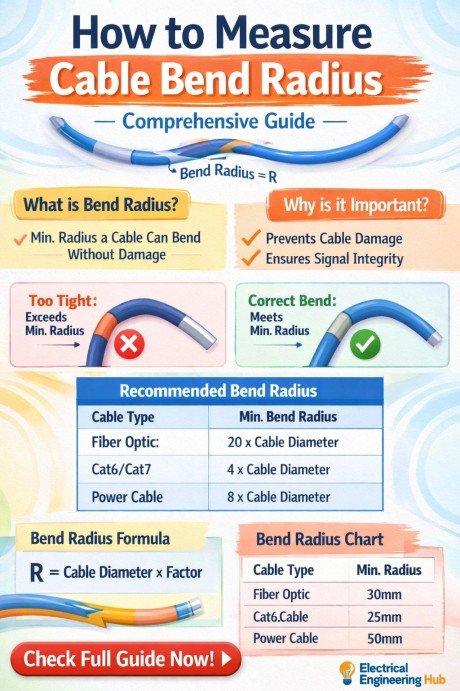
Table of Contents
This guide explains the calculation methods, international standards, measurement techniques, and installation best practices to ensure safe and reliable cable installations.
What Is Cable Bend Radius?
Cable bend radius is the minimum radius that a cable can be bent without causing damage to its conductor, insulation, shielding, or outer sheath.
Know more about Wire Sizing for Motors
The bend radius is measured from the centerline of the cable to the inside curve of the bend. Manufacturers specify this value because every cable construction has different mechanical characteristics.
Maintaining the correct bend radius ensures:
- Protection of cable insulation
- Prevention of conductor damage
- Longer cable service life
- Compliance with electrical standards
- Reduced maintenance costs
Why Is Cable Bend Radius Important?
Improper cable bending can create hidden damage that may not appear immediately. However, over time, these stresses can lead to insulation breakdown and electrical faults.
Some common consequences include:
| Problem | Impact |
|---|---|
| Cracked insulation | Reduced dielectric strength |
| Deformed conductors | Increased resistance |
| Damaged shielding | Electromagnetic interference |
| Sheath damage | Moisture ingress |
| Mechanical stress | Shortened cable lifespan |
For large power distribution projects, following proper bend radius requirements is a mandatory part of quality assurance and commissioning.
Find all about 11kV Cable Bending Radius
How to Measure Cable Bend Radius
The process of measuring cable bend radius is straightforward when the cable diameter is known.
Step 1: Measure the Cable Diameter
Use a vernier caliper or measuring tape to determine the overall outside diameter (OD) of the cable.
For example:
| Cable Type | Diameter |
|---|---|
| LV Power Cable | 30 mm |
| MV Cable | 50 mm |
| Control Cable | 15 mm |
Step 2: Identify the Required Bend Radius Factor
The bend radius factor depends on cable type and applicable standards.
Typical values include:
| Cable Type | Minimum Bend Radius |
|---|---|
| Single-core power cable | 15 × OD |
| Multi-core power cable | 12 × OD |
| Instrumentation cable | 8 × OD |
| Fiber optic cable | 10–20 × OD |
Know more about Wire Bending Radius NEC
Step 3: Apply the Formula
The basic formula used in How to Measure Cable Bend Radius is:
Minimum Bend Radius = Cable Diameter × Bend Radius Multiplier
Example:
Cable diameter = 40 mm
Required bend radius = 12 × OD
Minimum Bend Radius = 40 × 12
Minimum Bend Radius = 480 mm
This means the cable should never be bent tighter than a radius of 480 mm.
Cable Bend Radius Calculation Examples
The following examples help illustrate practical calculations.
Example 1: Multi-Core Power Cable
| Parameter | Value |
|---|---|
| Cable Diameter | 35 mm |
| Bend Factor | 12 |
| Bend Radius | 420 mm |
Calculation:
35 × 12 = 420 mm
See our comprehensive guide on cable bending radius iec standard
Example 2: Single-Core Medium Voltage Cable
| Parameter | Value |
|---|---|
| Cable Diameter | 55 mm |
| Bend Factor | 15 |
| Bend Radius | 825 mm |
Calculation:
55 × 15 = 825 mm
Example 3: Instrumentation Cable
| Parameter | Value |
|---|---|
| Cable Diameter | 18 mm |
| Bend Factor | 8 |
| Bend Radius | 144 mm |
Calculation:
18 × 8 = 144 mm
Know all about ieee and iec standards
International Standards for Cable Bend Radius
Several international standards provide guidance on minimum bending requirements.
IEC Standards
The International Electrotechnical Commission (IEC) specifies minimum bending requirements for various cable types.
For a detailed explanation of IEC requirements and cable categories, refer to cable bending radius iec standard.
IEC standards focus on:
- Mechanical integrity
- Installation safety
- Long-term cable performance
- Manufacturer compliance
NEC Requirements
The National Electrical Code (NEC) provides requirements for:
- Conductors entering equipment
- Cable tray installations
- Pull boxes and conduit systems
- Minimum bending space dimensions
NEC requirements are particularly important in commercial and industrial installations.
Know more about IEC Standard for MV Cable Testing
IEEE Recommendations
IEEE standards provide additional guidance for:
- Medium-voltage cable systems
- High-voltage installations
- Utility distribution networks
- Substation cable routing
How to Measure Bend Radius in the Field
During installation, technicians often verify the actual bend radius after cable routing.
Follow these steps:
- Locate the center of the cable bend.
- Identify the inner curve of the cable.
- Measure the radius from the center point to the cable centerline.
- Compare the measured value with the calculated minimum radius.
- Ensure the measured radius is equal to or greater than the required value.
A simple measuring tape can often provide sufficient accuracy for field verification.
Know more about IEC Standard for Insulation Resistance Test
Cable Types and Typical Bend Radius Requirements
Different cable constructions have different flexibility characteristics.
| Cable Type | Typical Bend Radius |
|---|---|
| PVC Insulated Cable | 8–12 × OD |
| XLPE Power Cable | 12–15 × OD |
| Armored Cable | 12–15 × OD |
| Fiber Optic Cable | 10–20 × OD |
| Instrumentation Cable | 8–10 × OD |
| Control Cable | 8–12 × OD |
Always verify manufacturer recommendations because some specialized cables require larger bend radii.
Installation Best Practices
Proper installation techniques help maintain cable reliability throughout its service life.
Avoid Sharp Bends
Never force cables around corners that are smaller than the specified radius.
Know more about Phase to Phase Clearance as per IEC 61439
Use Cable Rollers
Cable rollers help maintain smooth bends during pulling operations.
Follow Manufacturer Instructions
Manufacturer data sheets take precedence over generic recommendations.
Monitor Pulling Tension
Excessive pulling force combined with tight bends can severely damage cable insulation.
Provide Adequate Cable Tray Space
Cable trays should allow gradual directional changes without creating excessive stress.
Inspect After Installation
Conduct a visual inspection of all bends before energizing the system.
Find out more about iec 61439 busbar clearance
Common Mistakes to Avoid
The following mistakes are frequently observed during cable installation:
- Ignoring manufacturer specifications
- Measuring diameter incorrectly
- Using conduit bends that are too tight
- Exceeding pulling tension limits
- Forcing cables into overcrowded trays
- Assuming all cable types have the same bend radius
Avoiding these errors significantly improves installation quality and system reliability.
Benefits of Correct Cable Bend Radius Measurement
When installers understand How to Measure Cable Bend Radius correctly, several benefits are achieved.
- Improved electrical performance
- Reduced insulation stress
- Longer service life
- Lower maintenance costs
- Better compliance with standards
- Increased operational reliability
These advantages become even more important in medium-voltage and critical industrial applications where cable replacement can be expensive and time-consuming.
Learn more about earthing cable size as per iec
Conclusion
Knowing How to Measure Cable Bend Radius is a fundamental skill for anyone involved in cable design, installation, or maintenance. The process involves measuring the cable diameter, identifying the applicable bend radius factor, and applying the correct calculation formula.
Compliance with IEC, NEC, IEEE, and manufacturer requirements ensures that cables remain mechanically and electrically sound throughout their operating life. By following proper measurement methods and installation best practices, engineers can prevent costly failures and maximize cable system reliability.
Frequently Asked Questions
What is the formula for calculating cable bend radius?
The formula is:
Minimum Bend Radius = Cable Outside Diameter × Bend Radius Factor
The factor depends on cable type and applicable standards.
How do I know the correct bend radius for my cable?
Check the cable manufacturer’s technical data sheet. If unavailable, refer to IEC, NEC, or IEEE recommendations for the specific cable category.
What happens if a cable is bent beyond its minimum radius?
Excessive bending may damage insulation, deform conductors, weaken shielding, and reduce cable lifespan.
Does cable size affect bend radius?
Yes. Larger cables generally require larger bend radii because they are less flexible and experience higher mechanical stress during bending.
Are bend radius requirements different for armored and unarmored cables?
Yes. Armored cables typically require larger bend radii due to their additional mechanical protection layers and reduced flexibility.
Follow Us on Social:
Subscribe our Newsletter on Electrical Insights for latest updates from Electrical Engineering Hub
#HowToMeasureCableBendRadius,#CableBendRadius,#CableInstallation,#ElectricalEngineering,#PowerCables,#CableManagement,#IECStandards,#NECStandards,#ElectricalSafety,#CableSizing