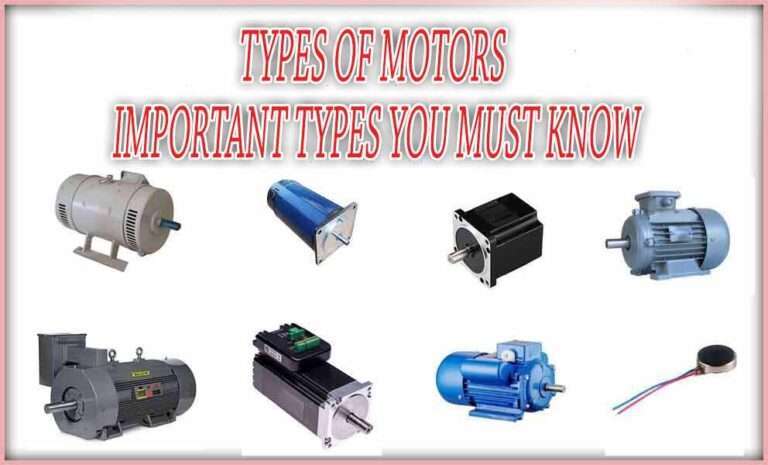
Wire Sizing for Motors | Important Motor Cable Size Calculation
Selecting the correct cable size for a motor is one of the most important tasks in electrical design. An undersized cable can cause excessive voltage drop, overheating, insulation failure, nuisance tripping, and reduced motor efficiency. On the other hand, an oversized cable increases installation costs unnecessarily. This is why proper Wire Sizing for Motors is essential for safe and efficient motor operation.
Whether you are working with industrial motors, agricultural pumps, HVAC equipment, or residential machinery, understanding the principles of motor cable sizing helps ensure compliance with electrical standards and improves system reliability.
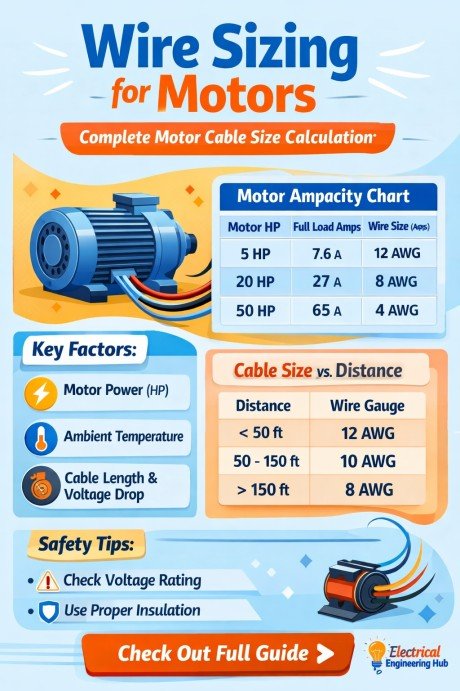
Table of Contents
If you want a quick calculation, you can use our online wire sizing for motors tool to determine the appropriate conductor size based on motor rating, voltage, power factor, and installation conditions.
Use our online tool motor cable size calculator
Why Motor Cable Sizing Is Important
Electric motors draw significant current during normal operation and even higher current during startup. The cable supplying the motor must be capable of carrying this current without excessive temperature rise.
Proper motor cable selection provides the following benefits:
- Prevents cable overheating
- Reduces voltage drop
- Improves motor efficiency
- Minimizes energy losses
- Extends motor life
- Ensures electrical safety
- Complies with electrical codes and standards
A properly sized cable also helps maintain motor starting performance, especially in long cable runs where voltage drop can become a serious concern.
Factors Affecting Wire Sizing for Motors
Several factors must be considered before selecting the conductor size for a motor circuit.
Motor Full Load Current (FLC)
The motor full load current is the foundation of cable sizing calculations. Larger motors require larger conductors because they draw higher operating currents.
Use our online tool Armoured Cable Size Calculator
Supply Voltage
Motor current varies according to operating voltage. A motor operating at 400V generally draws less current than the same motor operating at 230V for the same power output.
Cable Length
Long cable runs increase resistance and voltage drop. In many installations, voltage drop becomes the controlling factor rather than ampacity.
Installation Method
The cable installation environment affects heat dissipation. Cables installed in conduits, cable trays, underground ducts, or directly buried have different current-carrying capacities.
Ambient Temperature
Higher surrounding temperatures reduce the current-carrying capacity of conductors.
Starting Current
Motor starting current may reach 5 to 8 times the full load current. Cable sizing must account for motor starting requirements to prevent excessive voltage drop.
Find all about Testing 12 Volt Electric Motor
Power Factor and Efficiency
Motor efficiency and power factor influence the current demand and therefore impact cable selection.
Basic Formula for Motor Current Calculation
Three-Phase Motor Current
| Parameter | Formula |
|---|---|
| Current (A) | I = P × 1000 ÷ (√3 × V × PF × η) |
Where:
- P = Power in kW
- V = Line Voltage
- PF = Power Factor
- η = Efficiency
Single-Phase Motor Current
| Parameter | Formula |
|---|---|
| Current (A) | I = P × 1000 ÷ (V × PF × η) |
These formulas provide the estimated operating current that serves as the starting point for cable sizing.
Typical Motor Cable Size Reference Table
The following table provides a general reference for common motor ratings under normal installation conditions.
| Motor Power | Approximate Current | Recommended Copper Cable |
|---|---|---|
| 1 HP | 4–6 A | 1.5 mm² |
| 2 HP | 8–10 A | 2.5 mm² |
| 3 HP | 12–15 A | 4 mm² |
| 5 HP | 18–22 A | 6 mm² |
| 7.5 HP | 28–32 A | 10 mm² |
| 10 HP | 35–40 A | 10 mm² |
| 15 HP | 50–60 A | 16 mm² |
| 20 HP | 70–80 A | 25 mm² |
| 30 HP | 100–110 A | 35 mm² |
| 50 HP | 150–170 A | 70 mm² |
These values should always be verified against applicable electrical standards and site conditions.
Know more about Electric Motor Polarization Index Test
Voltage Drop Considerations
Voltage drop is often overlooked during cable selection. Excessive voltage drop can reduce motor torque, increase current draw, and shorten motor life.
Most electrical standards recommend:
| System Type | Maximum Voltage Drop |
|---|---|
| Lighting Circuits | 3% |
| Power Circuits | 5% |
| Motor Circuits | 3%–5% |
For motors installed far from the power source, engineers frequently increase conductor size to maintain acceptable voltage levels. Use our free voltage drop calculator here.
Copper vs Aluminum Cables for Motors
Both copper and aluminum conductors are used in motor installations.
| Feature | Copper | Aluminum |
|---|---|---|
| Conductivity | Higher | Lower |
| Mechanical Strength | Better | Moderate |
| Weight | Heavier | Lighter |
| Cost | Higher | Lower |
| Cable Size Required | Smaller | Larger |
Copper remains the preferred choice for most motor circuits because of its superior conductivity and reliability.
Know more about Electric Motor Core Loss Test
How to Calculate Motor Cable Size
The motor cable sizing process generally follows these steps:
- Determine motor power rating.
- Calculate full load current.
- Apply correction factors.
- Check conductor ampacity.
- Verify voltage drop limits.
- Confirm short-circuit withstand capability.
- Select the nearest standard cable size.
For faster calculations, use our cable size calculator for motor to automatically determine the recommended conductor size based on motor parameters.
Single-Phase Motor Cable Selection
Single-phase motors are commonly used in residential and agricultural applications such as water pumps, air compressors, and small machinery.
When selecting cables for single-phase motors, engineers should consider:
- Running current
- Starting current
- Cable length
- Voltage drop
- Installation conditions
For residential pump installations and small machinery projects, our single phase motor wire size calculator can help identify the appropriate conductor size quickly and accurately.
Know more about Types of Electric Motor Testing
Common Mistakes in Motor Cable Sizing
Many motor failures can be traced back to incorrect cable selection.
Avoid these common mistakes:
- Ignoring voltage drop calculations
- Using only motor nameplate current
- Neglecting ambient temperature corrections
- Failing to account for motor starting current
- Choosing cable size solely based on cost
- Ignoring future load expansion requirements
- Not following local electrical codes
Proper planning during the design stage can prevent costly downtime and maintenance issues later.
Best Practices for Motor Cable Installation
Following good installation practices improves performance and reliability.
Use Quality Cables
Select cables that comply with recognized standards and are suitable for the installation environment.
Maintain Proper Terminations
Loose connections create heat and may damage motor terminals.
Protect Against Mechanical Damage
Use conduits, trays, or protective coverings where necessary.
Know more about Electric Motor Stator Testing
Perform Regular Inspections
Periodic inspections help identify insulation deterioration, overheating, and loose connections before failures occur.
Follow Manufacturer Recommendations
Motor manufacturers often provide specific guidance regarding conductor sizing and maximum voltage drop.
Conclusion
Choosing the correct cable size is a critical aspect of motor system design. Proper Wire Sizing for Motors ensures safe operation, minimizes voltage drop, improves efficiency, and extends equipment life. Engineers and electricians must evaluate motor current, cable length, installation conditions, temperature, and starting requirements before selecting a conductor.
Using accurate calculations and following electrical standards can prevent many common motor problems. Whether you are designing an industrial motor feeder or wiring a small agricultural pump, proper cable sizing remains one of the most important factors for long-term system performance.
Know everything about 3 Phase Motor Overload Relay Setting
FAQs
What is the most important factor in motor cable sizing?
Motor full load current is the primary factor. However, voltage drop, cable length, ambient temperature, and installation method must also be considered.
Can I use the same cable size for all motors with the same horsepower?
No. Cable size may vary depending on voltage, distance, installation conditions, and applicable electrical standards.
Why does motor starting current affect cable selection?
Motors draw several times their rated current during startup. The cable must handle this temporary surge without causing excessive voltage drop.
Is copper cable better than aluminum for motors?
Copper generally offers better conductivity, lower resistance, and improved reliability, making it the preferred choice for most motor installations.
How much voltage drop is acceptable for motor circuits?
Most engineers aim to keep motor circuit voltage drop between 3% and 5% to maintain proper performance and efficiency.
Follow Us on Social:
Subscribe our Newsletter on Electrical Insights for latest updates from Electrical Engineering Hub
#WireSizingForMotors,#MotorCableSizing,#ElectricalEngineering,#MotorInstallation,#VoltageDropCalculation,#CableSizeCalculator,#ElectricMotor,#PowerDistribution,#IndustrialElectrical,#MotorProtection