Phase to Phase Clearance in 132 kV | Complete Standards, Safety Requirements & Design Guide
Electrical clearances are among the most critical design parameters in high-voltage power systems. Proper conductor spacing ensures system reliability, prevents flashovers, minimizes outages, and protects equipment from insulation failures. When designing substations, transmission lines, or switchyards, engineers must carefully evaluate the required distances between energized conductors.
Understanding Phase to Phase Clearance in 132 kV is essential for electrical engineers, utility planners, consultants, and maintenance teams. The clearance requirements are influenced by operating voltage, insulation level, environmental conditions, switching surges, and applicable international standards such as IEC and IEEE.
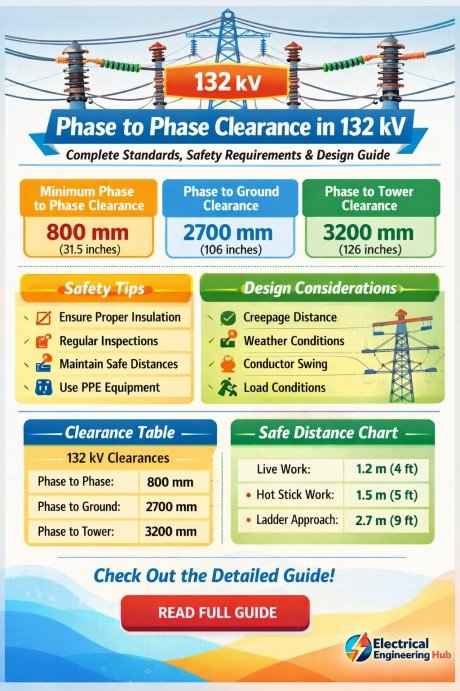
Table of Contents
This guide explains the standard requirements, design considerations, safety practices, and factors affecting conductor spacing in 132 kV systems.
What is Phase to Phase Clearance?
Phase-to-phase clearance refers to the minimum safe distance maintained between two energized conductors of different phases. This spacing prevents electrical arcing, insulation breakdown, and flashover under normal operating conditions and transient overvoltages.
Know more about Phase to Phase Clearance as per IEC 61439: Best Guide
In a 132 kV power system, the voltage difference between phases can become significant during switching operations, lightning impulses, and fault conditions. Therefore, adequate conductor separation is necessary to maintain system stability and safety.
The required clearance varies depending on whether the installation is located in a transmission line corridor, air-insulated substation (AIS), gas-insulated substation (GIS), or switchyard.
Importance of Phase to Phase Clearance in 132 kV Systems
Maintaining adequate conductor spacing provides several operational benefits:
- Prevents phase-to-phase flashover
- Improves system reliability
- Reduces outage frequency
- Enhances personnel safety
- Protects expensive equipment
- Supports compliance with IEC standards
- Minimizes insulation stress
- Reduces maintenance requirements
Insufficient clearance can result in catastrophic failures, equipment damage, and extended power interruptions.
Use our online tool Creepage Distance Calculator
Standard Phase to Phase Clearance in 132 kV
The actual clearance depends on utility standards and design practices. However, commonly adopted values based on IEC recommendations and utility specifications are shown below.
Typical Air Clearance Requirements for 132 kV Systems
| Parameter | Typical Clearance |
|---|---|
| Phase-to-Phase Clearance | 1500 mm to 1800 mm |
| Phase-to-Earth Clearance | 1300 mm to 1500 mm |
| Vertical Clearance Between Conductors | 1500 mm to 2000 mm |
| Safety Working Clearance | As per utility regulations |
| Minimum Approach Distance | Determined by safety standards |
Most utilities adopt a phase-to-phase spacing of approximately 1500 mm in 132 kV air-insulated substations, although larger values may be selected for improved reliability.
IEC Considerations for 132 kV Clearance Design
IEC standards establish insulation coordination requirements for high-voltage systems. Clearance values are not determined solely by operating voltage. Engineers must also consider:
- Lightning impulse withstand voltage
- Switching impulse withstand voltage
- Altitude correction factors
- Pollution severity
- Environmental contamination
- System grounding method
- Overvoltage protection strategy
Know more about IEC Standard for Busbar Clearance
The insulation level selected for equipment directly affects the required air clearances within the switchyard.
Typical Insulation Levels for 132 kV Equipment
| Parameter | Typical Value |
|---|---|
| Highest System Voltage | 145 kV |
| Power Frequency Withstand Voltage | 275 kV |
| Lightning Impulse Withstand Voltage | 650 kV |
| Nominal System Voltage | 132 kV |
These insulation levels help determine conductor spacing and equipment layout.
Factors Affecting Phase to Phase Clearance in 132 kV Installations
Several engineering factors influence clearance requirements.
Environmental Conditions
Weather plays a major role in insulation performance.
Common environmental factors include:
- Rain
- Fog
- Dust
- Humidity
- Salt contamination
- Industrial pollution
Know more about IEC Standard for Earthing System
Regions with severe pollution often require larger clearances and enhanced insulation systems.
Altitude Above Sea Level
Air density decreases at higher elevations, reducing dielectric strength.
As altitude increases:
- Flashover voltage decreases
- Air insulation weakens
- Larger clearances become necessary
IEC standards provide correction factors for installations above 1000 meters elevation.
Switching Surges
Circuit breaker operations generate transient overvoltages that may exceed normal operating levels.
Proper spacing ensures conductors can withstand these temporary voltage rises without insulation failure.
Lightning Activity
Areas with frequent lightning strikes require additional insulation margins and surge protection systems.
Engineers often coordinate clearances with surge arrester performance to achieve optimum protection.
Know all about ieee and iec standards
Phase to Phase Clearance in 132 kV Air Insulated Substations
Air-insulated substations require careful arrangement of conductors, busbars, disconnect switches, and circuit breakers.
The layout should provide:
- Safe operating distances
- Maintenance accessibility
- Adequate insulation margins
- Future expansion capability
Typical AIS Clearances
| Location | Recommended Clearance |
|---|---|
| Busbar to Busbar | 1500–1800 mm |
| Jumper to Jumper | 1500 mm minimum |
| Equipment Terminal Clearance | As per manufacturer |
| Gantry Conductor Spacing | Utility-specific |
These values may vary depending on utility specifications and project requirements.
Know more about IEC Standard for Neutral to Earth Voltage
Transmission Line Phase Spacing for 132 kV
Transmission line conductor spacing differs from substation spacing because conductors are exposed to wind, sag, temperature variation, and mechanical movement.
Typical factors considered include:
- Conductor swing
- Wind pressure
- Ice loading
- Maximum operating temperature
- Span length
- Tower configuration
Typical 132 kV Transmission Line Spacing
| Tower Type | Typical Phase Spacing |
|---|---|
| Horizontal Configuration | 3.5 m – 4.5 m |
| Vertical Configuration | 2.5 m – 4.0 m |
| Delta Configuration | Utility-specific |
The final spacing is determined through electrical and mechanical design calculations.
Know more about Electrical Standards USA
Safety Requirements During Maintenance
Working near energized 132 kV equipment demands strict adherence to safety procedures.
Essential Safety Measures
- Follow lockout and tagout procedures
- Verify equipment isolation
- Use approved grounding equipment
- Maintain minimum approach distances
- Wear arc-rated PPE
- Use insulated tools
- Follow utility safety regulations
- Conduct risk assessments before work
Personnel safety should always take priority over operational requirements.
Common Problems Caused by Inadequate Clearance
Insufficient conductor spacing can create serious operational issues.
Potential Consequences
| Problem | Impact |
|---|---|
| Flashover | System outage |
| Arc Formation | Equipment damage |
| Insulation Failure | Costly repairs |
| Protection Operation | Unplanned shutdown |
| Fire Hazard | Safety risk |
| Reduced Reliability | Increased maintenance |
Proper engineering design significantly reduces these risks.
Explore details on iec 61508 functional safety
Best Practices for 132 kV Clearance Design
Successful high-voltage projects follow proven engineering practices.
Design Recommendations
- Follow IEC and utility standards.
- Consider future system expansion.
- Include environmental correction factors.
- Perform insulation coordination studies.
- Verify clearances through detailed drawings.
- Maintain adequate safety margins.
- Conduct regular inspections.
- Install surge protection devices.
- Review manufacturer requirements.
- Perform periodic maintenance audits.
These practices improve long-term system reliability and operational safety.
Conclusion
Phase to Phase Clearance in 132 kV systems is a fundamental aspect of power system design. Adequate conductor spacing prevents flashovers, protects equipment, enhances personnel safety, and improves overall system reliability. While many utilities commonly adopt phase-to-phase clearances ranging from 1500 mm to 1800 mm in air-insulated substations, the final design must consider insulation levels, environmental conditions, altitude, switching surges, and applicable IEC standards.
Dive deeper into instrument earthing iec standard
A well-designed clearance scheme not only ensures compliance with technical regulations but also reduces maintenance costs and minimizes the risk of unplanned outages. For every 132 kV project, careful engineering analysis and adherence to established standards remain essential for safe and reliable operation.
Frequently Asked Questions
What is the standard phase-to-phase clearance for 132 kV?
Most utilities use a phase-to-phase clearance between 1500 mm and 1800 mm in air-insulated substations, depending on design standards and insulation coordination requirements.
Why is phase-to-phase clearance important in 132 kV systems?
It prevents flashover, insulation breakdown, equipment damage, and power outages while ensuring safe operation of the electrical network.
Does altitude affect 132 kV clearance requirements?
Yes. Higher altitudes reduce air insulation strength, requiring increased clearances to maintain the same level of electrical safety.
What standards are used for determining 132 kV clearances?
IEC standards, utility specifications, insulation coordination studies, and equipment manufacturer recommendations are commonly used.
Is transmission line phase spacing the same as substation phase spacing?
No. Transmission lines require larger spacing because conductors are subject to wind, sag, temperature changes, and mechanical movement, while substations have fixed conductor arrangements.
Explore details on iec standard for underground cable laying
Follow Us on Social:
Subscribe our Newsletter on Electrical Insights for latest updates from Electrical Engineering Hub
#phaseToPhaseClearance,#132kVClearance,#132kVTransmissionLine,#ElectricalClearance,#IECStandards,#PowerSystemEngineering,#HighVoltageEngineering,#TransmissionLineDesign,#ElectricalSafety,#SubstationDesign