IEEE Standard for Pad Mounted Transformer: Complete Guide for Testing, Installation and Compliance
The IEEE standard for pad mounted transformer plays a critical role in ensuring safety, reliability, and performance in modern power distribution systems. Pad mounted transformers are widely used in residential, commercial, and industrial networks where underground distribution is preferred. These transformers are enclosed, tamper-resistant, and designed for ground-level installation, making them suitable for urban infrastructure.
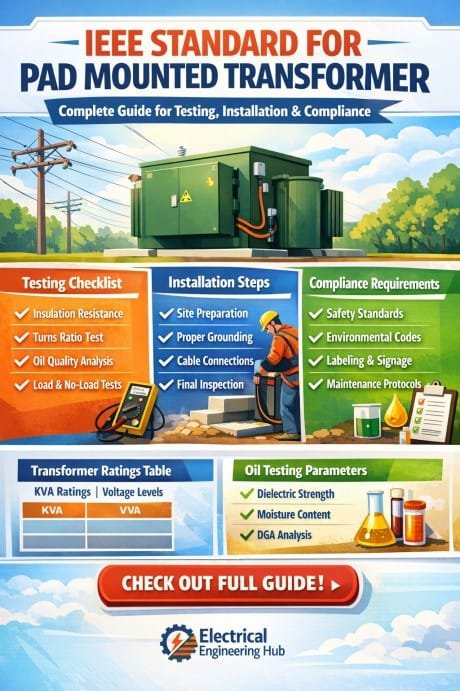
Table of Contents
Understanding the IEEE standard for pad mounted transformer helps engineers, installers, and project managers maintain compliance, reduce operational risks, and extend equipment life. This guide covers key standards, testing procedures, installation practices, and compliance requirements in a practical and easy-to-understand manner.
Know more about Transformer Sizing for Residential Building
Overview of Pad Mounted Transformers
Pad mounted transformers are distribution transformers installed on a concrete pad and enclosed in a locked steel cabinet. They are commonly used in underground distribution systems where overhead lines are not practical.
Key features include:
- Dead-front design for enhanced safety
- Tamper-proof enclosures
- Compact footprint for urban use
- Low maintenance requirements
These transformers are governed by multiple IEEE standards that define their design, performance, and operational limits.
Key IEEE Standards Applicable
The IEEE standard for pad mounted transformer is not a single document but a combination of standards that collectively define requirements.
Here is a simplified table of the most relevant IEEE standards:
| Standard Number | Title | Purpose |
|---|---|---|
| IEEE C57.12.00 | General Requirements for Liquid-Immersed Transformers | Defines construction and performance |
| IEEE C57.12.34 | Requirements for Pad-Mounted Transformers | Specific to pad-mounted design |
| IEEE C57.12.90 | Test Code for Transformers | Covers testing procedures |
| IEEE C57.91 | Loading Guide | Provides loading recommendations |
| IEEE C57.131 | Environmental and Safety Guidelines | Focuses on environmental considerations |
These standards ensure that transformers meet performance benchmarks and operate safely under different conditions.
Know more about Transformer Cooling Methods: ONAN, ONAF, OFAF & More
Design Requirements Under IEEE Standards
The IEEE standard for pad mounted transformer outlines several design requirements that manufacturers must follow.
Electrical Design
- Voltage ratings must match system requirements
- Insulation levels should withstand surge conditions
- Proper grounding must be ensured
Mechanical Design
- Enclosure must be corrosion-resistant
- Doors should have secure locking systems
- Compartments must separate high and low voltage sections
Thermal Performance
- Transformers must operate within defined temperature limits
- Cooling methods such as oil immersion should be efficient
These design parameters ensure long-term reliability and safety in field conditions.
Testing Requirements and Procedures
Testing is a major component of the IEEE standard for pad mounted transformer. It ensures that each unit performs as expected before installation.
Explore all about Transformer Bond Sizing
Routine Tests
These tests are performed on every transformer:
- Winding resistance test
- Turns ratio test
- Insulation resistance test
- Polarity and phase relation test
Type Tests
Type tests are conducted on prototype units:
- Temperature rise test
- Lightning impulse test
- Short-circuit test
Special Tests
Depending on project requirements:
- Sound level measurement
- Zero-sequence impedance test
- Harmonic analysis
Below is a quick comparison of testing categories:
| Test Type | Frequency | Purpose |
|---|---|---|
| Routine Tests | Every unit | Quality assurance |
| Type Tests | Prototype | Design validation |
| Special Tests | As required | Project-specific needs |
Following proper testing ensures compliance and reduces failure risks in operation.
Find more Transformer calculators here
Installation Best Practices
Proper installation is essential to meet the IEEE standard for pad mounted transformer and ensure safe operation.
Site Preparation
- Install a reinforced concrete pad
- Ensure proper drainage around the site
- Maintain clearances from buildings and walkways
Placement and Handling
- Use proper lifting equipment
- Avoid tilting beyond recommended limits
- Align transformer with cable entry points
Grounding and Connections
- Establish a solid grounding system
- Use appropriate cable terminations
- Ensure tight and corrosion-free connections
Safety Considerations
- Maintain safe working distances
- Install warning labels and signage
- Ensure lockable enclosures remain secure
A well-installed transformer reduces maintenance costs and improves system stability.
Know all about Transformer Sizing for EV Charger
Compliance and Inspection
Compliance with the IEEE standard for pad mounted transformer is verified through inspections and documentation.
Pre-Commissioning Checks
- Verify nameplate data
- Confirm oil levels and quality
- Check all electrical connections
Documentation Requirements
- Test certificates
- Manufacturer compliance reports
- Installation records
Periodic Inspection
Regular inspections help maintain compliance:
- Visual inspection for corrosion or damage
- Oil testing for dielectric strength
- Thermal scanning for hotspots
Know more about Transformers Earthspark Size Chart
Here is a simple inspection checklist:
| Inspection Item | Frequency | Action Required |
|---|---|---|
| Oil Quality | Annually | Replace or filter if needed |
| Connections | 6 months | Tighten and clean |
| Enclosure | Quarterly | Check for rust or damage |
| Grounding | Annually | Verify resistance levels |
Consistent monitoring ensures the transformer remains within IEEE guidelines.
Common Challenges and Solutions
Even with proper standards, field challenges can arise.
Overloading
Exceeding load limits can reduce transformer life. Use IEEE loading guides to manage demand.
Environmental Factors
Dust, moisture, and heat can affect performance. Proper sealing and ventilation help mitigate these risks.
Improper Installation
Incorrect grounding or poor cable termination can lead to failures. Following installation guidelines is critical.
Maintenance Neglect
Skipping inspections can lead to undetected issues. A structured maintenance plan ensures reliability.
Find all about Transformer Disconnect Sizing
Benefits of Following IEEE Standards
Adhering to the IEEE standard for pad mounted transformer offers several advantages:
- Improved safety for operators and public
- Enhanced transformer lifespan
- Reduced downtime and maintenance costs
- Compliance with regulatory requirements
- Better performance under varying load conditions
These benefits make IEEE standards essential for any power distribution project.
Practical Tips for Engineers and Installers
To ensure effective implementation:
- Always verify the latest IEEE standards before project execution
- Maintain detailed records of testing and installation
- Train staff on safety and compliance requirements
- Use certified components and accessories
A proactive approach helps avoid costly errors and ensures smooth project execution.
Conclusion
The IEEE standard for pad mounted transformer serves as a comprehensive framework for design, testing, installation, and compliance. It ensures that transformers operate safely, efficiently, and reliably in diverse environments.
Know more about Best Transformer Testing Companies in Canada | Trusted Electrical Testing Experts & Utility Service Providers
By understanding and applying these standards, professionals can minimize risks, improve system performance, and achieve long-term operational success. Whether you are involved in manufacturing, installation, or maintenance, following IEEE guidelines is essential for delivering high-quality and compliant power distribution solutions.
Follow Us on Social:
Subscribe our Newsletter on Electrical Insights for latest updates from Electrical Engineering Hub
#ieeestandardforpadmountedtransformer, #padmountedtransformer, #transformertesting, #ieeetransformerstandards, #electricalengineering, #powerdistribution, #utilitystandards, #transformermaintenance, #energysystems, #electricalsafety