IEC Standard for Junction Box: Complete Guide to Compliance, Design & Safety Requirements
Understanding the IEC standard for junction box is essential for engineers, contractors, and manufacturers working in electrical installations. A junction box is more than a simple enclosure; it plays a critical role in ensuring electrical safety, protecting connections, and maintaining system reliability in both industrial and residential environments.
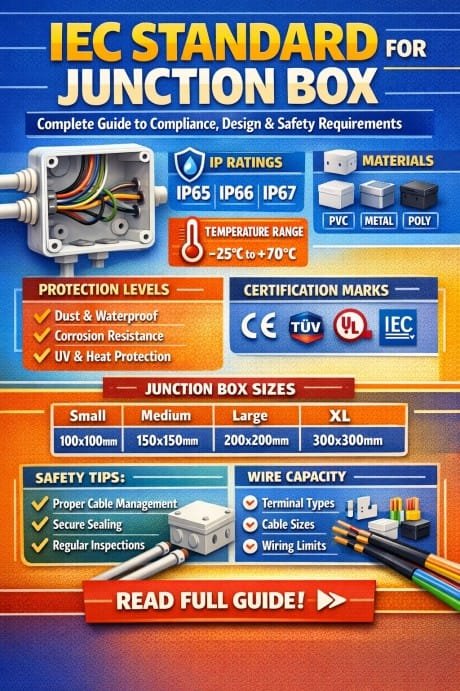
Table of Contents
This guide explains compliance requirements, design principles, and safety considerations based on international standards, helping you implement best practices with confidence.
What is an IEC Standard for Junction Box?
The IEC standard for junction box refers to guidelines issued by the International Electrotechnical Commission (IEC) that define how junction boxes should be designed, tested, and used. These standards ensure that electrical enclosures meet safety, durability, and performance requirements across different environments.
IEC standards are widely accepted globally, making them crucial for export-oriented manufacturing and multinational projects. They help maintain consistency in quality and ensure that electrical systems operate safely under varying conditions.
Know more about IEC Standard for Neutral to Earth Voltage – Limits, Measurement & Safety Guidelines
Key IEC Standards Applicable to Junction Boxes
Several IEC standards apply when designing or selecting a compliant junction box. Each standard focuses on a specific aspect of performance and safety.
| IEC Standard | Description | Application |
|---|---|---|
| IEC 60529 | Defines IP (Ingress Protection) ratings | Protection against dust and water |
| IEC 62208 | Empty enclosures for low-voltage switchgear | General enclosure design |
| IEC 61439 | Low-voltage switchgear assemblies | Industrial distribution systems |
| IEC 60079 | Equipment for explosive atmospheres | Hazardous area junction boxes |
| IEC 60670 | Boxes and enclosures for electrical accessories | Residential and commercial use |
These standards collectively define the framework for a compliant iec standard for junction box design.
Find all about Capacitor Bank Sizing for Power Factor Correction – Step by Step
Importance of Compliance in Junction Boxes
Compliance with the iec standard for junction box ensures that installations are safe, reliable, and legally acceptable in many regions. Non-compliance can lead to serious risks such as electrical fires, equipment failure, or regulatory penalties.
Key benefits of compliance include:
- Enhanced electrical safety
- Protection against environmental factors
- Improved durability and lifespan
- Acceptance in international markets
- Reduced maintenance and downtime
Ignoring these standards often results in hidden costs that outweigh initial savings.
Design Requirements for IEC-Compliant Junction Boxes
Designing according to the iec standard for junction box involves multiple technical considerations. These include material selection, enclosure strength, thermal performance, and protection levels.
Find all about IEC Standard for Relay Testing: Best Guide
1. Material Selection
The choice of material affects durability and safety. Common materials include:
- Mild steel for industrial applications
- Stainless steel for corrosive environments
- Polycarbonate or ABS for lightweight and insulation properties
Each material must meet mechanical strength and flame resistance criteria defined by IEC guidelines.
2. Ingress Protection (IP Rating)
IP ratings are a critical part of the iec standard for junction box. They indicate resistance to dust and water.
| IP Rating | Protection Level |
|---|---|
| IP54 | Limited dust ingress, splash protection |
| IP65 | Dust-tight, protection against water jets |
| IP66 | Dust-tight, strong water jets |
| IP67 | Temporary immersion |
Selecting the right IP rating depends on the installation environment.
3. Temperature and Heat Dissipation
Proper thermal management is essential. Junction boxes must:
- Withstand ambient temperature variations
- Prevent overheating of internal components
- Allow heat dissipation through design or ventilation
IEC standards define temperature limits to ensure safe operation.
4. Mechanical Strength
The enclosure must resist impact, vibration, and external forces. This is especially important in industrial settings where equipment is exposed to harsh conditions.
Safety Requirements Under IEC Standards
Safety is the core focus of the iec standard for junction box. These requirements minimize risks to both equipment and personnel.
Electrical Insulation
Adequate insulation prevents short circuits and electric shocks. Materials used must have high dielectric strength and comply with insulation class requirements.
Earthing and Bonding
Proper grounding ensures fault currents are safely discharged. IEC standards specify:
- Earthing terminals inside the box
- Continuity of metallic parts
- Reliable bonding connections
Find all about BS 7671 Wiring Regulations: Expert Guide to Compliance, Safety, and Practical Applications
Fire Resistance
Junction boxes must be resistant to fire hazards. Materials should:
- Be flame-retardant
- Limit smoke emission
- Prevent flame propagation
Protection in Hazardous Areas
For explosive environments, the iec standard for junction box refers to IEC 60079. These boxes must:
- Be explosion-proof or flameproof
- Prevent ignition sources
- Withstand internal explosions
Installation Guidelines for IEC-Compliant Junction Boxes
Correct installation is just as important as design. Even a high-quality junction box can fail if installed improperly.
Best Practices
- Ensure proper cable entry using certified glands
- Maintain sealing integrity to preserve IP rating
- Avoid overloading with excessive wiring
- Use appropriate mounting techniques
- Follow manufacturer instructions strictly
Know more about Phase to Phase Clearance as per IEC 61439: Best Guide
Common Installation Mistakes
| Mistake | Impact |
|---|---|
| Improper sealing | Loss of IP protection |
| Overcrowded wiring | Heat buildup and failure |
| Incorrect gland selection | Water or dust ingress |
| Poor earthing | Electrical hazards |
Avoiding these mistakes ensures full compliance with the iec standard for junction box.
Testing and Certification Requirements
Before a junction box is approved for use, it must undergo rigorous testing based on IEC standards.
Typical Tests Include:
- IP testing for dust and water resistance
- Impact resistance tests
- Temperature rise tests
- Insulation resistance tests
- Flame retardancy tests
Certified products often carry markings indicating compliance, which helps buyers verify adherence to the iec standard for junction box. Know all about ieee and iec standards
Selection Guide for the Right Junction Box
Choosing the right junction box requires evaluating multiple factors.
Key Selection Criteria
- Environment (indoor, outdoor, hazardous)
- Required IP rating
- Material compatibility
- Number of cable entries
- Mounting type
- Compliance certification
Quick Selection Table
| Application | Recommended Material | IP Rating |
|---|---|---|
| Residential | Plastic (PVC/ABS) | IP54 |
| Industrial | Mild Steel | IP65 |
| Outdoor | Stainless Steel | IP66 |
| Hazardous Area | Explosion-proof Alloy | IP66/IP67 |
Following these criteria ensures alignment with the iec standard for junction box.
Future Trends in Junction Box Design
As technology evolves, the iec standard for junction box continues to adapt. Modern designs now focus on:
- Smart junction boxes with monitoring capabilities
- Improved heat dissipation technologies
- Eco-friendly and recyclable materials
- Compact and modular designs
- Integration with IoT systems
Know more about Transformer Oil Testing: 9 Important Tests for Healthiness
These advancements improve efficiency while maintaining strict compliance with IEC standards.
Conclusion
The iec standard for junction box provides a comprehensive framework for ensuring safety, reliability, and performance in electrical systems. From design and material selection to installation and testing, every aspect is governed by well-defined guidelines.
Adhering to these standards is not just about compliance; it is about building systems that are safe, durable, and future-ready. Whether you are designing a new system or upgrading an existing one, understanding these requirements will help you make informed decisions and avoid costly mistakes.
Know more about IEC Standard for Insulation Resistance Test – Procedures, Limits & Best Practices Explained
Follow Us on Social:
Subscribe our Newsletter on Electrical Insights for latest updates from Electrical Engineering Hub
#iecstandardforjunctionbox, #junctionboxstandard, #electricalstandards, #ieccompliance, #electricalsafety, #industrialelectrical, #junctionboxdesign, #wiringstandards, #electricalinstallation, #engineeringstandards