IEC Standard for Megger Test: Insulation Resistance Testing According to IEC Guidelines
The insulation resistance test, commonly known as the Megger test, is one of the most essential diagnostic methods used in electrical systems. It helps ensure that cables, motors, transformers, and other electrical equipment maintain proper insulation integrity. To guarantee consistency, safety, and accuracy, international standards have been established.
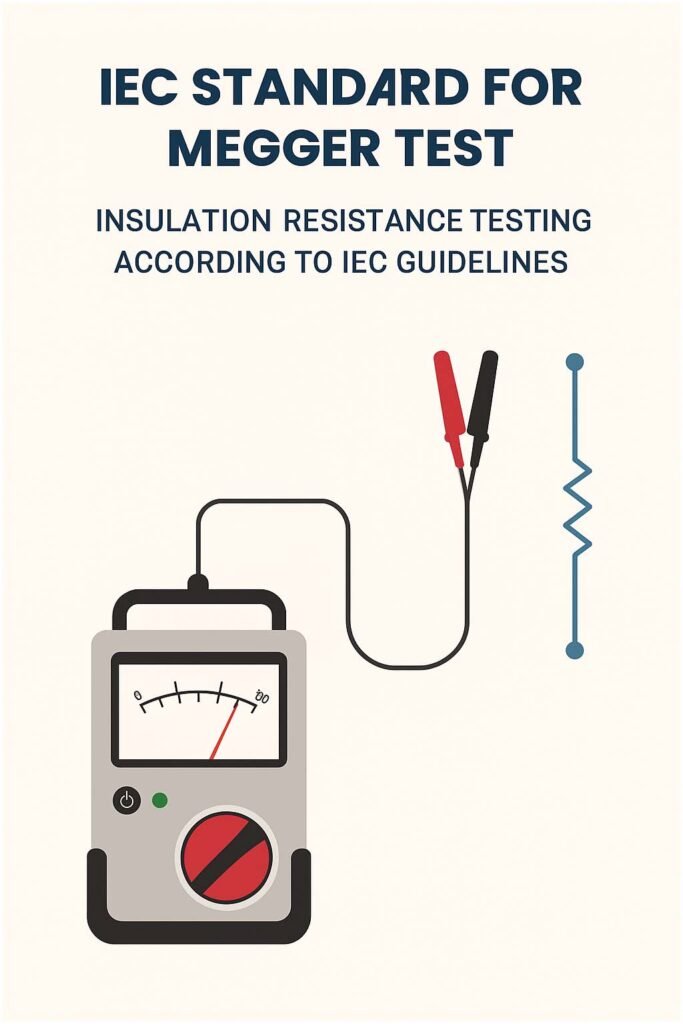
Table of Contents
Among them, the IEC standard for Megger test plays a crucial role in defining testing methods, voltage levels, and acceptance criteria for insulation resistance testing. Understanding these standards is vital for engineers, technicians, and maintenance professionals who deal with electrical systems on a daily basis.
What is a Megger Test?
A Megger test measures the insulation resistance of electrical equipment by applying a high DC voltage and recording the resistance in megaohms (MΩ). This test helps detect moisture ingress, insulation degradation, and other defects that can lead to current leakage or short circuits. The test is typically carried out using an insulation resistance tester, commonly called a Megger, which is a brand name that has become synonymous with the test itself.
The basic principle of a Megger test is simple: when a DC voltage is applied across an insulating material, a small leakage current flows through it. The insulation resistance is calculated using Ohm’s law, where resistance equals voltage divided by current. High insulation resistance indicates good insulation health, while low resistance values suggest deterioration or contamination.
Learn more about earthing cable size as per iec
IEC Standard for Megger Test Explained
The IEC standard for Megger test primarily refers to the guidelines outlined in IEC 60060, IEC 60085, and IEC 61557-2. These international standards define procedures for testing insulation resistance, ensuring uniformity across various types of electrical equipment.
The IEC 61557-2 standard specifically addresses insulation resistance measurement for low-voltage electrical installations. It defines test voltages, measurement ranges, and accuracy requirements for insulation testers.
The IEC 60085 standard focuses on the thermal evaluation and classification of electrical insulation systems. It relates to how insulation performance changes under temperature stress, which is a key factor in the reliability of Megger test results.
The IEC 60060 standard covers high-voltage testing techniques, including the insulation testing of power cables and transformers. It helps ensure that test voltages and procedures do not damage insulation during testing.
Together, these standards create a framework for performing insulation resistance tests in a safe and reliable manner.
Purpose of Following IEC Standards
The primary goal of following the IEC standard for Megger test is to ensure safety, reliability, and consistency. Electrical equipment in industrial and commercial installations operates under various environmental conditions. Without a standard approach, test results might vary, making it difficult to compare or interpret insulation quality.
By adhering to IEC standards, engineers can:
- Ensure uniform test procedures across different sites and equipment types.
- Reduce the risk of equipment damage during high-voltage testing.
- Identify insulation degradation early to prevent costly breakdowns.
- Maintain compliance with international electrical safety codes.
In addition, following IEC guidelines supports predictive maintenance, enabling timely insulation repairs or replacements before failures occur.
Discover everything about cable bending radius iec standard
Recommended Test Voltages According to IEC
The IEC standard for Megger test provides clear recommendations for the test voltage to be used depending on the rated voltage of the equipment. Using the correct voltage ensures accurate results without stressing the insulation unnecessarily.
Below is a summary of typical test voltages recommended by IEC 61557-2:
| Equipment Rated Voltage (V) | Test Voltage (V DC) | Minimum Insulation Resistance (MΩ) |
|---|---|---|
| Up to 50 V | 100 V | 0.25 MΩ |
| 50 V to 500 V | 500 V | 0.5 MΩ |
| 500 V to 1000 V | 1000 V | 1.0 MΩ |
| 1 kV to 5 kV | 2500 V | 5.0 MΩ |
| Above 5 kV | 5000 V | 10 MΩ or more |
These values serve as general guidelines. For high-voltage transformers or motors, even higher test voltages may be used according to IEC 60060 and manufacturer specifications.
Procedure for Megger Test as per IEC
The IEC standard for Megger test outlines a systematic procedure to ensure accurate and repeatable results. The process can be summarized as follows:
- Preparation – Disconnect the equipment from the power supply and discharge any residual voltage to prevent damage or injury.
- Cleaning and Inspection – Check for dust, oil, or moisture on terminals and insulation surfaces, as these can affect the reading.
- Connection – Connect the Megger leads: one to the conductor under test and the other to the equipment’s body or earth.
- Voltage Application – Apply the appropriate DC voltage as per IEC guidelines for one minute.
- Reading and Interpretation – Record the insulation resistance value displayed on the Megger.
- Polarization Index (PI) Test – Optionally, measure resistance at 1 minute and 10 minutes to calculate PI (10 min/1 min). A PI value above 2 indicates good insulation.
- Post-Test Discharge – Discharge the tested insulation to ground after the test to remove stored charge.
This procedure ensures repeatable and safe measurement under standardized conditions.
Find out more about iec 61439 busbar clearance
Factors Affecting Megger Test Results
Even when following the IEC standard for Megger test, certain external and environmental factors can affect readings. Understanding these helps ensure accurate interpretation.
- Temperature: Insulation resistance decreases with increasing temperature. IEC recommends correcting readings to a reference temperature of 20°C.
- Humidity: High moisture content can lower resistance values significantly.
- Test Duration: Longer test durations allow more accurate polarization readings.
- Surface Leakage: Dirt or moisture on the insulation surface may provide false low readings.
- Ageing and Contamination: Chemical or mechanical stress over time reduces insulation strength.
When these factors are considered, Megger test data becomes a reliable indicator of insulation health.
Interpretation of Results as per IEC
The IEC standard for Megger test provides general acceptance criteria, but actual acceptable limits often depend on equipment type and manufacturer recommendations. However, IEC suggests some general guidelines:
| Insulation Resistance (MΩ) | Condition Assessment |
|---|---|
| Above 100 MΩ | Excellent insulation |
| 10 MΩ to 100 MΩ | Good, within safe limits |
| 1 MΩ to 10 MΩ | Acceptable but monitor |
| Below 1 MΩ | Poor, needs immediate action |
A sudden drop in insulation resistance over time is a warning sign that insulation deterioration is occurring. Regular trend analysis is more valuable than relying on a single measurement.
Advantages of Following IEC Standard
Adhering to the IEC standard for Megger test brings several benefits for electrical maintenance and safety programs.
- Global Consistency – Results are comparable across different countries and industries.
- Safety Assurance – Ensures test voltage and methods do not endanger personnel or equipment.
- Accuracy and Repeatability – Standardized procedures produce reliable measurements.
- Predictive Maintenance – Helps identify insulation aging before failures occur.
- Regulatory Compliance – Satisfies inspection and certification requirements for international projects.
For industries such as power generation, oil and gas, and manufacturing, following IEC standards is essential for operational reliability and global compliance.
Explore details on iec standard for underground cable laying
Applications of Megger Test
The IEC standard for Megger test applies to a wide range of electrical equipment. Some common applications include:
- Power Cables – Checking insulation between conductors and earth.
- Motors and Generators – Evaluating winding insulation before commissioning or after maintenance.
- Transformers – Measuring insulation between windings and core.
- Switchgear and Circuit Breakers – Ensuring dielectric integrity before energization.
- Control Panels – Verifying insulation resistance of wiring circuits.
Regular testing under IEC guidelines enhances system reliability and extends equipment lifespan.
Common Mistakes to Avoid
Even with IEC guidance, improper testing can produce misleading results. Avoid these common mistakes:
- Applying incorrect test voltage for equipment rating.
- Conducting tests on wet or contaminated surfaces.
- Skipping the discharge step after testing.
- Not considering temperature correction.
- Ignoring manufacturer-specific recommendations.
Following IEC best practices minimizes errors and ensures valid results every time.
Get complete information about iec standard for busbar sizing
Final Thoughts
The IEC standard for Megger test provides a reliable framework for conducting insulation resistance tests across electrical installations. It ensures uniformity, accuracy, and safety, allowing engineers to diagnose insulation health effectively. By applying the correct test voltage, following standardized procedures, and interpreting results with care, electrical professionals can prevent insulation failures and improve equipment longevity.
In today’s high-demand electrical systems, insulation reliability is non-negotiable. Adhering to IEC standard for Megger test not only guarantees compliance but also enhances maintenance quality, operational safety, and long-term performance of electrical assets. Regular Megger testing, when performed under IEC guidelines, remains one of the most cost-effective methods to safeguard electrical infrastructure worldwide.
Understand better about nec 430.32
Follow Us on Social:
Subscribe our Newsletter on Electrical Insights for latest updates from Electrical Engineering Hub
#IECStandard, #MeggerTest, #InsulationResistanceTest, #ElectricalTesting, #HighVoltageTesting, #DielectricTest, #IEC60060, #IEC60243, #IEC60502, #InsulationTester, #ElectricalSafety, #PowerSystemTesting, #TransformerTesting, #MotorInsulation, #ElectricalStandards