
Power System Load Flow Analysis Guide – Accurate Methods, Standards & Real-World Examples
A reliable electrical network depends heavily on accurate planning and analysis. One of the most critical studies performed by power engineers is load flow analysis. This power system load flow analysis guide is written for engineers, students, and energy professionals who want a practical, standards-aligned, and real-world understanding of how load flow studies are performed and applied. The focus is not only on theory, but also on accuracy, methods, and field relevance.
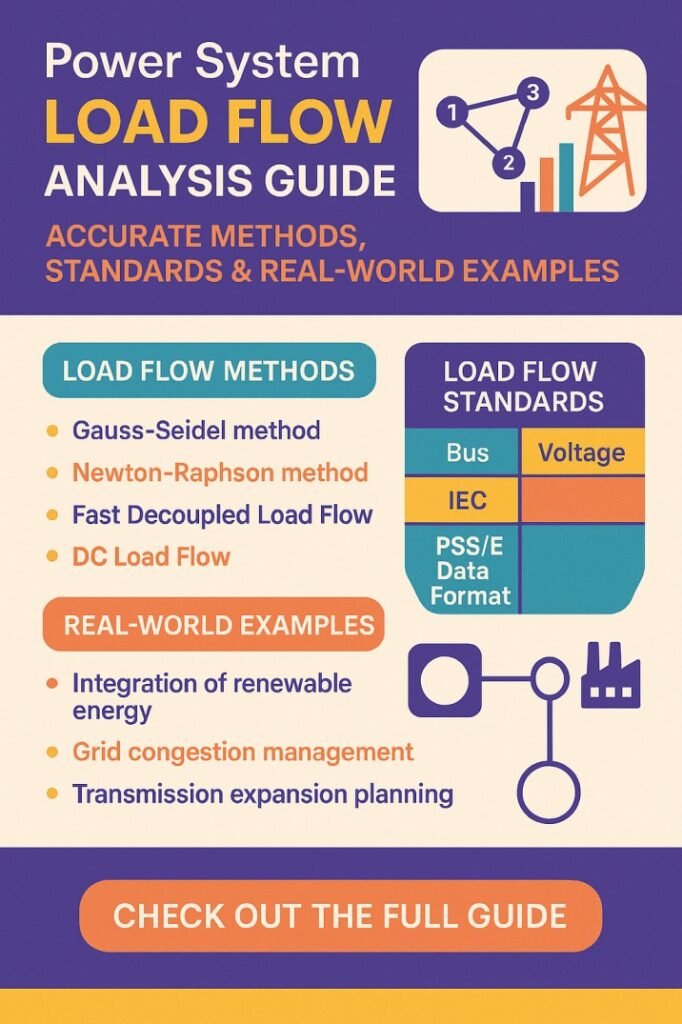
Table of Contents
Power system load flow analysis determines how electrical power moves through a network under steady-state conditions. It helps engineers predict voltage levels, power losses, and equipment loading before real-world operation. This power system load flow analysis guide explains concepts in a simple but technically sound manner, ensuring clarity without oversimplification.
Read in detail about iec 61439 busbar calculation
What Is Power System Load Flow Analysis
Load flow analysis, also called power flow analysis, is the computational study of active power, reactive power, voltage magnitude, and phase angle at each bus in a power system. It is a foundational study used during system planning, expansion, and operational optimization.
In practical terms, load flow answers questions such as:
- Are bus voltages within acceptable limits?
- Are transmission lines overloaded?
- How much real and reactive power is flowing in each branch?
- What is the total system power loss?
This power system load flow analysis guide emphasizes that load flow is not a one-time activity. Utilities perform it repeatedly as load patterns, generation mix, and network topology change.
Importance of Load Flow Studies in Modern Power Systems
Modern power systems are more complex than ever. Renewable energy integration, electric vehicles, and distributed generation have increased variability in networks. Load flow studies help engineers manage this complexity safely and efficiently.
Dive deeper into instrument earthing iec standard
Key reasons load flow analysis is essential include:
- Network planning and expansion decisions
- Voltage regulation and reactive power control
- Contingency and reliability studies
- Renewable energy interconnection analysis
- Energy loss minimization
Without load flow analysis, system operation would rely on assumptions rather than calculated results. This power system load flow analysis guide highlights how even small voltage deviations can lead to equipment stress or instability if ignored. Know more about IEC Standard for Load Flow Studies with practical guide for Accurate Power System Analysis
Bus Types Used in Load Flow Analysis
A power system is modeled using buses, each representing a node where power is injected or withdrawn. Understanding bus types is fundamental in any power system load flow analysis guide.
The three standard bus types are listed below:
- Slack Bus
Maintains system balance by supplying power losses and setting the reference angle. - PV Bus (Generator Bus)
Active power and voltage magnitude are specified, while reactive power is calculated. - PQ Bus (Load Bus)
Active and reactive power are specified, while voltage magnitude and angle are calculated.
These bus classifications allow mathematical equations to be solved systematically.
Uncover insights on iec standard for lighting lux level
Common Load Flow Analysis Methods
Several numerical techniques are used to solve load flow equations. Each method has strengths and limitations. A professional power system load flow analysis guide must explain these clearly.
Gauss-Seidel Method
This is one of the earliest load flow techniques. It is simple and easy to implement but converges slowly for large systems.
Key characteristics:
- Low memory requirement
- Simple algorithm
- Suitable for small networks
- Sensitive to initial values
Newton-Raphson Method
The Newton-Raphson method is widely used in real-world power system studies due to its fast convergence.
Advantages include:
- High accuracy
- Fast convergence
- Suitable for large interconnected systems
The main drawback is higher computational complexity, which modern software easily handles.
Use our online tool electricity load calculator in kw for home
Fast Decoupled Load Flow Method
This method is an optimized version of Newton-Raphson. It separates active and reactive power calculations.
Benefits include:
- Faster computation
- Reduced memory usage
- Acceptable accuracy for most planning studies
This power system load flow analysis guide recommends Fast Decoupled methods for large utility-scale systems where speed is critical.
Comparison of Load Flow Methods
The table below summarizes key differences between major load flow methods.
| Method Name | Convergence Speed | Accuracy Level | Suitable System Size |
|---|---|---|---|
| Gauss-Seidel | Slow | Moderate | Small |
| Newton-Raphson | Very Fast | High | Medium to Large |
| Fast Decoupled | Fast | Good | Large |
Understanding these differences helps engineers choose the correct technique based on project needs.
International Standards and Guidelines
Load flow studies are not performed randomly. They follow international and utility-specific standards. A well-structured power system load flow analysis guide must align with these references.
Learn more about Arc Flash Risk Assessment According to NFPA 70E
Commonly followed standards include:
- IEC 60038 for voltage standardization
- IEEE power system analysis guidelines
- Utility grid codes and planning criteria
- NERC reliability standards in North America
These standards define acceptable voltage limits, loading margins, and modeling practices. Compliance ensures system safety and regulatory approval.
Real-World Load Flow Example
Consider a 132 kV sub-transmission network supplying an industrial zone. Engineers perform a load flow study to verify performance under peak demand.
Explore details on Electrical Compliance Testing – Safety Regulations | Best Electrical Services in USA
Study assumptions:
- Peak load of 85 MW and 40 MVAr
- Two parallel transformers feeding the load
- One solar plant injecting 15 MW
Load flow results may show:
- Voltage drop of 4.2 percent at the far-end bus
- One transformer loaded at 92 percent capacity
- Reduced reactive power margin during evening hours
Based on this analysis, engineers may recommend capacitor banks or transformer augmentation. This practical scenario shows why a power system load flow analysis guide is critical for real operational decisions.
Role of Software Tools in Load Flow Analysis
Modern power engineers rely on specialized software to perform load flow studies efficiently.
Commonly used tools include:
- ETAP
- DIgSILENT PowerFactory
- PSS/E
- MATLAB-based power system toolboxes
These tools implement validated algorithms, generate reports, and visualize results. However, engineers must still understand the theory explained in this power system load flow analysis guide to interpret results correctly.
Learn more in detail on NEMA 250 Enclosures – Electrical Enclosure Standards | Best Manufacturing Companies in USA
Typical Load Flow Output Parameters
Load flow analysis generates multiple outputs that guide engineering decisions.
Key outputs include:
- Bus voltage magnitude and phase angle
- Active and reactive power flow in lines
- Transformer loading percentages
- Total system real and reactive losses
The table below shows typical acceptable operating limits.
| Parameter | Acceptable Range |
|---|---|
| Bus Voltage | 0.95 to 1.05 per unit |
| Line Loading | Below 80 to 90 percent |
| Transformer Loading | Below rated capacity |
| System Losses | As low as reasonably possible |
Monitoring these parameters helps maintain system stability and efficiency.
Know more about OSHA Electrical Safety Standard 1910 – Workplace Electrical Safety | Safety Experts
Common Mistakes in Load Flow Studies
Even experienced engineers can make errors if basic principles are overlooked. This power system load flow analysis guide highlights frequent mistakes to avoid.
Common issues include:
- Incorrect bus type assignment
- Unrealistic load modeling
- Ignoring reactive power limits
- Using outdated network data
Careful data validation and result checking reduce the risk of incorrect conclusions.
Future Trends in Load Flow Analysis
As power systems evolve, load flow analysis techniques are also advancing. Smart grids, real-time monitoring, and AI-assisted optimization are influencing how studies are performed.
Emerging trends include:
- Time-series load flow for renewable integration
- Probabilistic load flow analysis
- Integration with energy management systems
- Real-time digital twin models
These developments enhance accuracy and decision-making, reinforcing the long-term relevance of this power system load flow analysis guide.
Use our online tool Creepage Distance Calculator – Calculate Safe Insulation & Clearance for PCB and High Voltage Design
Conclusion
Load flow analysis remains a cornerstone of power system engineering. From planning new substations to integrating renewable energy, its applications are vast and critical. This power system load flow analysis guide has provided a structured explanation of methods, standards, and real-world examples without unnecessary complexity.
Engineers who master load flow analysis gain deeper insight into system behavior, reduce operational risks, and design more resilient electrical networks. Whether you are working in utilities, industry, or consulting, a solid understanding of load flow analysis is an essential professional skill. Know more about IEC Standard for Busbar Clearance
Follow Us on Social:
Subscribe our Newsletter on Electrical Insights for latest updates from Electrical Engineering Hub
#PowerSystemLoadFlowAnalysis, #LoadFlowStudy, #PowerSystemAnalysis, #ElectricalEngineeringGuide, #PowerFlowAnalysis, #IECStandards, #GridAnalysis, #PowerEngineering, #EnergySystems, #ElectricalDesign