Partial Discharge Test of Current Transformer: Step-by-Step Guide for Accurate Insulation Diagnostics
The partial discharge test of current transformer is a critical procedure used to evaluate insulation integrity in high voltage systems. Current transformers operate under electrical stress for long periods, and even small insulation defects can lead to serious failures. Detecting these defects early helps avoid outages, equipment damage, and safety risks. This guide explains the process in a clear and practical way, making it easier to understand how to perform accurate testing and interpret results.
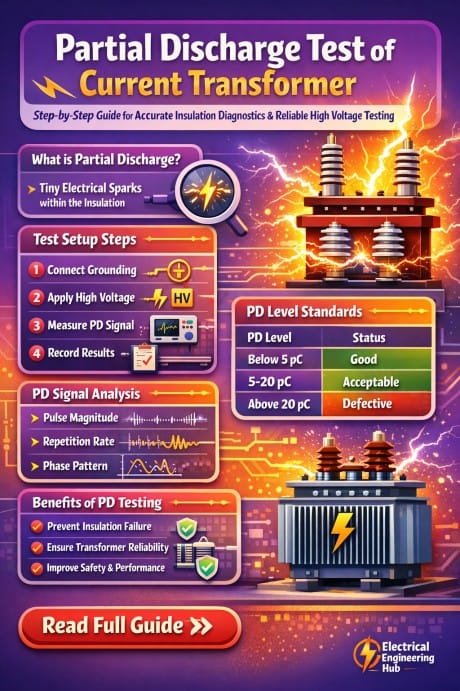
Table of Contents
What is Partial Discharge in Current Transformers
Partial discharge refers to a localized electrical discharge that only partially bridges the insulation between conductors. It often occurs in voids, cracks, or weak insulation areas. Over time, these discharges degrade insulation and can lead to complete breakdown.
In current transformers, partial discharge is commonly found in:
- Insulation between primary and secondary windings
- Solid insulation materials like paper, epoxy, or oil
- Air gaps caused by manufacturing defects or aging
Find all about Partial Discharge vs Tan Delta Cable Testing: Important Key Differences Every Engineer Must Know
The partial discharge test of current transformer helps identify these weak points before they turn into major failures.
Importance of Partial Discharge Testing
Reliable operation of power systems depends heavily on insulation performance. Partial discharge testing plays a key role in condition monitoring and preventive maintenance.
Key benefits include:
- Early detection of insulation defects
- Increased equipment life
- Reduced risk of unexpected failures
- Improved system reliability
- Compliance with international standards like IEC 61869 and IEC 60270
Ignoring insulation issues can result in costly repairs and downtime. That is why this test is widely used during factory acceptance tests and routine maintenance.
Equipment Required for Testing
To carry out the partial discharge test of current transformer, specialized equipment is needed to ensure accurate measurement and safety.
| Equipment Name | Purpose |
|---|---|
| High Voltage Test Set | Applies controlled voltage to the transformer |
| Coupling Capacitor | Detects discharge signals |
| Measuring Impedance | Converts discharge pulses into measurable signals |
| PD Detector or Analyzer | Displays and records discharge levels |
| Shielded Test Cables | Reduces external noise interference |
| Grounding System | Ensures operator safety |
Modern testing systems also include digital filters and software for advanced analysis.
Know more about Partial Discharge Test Equipment Price in USA & Europe
Step-by-Step Testing Procedure
Performing the partial discharge test of current transformer requires a systematic approach to ensure reliable results.
Preparation and Setup
Before starting the test, ensure the transformer is clean and dry. Moisture or contamination can affect readings.
- Disconnect the transformer from the system
- Properly ground all non-tested terminals
- Connect the test circuit as per standard configuration
- Ensure all measuring instruments are calibrated
A proper setup minimizes noise and improves measurement accuracy.
Voltage Application
The test voltage is applied gradually to avoid sudden stress on insulation.
- Increase voltage slowly up to the specified level
- Typically, the test voltage is higher than the operating voltage
- Maintain the voltage for a defined duration
Find all about Top 15 Partial Discharge Tester Suppliers in United States
During this stage, the system monitors any discharge activity within the insulation.
Measurement of Partial Discharge
The measuring system captures discharge pulses and converts them into picoCoulombs (pC), which is the standard unit.
- Record the discharge magnitude
- Observe the inception voltage (PDIV)
- Note the extinction voltage (PDEV)
These parameters help assess insulation strength and condition.
Noise Reduction and Calibration
External interference can affect results, so noise reduction is essential.
- Use shielded cables and proper grounding
- Perform background noise measurement before testing
- Apply filters to isolate actual discharge signals
Use our online tool Transformer Short Circuit Calculator – Accurate Fault Current & Transformer Protection Tool
Calibration ensures that the readings are accurate and consistent.
Result Interpretation
Understanding the results is as important as performing the test.
| Parameter | Meaning |
|---|---|
| PD Level (pC) | Magnitude of discharge activity |
| PD Inception Voltage | Voltage at which discharge starts |
| PD Extinction Voltage | Voltage at which discharge stops |
| Discharge Pattern | Helps identify type of defect |
Low discharge levels indicate healthy insulation, while high values suggest defects or aging.
Acceptance Criteria and Standards
Different standards define acceptable limits for partial discharge levels. These limits depend on voltage class and insulation type.
| Voltage Level | Acceptable PD Level |
|---|---|
| Up to 72.5 kV | ≤ 10 pC |
| 72.5 kV to 245 kV | ≤ 5 pC |
| Above 245 kV | ≤ 5 pC or lower |
Always refer to manufacturer specifications and applicable standards for accurate limits.
Know more about Transformer Oil Testing: 9 Important Tests for Healthiness
Common Causes of Partial Discharge
Understanding the root causes helps in taking corrective actions.
- Manufacturing defects
- Insulation aging
- Moisture ingress
- Poor installation practices
- Overvoltage conditions
Regular testing helps identify these issues before they escalate.
Best Practices for Accurate Testing
To achieve reliable results in the partial discharge test of current transformer, follow these best practices:
- Maintain a noise-free testing environment
- Use properly calibrated equipment
- Follow standard testing procedures strictly
- Keep detailed test records for comparison
- Train personnel in high voltage testing techniques
Consistency in testing improves long-term monitoring and analysis.
Know more about IEEE Standard for Instrument Transformers
Challenges in Partial Discharge Testing
Despite its advantages, the test comes with certain challenges.
- Electrical noise interference
- Difficulty in locating exact defect position
- Requirement of skilled personnel
- High cost of testing equipment
Advanced diagnostic tools and experience help overcome these limitations.
Role in Predictive Maintenance
The partial discharge test of current transformer is an essential part of predictive maintenance strategies. It allows utilities and industries to monitor insulation health over time and plan maintenance activities accordingly.
Instead of waiting for failures, operators can:
- Schedule maintenance based on condition
- Avoid unplanned outages
- Optimize asset performance
This approach reduces operational costs and improves system efficiency.
Explore details on largest transformer manufacturer in usa
Conclusion
The partial discharge test of current transformer is a powerful diagnostic tool for ensuring insulation reliability in high voltage equipment. By following a structured testing process and understanding the results, engineers can detect early signs of insulation failure and take corrective action in time. With proper equipment, skilled execution, and regular monitoring, this test plays a vital role in maintaining safe and efficient power systems. Know more about Transformer Cooling Methods: ONAN, ONAF, OFAF & More
Get new guides in your feed. Follow Electrical Insights on LinkedIn for new electrical standards guides, calculators and design tips from Azad Circuit Hub.
#partialdischargetest,#currenttransformertesting,#highvoltagetesting,#electricaltesting,#insulationtesting,#powerengineering,#substationmaintenance,#pdtesting,#switchgear,#electricaldiagnostics