IEEE Standard for Generator Protection: Complete Guide to Design, Compliance & Protection Schemes
The ieee standard for generator protection plays a critical role in ensuring the safe, reliable, and efficient operation of power generation systems. Generators are among the most valuable assets in any electrical network, and even a minor fault can result in severe damage, downtime, and financial loss. This is why engineers rely on standardized protection practices defined by IEEE to design robust protection schemes.
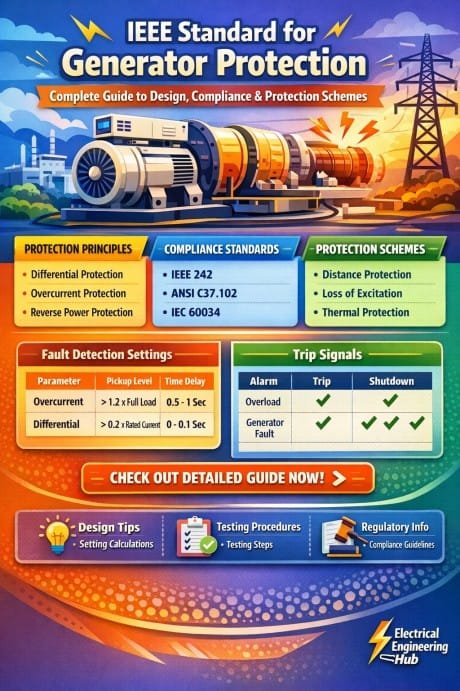
Table of Contents
This guide explains the principles, design approach, compliance requirements, and practical protection schemes based on the ieee standard for generator protection, helping professionals make informed decisions in real-world applications.
Understanding the Importance of Generator Protection
Generators operate under complex electrical and mechanical conditions. Faults such as short circuits, overloads, and insulation failures can quickly escalate if not detected early. The ieee standard for generator protection provides a structured framework to mitigate these risks.
Find all about IEEE Standard for Insulation Resistance Test
Proper generator protection ensures:
- Prevention of catastrophic failures
- Increased equipment lifespan
- System stability and continuity
- Safety of personnel and assets
Without proper adherence to the ieee standard for generator protection, even well-designed systems can face unexpected failures.
Key IEEE Standards Related to Generator Protection
IEEE has developed several standards that collectively guide generator protection design and implementation. These standards define protection philosophy, relay selection, and coordination practices.
Major IEEE Standards Overview
| Standard Number | Description |
|---|---|
| IEEE C37.102 | Guide for AC Generator Protection |
| IEEE C37.101 | Guide for Generator Ground Protection |
| IEEE C50 Series | Standards for generator construction and performance |
| IEEE 242 (Buff Book) | Protection and coordination of industrial systems |
Among these, IEEE C37.102 is the most widely referenced document when applying the ieee standard for generator protection in practical systems.
Know more about IEEE Standard for Instrument Transformers
Types of Faults Covered in IEEE Protection Standards
The ieee standard for generator protection categorizes faults into electrical and mechanical types, each requiring specific protection methods.
Electrical Faults
- Stator winding faults
- Rotor faults
- Phase-to-phase faults
- Ground faults
- Overvoltage and undervoltage conditions
Mechanical and Abnormal Conditions
- Loss of excitation
- Reverse power (motoring)
- Overfrequency and underfrequency
- Overheating due to overload
Understanding these fault categories is essential for designing protection schemes aligned with the ieee standard for generator protection.
Explore all about IEEE Standard for Cable Insulation Resistance Test
Protection Functions and ANSI Codes
Protection systems are typically implemented using relays identified by ANSI device numbers. The ieee standard for generator protection aligns closely with these codes.
Common Generator Protection Functions
| ANSI Code | Protection Function |
|---|---|
| 87G | Differential protection |
| 64G | Stator ground fault protection |
| 40 | Loss of excitation |
| 32 | Reverse power |
| 46 | Negative sequence current |
| 24 | Overexcitation (V/Hz) |
| 27/59 | Under/Over voltage |
| 81 | Frequency protection |
Each of these functions contributes to a layered protection approach recommended in the ieee standard for generator protection.
Design Philosophy Based on IEEE Guidelines
A well-designed system follows a selective, sensitive, and reliable protection philosophy. The ieee standard for generator protection emphasizes coordination between primary and backup protection systems.
Key Design Principles
- Sensitivity to detect low-level faults
- Selectivity to isolate only the faulty section
- Speed to minimize damage
- Reliability to avoid false trips
Engineers must carefully balance these parameters when applying the ieee standard for generator protection in different system sizes.
Know more about IEEE Standard for Contact Resistance
Differential Protection: The Primary Scheme
Differential protection (ANSI 87G) is considered the most important scheme under the ieee standard for generator protection. It compares current entering and leaving the generator.
Working Principle
- Under normal conditions: Current in = Current out
- During fault: Current mismatch triggers relay
Advantages
- High sensitivity
- Fast operation
- Selective fault detection
This scheme forms the backbone of any protection system designed using the ieee standard for generator protection.
Stator Ground Fault Protection Methods
Ground faults are among the most common generator failures. The ieee standard for generator protection recommends multiple methods depending on grounding type.
Common Techniques
| Method | Application |
|---|---|
| Neutral Overvoltage | Ungrounded systems |
| Third Harmonic Voltage | Large generators |
| Low-frequency Injection | High sensitivity applications |
Selecting the right method ensures compliance with the ieee standard for generator protection and improves fault detection accuracy.
Find all about IEEE Standard for Short Circuit Calculation
Rotor Protection and Loss of Excitation
Rotor faults can severely affect generator stability. The ieee standard for generator protection highlights the importance of detecting excitation system failures.
Key Protection Functions
- Loss of excitation (ANSI 40)
- Field ground detection
- Overfluxing protection
Loss of excitation can cause the generator to operate as an induction machine, leading to instability. Proper implementation of the ieee standard for generator protection helps prevent such conditions.
Reverse Power Protection and Prime Mover Safety
Reverse power protection (ANSI 32) is critical for preventing damage to the prime mover. According to the ieee standard for generator protection, this function detects when power flows back into the generator.
Typical Causes
- Turbine failure
- Fuel supply interruption
- Mechanical faults
Know more about IEC Standard for Neutral to Earth Voltage – Limits, Measurement & Safety Guidelines
Protection Role
- Trips generator during motoring condition
- Prevents overheating and mechanical damage
This function is essential in systems where compliance with the ieee standard for generator protection is required.
Compliance Requirements and Best Practices
Meeting compliance with the ieee standard for generator protection involves more than just installing relays. It requires a systematic approach to design, testing, and maintenance.
Compliance Checklist
- Proper relay selection based on generator rating
- Coordination studies for protection schemes
- Routine testing and calibration
- Documentation and record keeping
Testing and Maintenance Table
| Activity | Frequency |
|---|---|
| Relay Testing | Annually |
| Functional Checks | Quarterly |
| Insulation Testing | Bi-annually |
| System Audit | Every 2–3 years |
Following these practices ensures long-term compliance with the ieee standard for generator protection.
Find all about IEC Standard for Relay Testing: Best Guide
Coordination with System Protection
Generator protection must work in coordination with transformer and grid protection systems. The ieee standard for generator protection stresses the importance of avoiding unnecessary tripping.
Coordination Goals
- Ensure backup protection availability
- Prevent cascading failures
- Maintain system stability
Proper coordination enhances the effectiveness of the ieee standard for generator protection across the entire power system.
Modern Trends in Generator Protection
With the advancement of digital relays and automation, the ieee standard for generator protection is now implemented using intelligent electronic devices (IEDs).
Know all about ieee and iec standards
Emerging Technologies
- Numerical relays with self-diagnostics
- SCADA integration
- Remote monitoring and control
- Predictive maintenance using data analytics
These technologies improve the implementation of the ieee standard for generator protection by increasing reliability and reducing downtime.
Conclusion
The ieee standard for generator protection provides a comprehensive framework for safeguarding generators against electrical and mechanical faults. From differential protection to advanced monitoring systems, each component plays a vital role in ensuring operational reliability.
Know more about Transformer Oil Testing: 9 Important Tests for Healthiness
By following IEEE guidelines, engineers can design systems that are not only compliant but also efficient and future-ready. Whether you are working on industrial plants, power stations, or distributed generation systems, applying the ieee standard for generator protection is essential for achieving long-term performance and safety.
Follow Us on Social:
Subscribe our Newsletter on Electrical Insights for latest updates from Electrical Engineering Hub
#IEEEGeneratorProtection, #GeneratorProtectionStandard, #PowerSystemProtection, #IEEEStandards, #ElectricalProtection, #GeneratorSafety, #ProtectionRelay, #PowerEngineering, #GridProtection, #IndustrialPower